English
EN


The digital euro is coming, and the year is now known. At the same time, gold is under pressure, while new plans for mass layoffs at Volkswagen show just how much competitiveness European industry has lost.
The gold price fell this week to $4,000 per troy ounce, a level last seen in November. Bloomberg writes that gold is under pressure from the stronger US dollar. A stronger dollar weighs on the gold price because gold is traded in dollars, making it more expensive for buyers using other currencies, which can reduce demand. According to Bloomberg, increased expectations that the Federal Reserve will pursue a stricter policy to keep inflation under control are also playing an important role. But is that justified?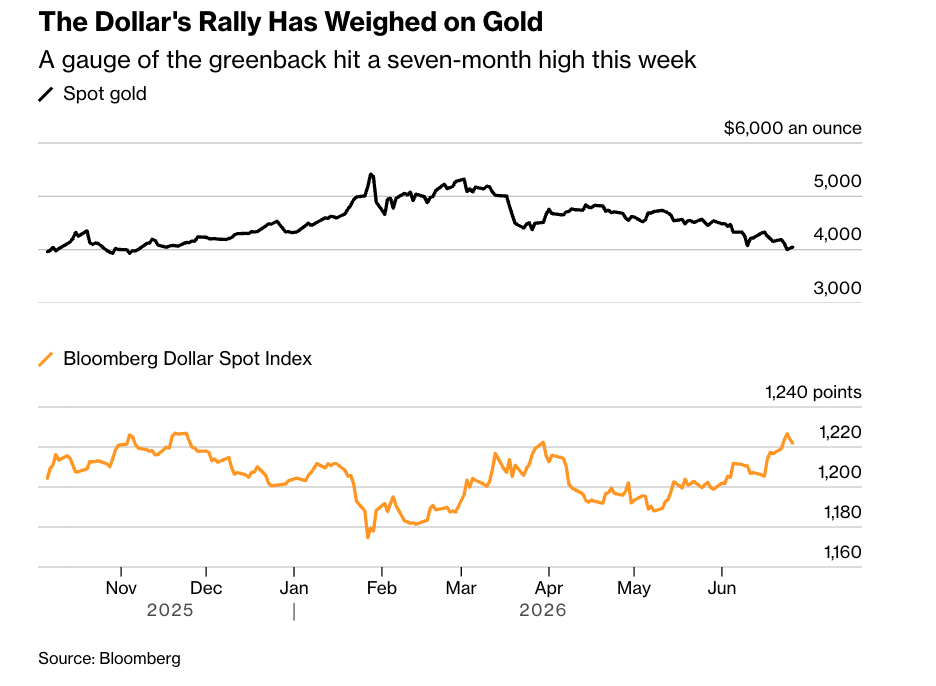
Development of the gold price and the dollar (source: Bloomberg)
Last week, we already wrote about the normalization of shipping traffic through the Strait of Hormuz. As a result, oil prices fell quickly, which means there is much less inflation in the pipeline than many had feared.
At the same time, the Fed struck a more hawkish tone during the first meeting under its new chair, Kevin Warsh. According to leading economist Robin Brooks, markets interpreted this as a signal that further rate hikes may be possible, causing real interest rates to rise and putting additional pressure on gold. Rising real interest rates put pressure on gold and other precious metals because interest-bearing alternatives become more attractive. “After all, there is little need for a hedge against debasement when inflation is falling and real interest rates are rising,” Brooks said.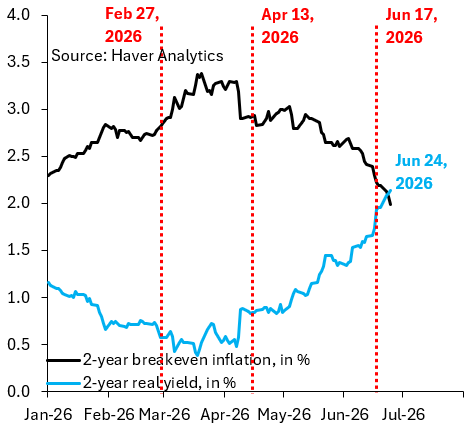
Real interest rates jump while inflation expectations fall after the Fed meeting of June 17 (source: Robin Brooks)
Brooks writes that he disagrees with what markets are currently pricing in. According to him, the Fed meeting was mainly performative: the new Fed chair Kevin Warsh had to sound hawkish in his first appearance in order to underline his independence from the White House and prove his credibility on inflation. Brooks therefore attaches less weight to the Fed’s strict tone and expects the market to start pricing in rate cuts again later.
He also notes that oil prices are back around pre-war levels, while markets are simultaneously pricing in a much more hawkish Fed. According to Brooks, that is not logical, because lower oil prices reduce inflationary pressure and therefore make additional rate hikes less necessary.
What we are seeing now, he calls the “deflation trade”, a move he considers irrational. According to Brooks, this trend may remain popular until new data paint a different picture, such as the inflation figure on July 14. He expects that it will then become clear that the deflationary effect of falling oil prices gives the Fed less reason to raise rates and instead creates room for a rate cut. The structural force behind the “debasement trade”, namely irresponsible government budget deficits, remains fully intact, according to him.
In this week’s podcast, we discussed the decline in precious metal prices with expert Jeroen Vandamme, along with his expectations for the coming period and the question of whether it is already time to buy the dip.
Another sign that European competitiveness is under pressure: Volkswagen AG wants to cut tens of thousands of additional jobs and is also considering closing factories. The group currently employs around 657,000 people, but that number could potentially be reduced by 100,000. Due to US import tariffs, weak sales in China and high costs, VW is finding it increasingly difficult to compete. The German car industry has been struggling for some time already.
The restructuring is intended to make the company competitive again, but whether this will succeed remains uncertain. In Germany, restructuring plans are often watered down by union leaders and state politicians, who together hold a blocking majority on the supervisory board.
Earlier, 28,000 employees had already agreed to a severance scheme as part of a previously announced plan to reduce the workforce by 50,000 people by 2030. VW has also already scaled back its production capacity from 12 million vehicles per year toward a more realistic level of 9 million.
The new plan would reduce annual costs by €11 billion by the end of this decade. The sites that could potentially close include Audi’s plant in Neckarsulm and VW factories in Hanover, Zwickau and Emden. The VW brand, which has long struggled with low profitability, could also be spun off.
The European Union has moved a major step closer to introducing a digital euro. The European Parliament’s Committee on Economic and Monetary Affairs (ECON) voted on Tuesday in favour of plans for the digital euro. The ECB wants to start the pilot programme for the CBDC as early as 2027, and the digital currency is expected to be fully launched in 2029.
Citizens will then be able to hold digital euros in a separate digital wallet. That wallet may be offered by banks or other designated institutions, such as possibly a post office or public service provider. They will then be able to use it to pay in shops, online or directly to other people, via a payment card, app or phone. The digital euro is meant to have the same value as cash, but there will probably be a limit on the amount users are allowed to hold.
Supporters say they want to introduce the digital euro in order to make Europe less dependent on US payment systems such as Visa, Mastercard, Apple Pay and Google Pay. “The approval of the regulation on the digital euro is a major victory for citizens and small businesses,” said Italian MEP Pasquale Tridico, who negotiated on the file on behalf of the left-wing group.
Opponents, however, mainly see risks for citizens and small businesses. Economist Daniel Lacalle calls the CBDC “surveillance disguised as money”. He warns that a CBDC could undermine financial privacy because payment data could become much more directly available to governments and central banks. He fears that the digital currency will eventually become mandatory and could ultimately be used to track, steer or even restrict payments. According to Lacalle, it is as if there is no police officer standing by the side of the road to intervene in the event of possible violations, but rather an officer permanently sitting next to you in the car.
The European Parliament is expected to formally confirm the committee’s position in early July during a plenary vote in Strasbourg. Negotiations with the 27 EU member states can then begin. The aim is to reach a final agreement on the rules for the digital euro before the end of this year.