English
EN


The debt mountain is growing much faster worldwide than the economy. According to Jack Hoogland, this is the most important reason to remain structurally positive on gold: sooner or later, confidence in paper money will erode further and investors will once again seek refuge in hard assets.
Earlier this month, I explained in this article and in this article why we expected the decline of recent months to give way to a very sharp rise in the gold price, once investors conclude that central banks cannot, or cannot sufficiently, combat inflation without thereby causing excessive economic damage.
The most important reason why we are structurally positive on gold (and silver) is the high budget deficits, which lead to ever more rapidly rising government debt. First, let us take a brief look at Switzerland.
In the tweet below, we see a brief summary of why Switzerland performs so much better than Germany (and many other countries).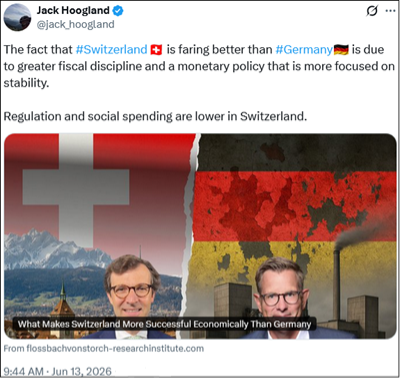
One important fact is that the Swiss government keeps its budget structurally under control and therefore almost never runs budget deficits.
If politicians worldwide did the same as the Swiss, we would have no interest whatsoever in investing in gold. The harsh reality, however, is that almost no country has its budget in order. Far from it!
In the famous, annually published, 464-page In Gold We Trust report, I came across the facts below.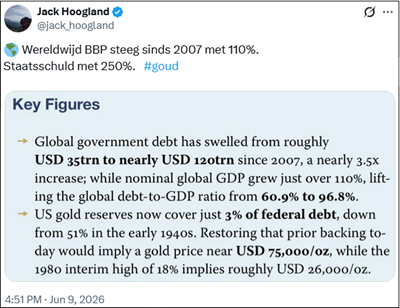
Global government debt has grown more than twice as fast as the economy since 2007.
Eroding confidence
And there is every reason to assume that government debt will rise even faster in the coming years relative to the economy. Just think of (geo)political tensions, ageing populations and ever more rapidly rising interest costs.
This leads to money-printing central banks and to an ever more rapidly increasing amount of paper money in circulation. As a result, the purchasing power of paper currencies continues to erode, and with it confidence in politicians, central bankers and the financial system.
To restore that confidence, paper money will at some point in the coming years have to be backed by gold again.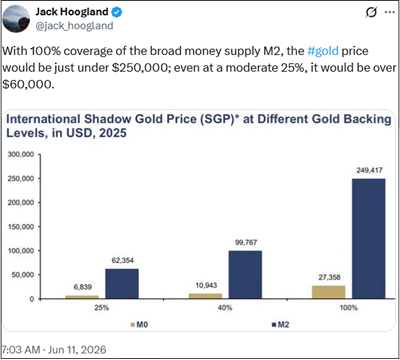
And as we can see in the chart above (from the same IGWT report), gold would have to rise to more than $62,000 to provide just 25% backing for the M2 money supply. And that is before considering that the amount of paper money in circulation is likely to rise much further in the coming years!
What applies to gold applies to all hard assets, including silver, copper and uranium. These are commodities that will benefit even more from insufficient supply.
Just as during the bull markets of the 1970s and the 2000s, and just as in 2022, sharp corrections like this are ideal opportunities to buy or add to positions. On the way to those much higher prices, wonderful periods such as 2024/25 will be interspersed with sharp corrections!
Jack Hoogland worked at the American bank Citigroup in Amsterdam, Düsseldorf, Madrid and Brussels as a Financial Analyst, Risk Manager and Finance Director. Jack has been following the financial markets since the late 1980s and, after the financial crisis, increasingly focused on macroeconomics and the financial system. Read more from Jack Hoogland.