English
EN


Gold fell 2.8% and silver 5.8% at the low on Tuesday, June 23, before recovering. The following day brought further declines. Higher interest-rate expectations at the Fed and a sharp correction in tech stocks are weighing on the yellow metal. While Deutsche Bank and Goldman Sachs have lowered their outlooks for gold, Société Générale and JPMorgan see opportunities to buy the dip. Seasonal effects are also visible in gold prices, and markets have historically often cooled during the summer.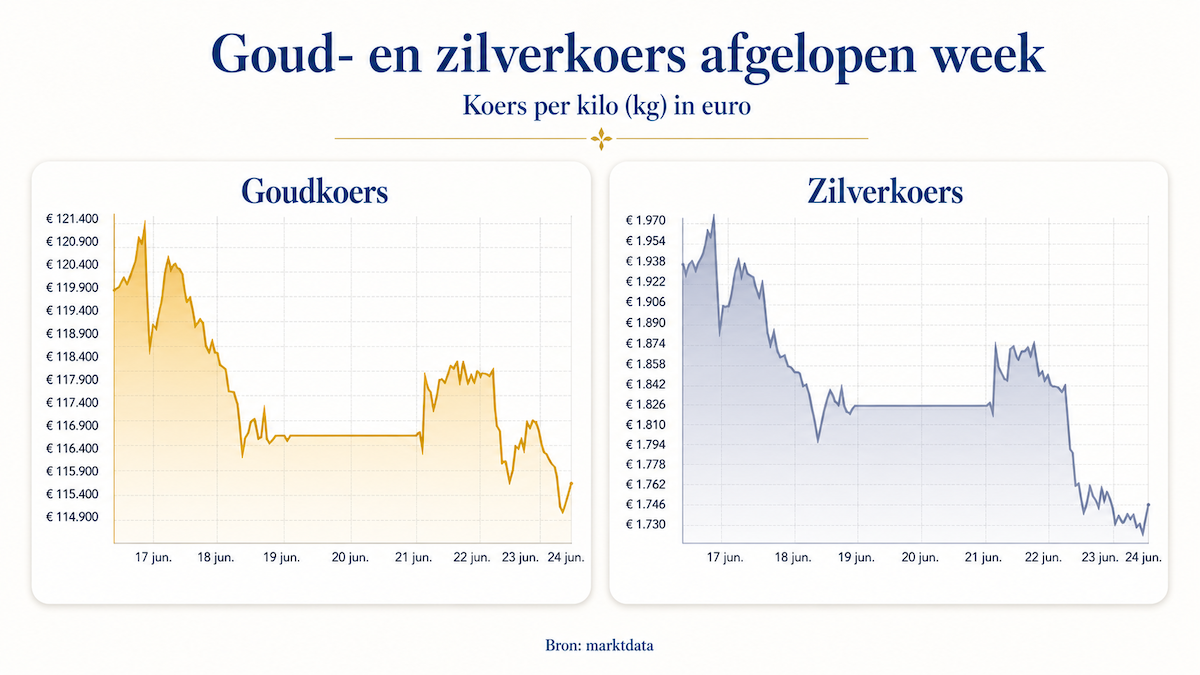
In the run-up to the meeting of the Fed, the US central bank, on Wednesday, June 17, gold and silver prices recovered. Markets were startled when the newly appointed chair, Kevin Warsh, struck a more cautious, hawkish tone. Meanwhile, markets are taking into account an interest-rate hike later this year. Higher interest rates are bad news for non-interest-bearing assets such as gold and silver, because interest-bearing bonds then become relatively more attractive.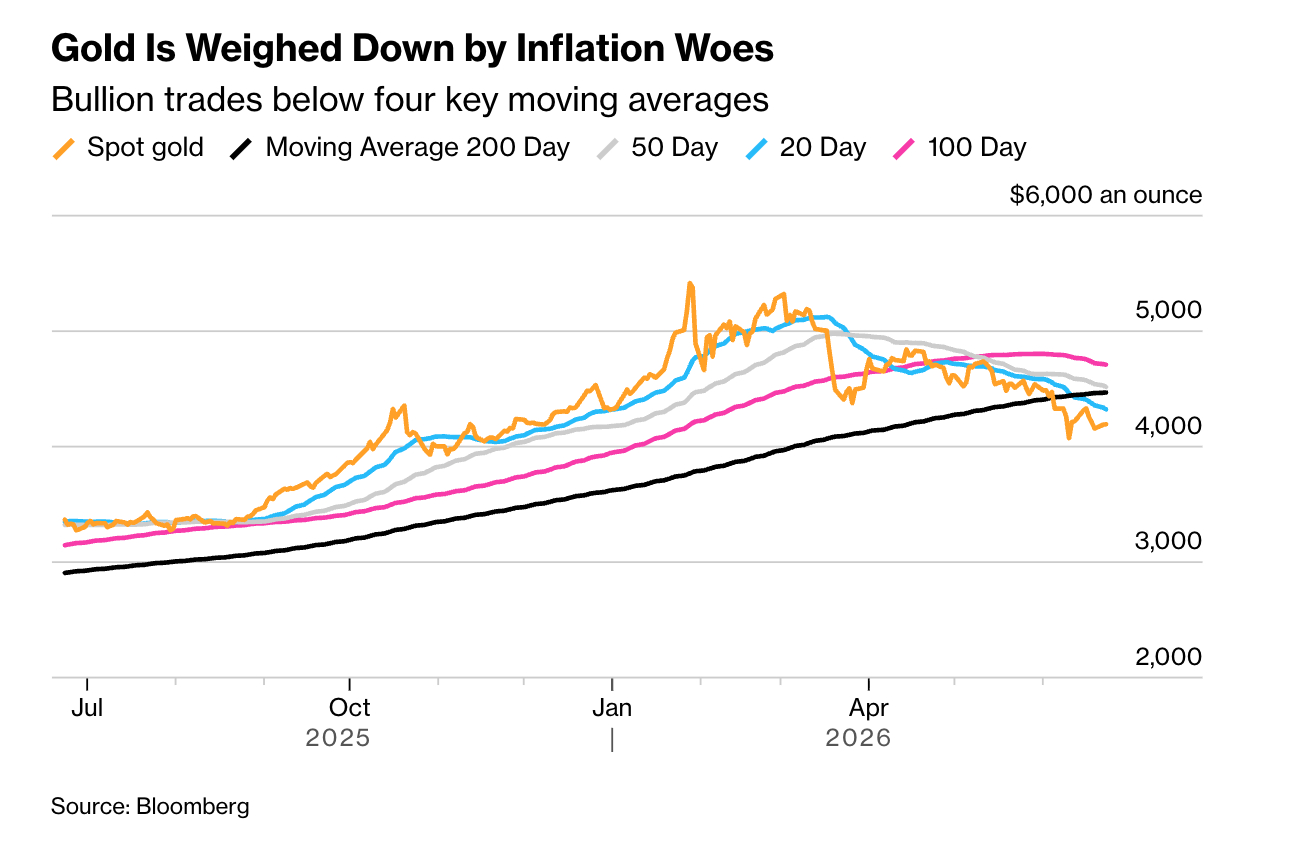
Gold (yellow line) falls below its 200-day moving average (black line). The 50-day moving average is shown in grey, the 20-day in blue and the 100-day in magenta. Source: Bloomberg.
Since then, both gold and silver have continued to slide. Gold has even fallen through the symbolic threshold of $4,100 per troy ounce (31.1 grams). As a result, the metal is now below its 200-day moving average, as well as below its 100-day, 50-day and 20-day moving averages. When the price falls through these kinds of support levels, it can trigger further declines, because traders may be forced to sell due to margin calls.
Gold and silver are facing headwinds from a strong dollar and new interest-rate expectations, but the decline is now being accelerated by a correction in tech stocks. Normally, gold moves in the opposite direction to equities, but that relationship mainly appears over the longer term. One of gold’s major advantages is that it is highly liquid: you can sell it quickly when you need cash. As a result, gold can fall alongside equities in the short term, because traders sell gold to cover losses elsewhere.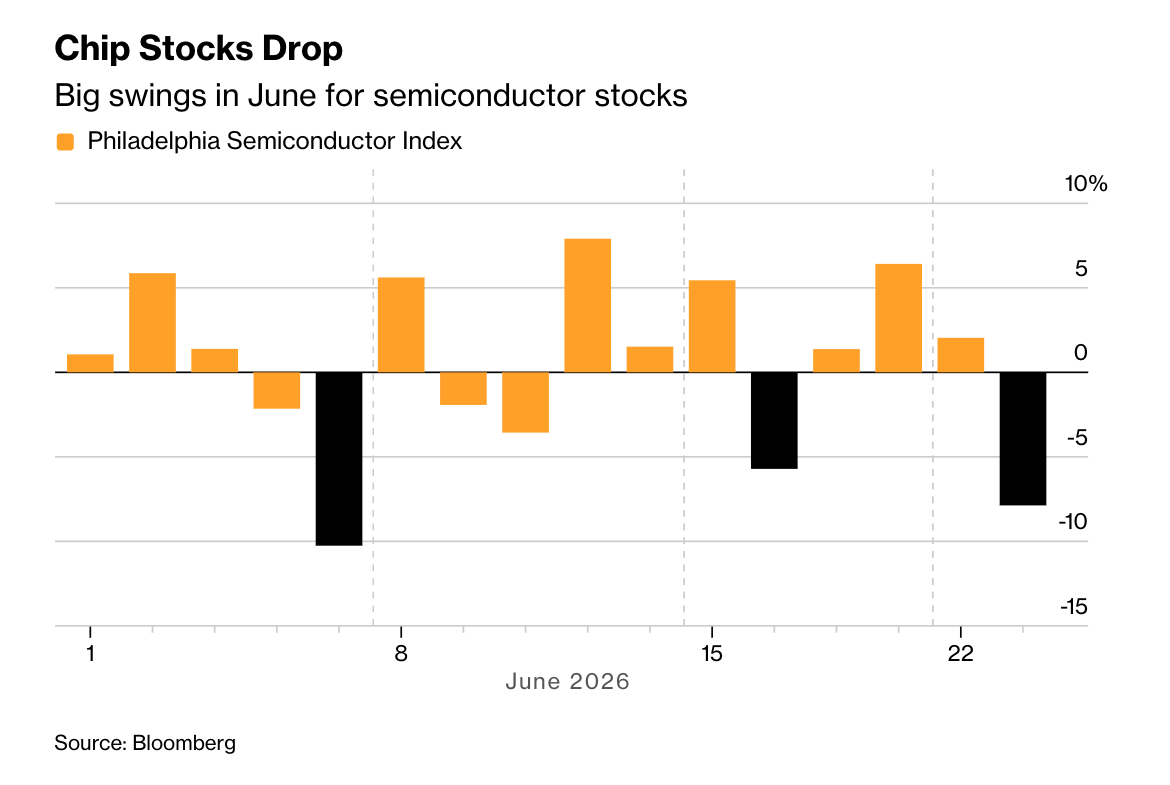
The percentage gain (orange) or decline (black) per day over the past month for the Philadelphia Semiconductor Index. Source: Bloomberg.
The declines in tech stocks are significant, as fears of overvaluation increase. One equity analyst described it not as a shipwreck, but as a “chipwreck”. The Philadelphia Semiconductor Index, an index of major chip-producing tech companies such as Nvidia and TSMC, fell 7.6% in a single day. South Korea’s KOSPI fell by as much as 10% on Tuesday, June 23, and this index, which is heavily driven by chip stocks, is currently showing exceptionally high volatility.
Major investment banks regularly publish price forecasts for gold. Since the conflict in the Middle East has upended the outlook for inflation, several banks have lowered their expected gold prices. Goldman Sachs and Deutsche Bank have lowered their year-end 2026 price forecasts to $4,900 and $4,800 respectively. The German bank thereby cut its own forecast by 22%. Not all banks agree with this view, however, with JPMorgan being one example.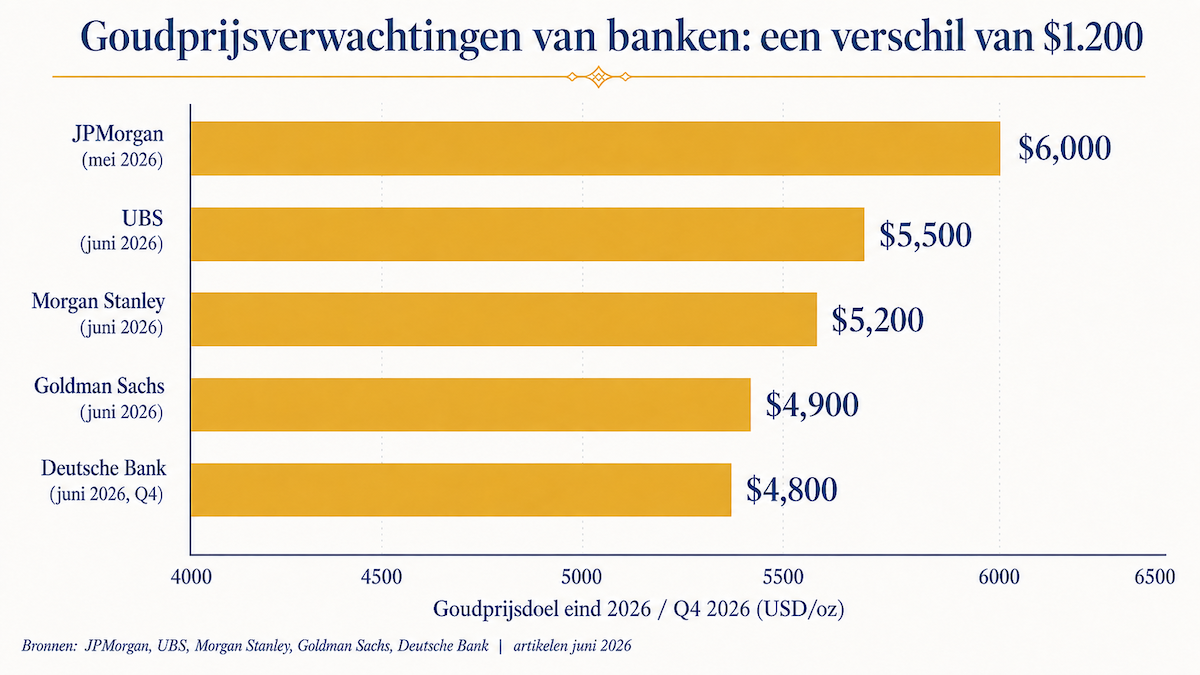
Price targets for the gold price in the fourth quarter or at the end of 2026. The date next to the name of each bank indicates when the price target was set.
How can expectations among banks regarding gold differ so widely? The banks differ in what they see as the most important factor behind gold’s price development. Does one see gold as a speculative investment that rises in price when rate cuts are expected? Or does one see gold as a long-term investment supported by structural purchases by central banks? For investors, it may be useful to ask themselves which perspective best suits them when forming their own assessment at this point.
Many banks point out that the Fed’s new course represents a significant headwind for gold. Where they differ is that a bank such as JPMorgan looks at structural patterns: continued purchases by central banks, geopolitical tensions, gold as a hedge against currency debasement and inflation, sustained demand from Asia and weak supply growth from gold mining.
Other banks, such as Morgan Stanley, instead point to declining investor demand, as reflected in slowing inflows into gold ETFs. They emphasise the behaviour of investors who respond to interest-rate expectations in the short term. Deutsche Bank, for example, assumes that the Fed will leave rates unchanged in 2026, but that the gold price could fall further if rates are raised after all.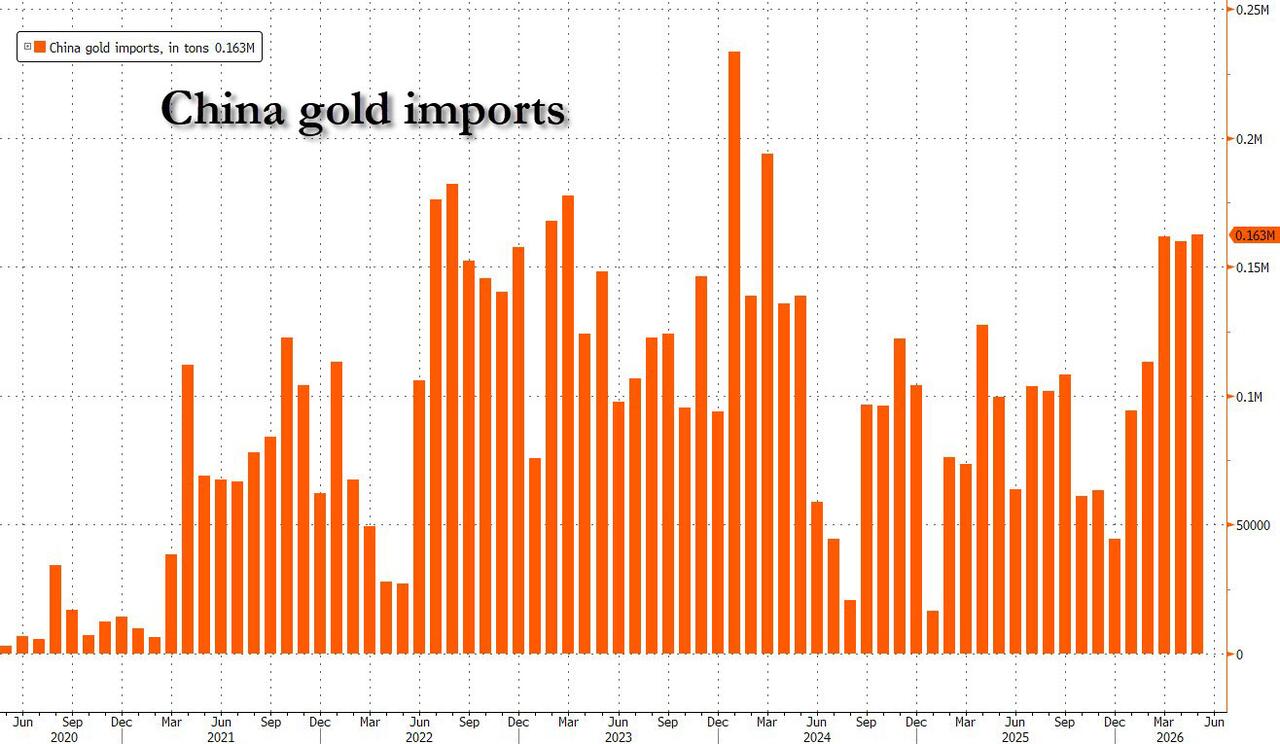
Chinese gold imports in tonnes over the past five years. Purchases in March, April and May were all around 160 tonnes per month, regardless of the price decline. Source: ZeroHedge.
One of the structural patterns JPMorgan points to is demand from Asia. That demand appears far from weakening. Chinese gold imports rose in May to their highest level in more than two years, reaching around 163 tonnes per month. We also recently wrote that, according to research by the World Gold Council, central banks worldwide expect to continue buying gold.
Société Générale sees opportunities: “buy the dip,” Kitco writes following an update from the French bank. The bank is increasing its exposure to commodities within its multi-asset strategy. Société Générale expects strong demand from electrification and AI investments. Its position in gold is being increased from 7% to 10%. The French bank is bullish because it does not expect the Fed to actually raise interest rates.
JPMorgan also states that the current correction in the gold price has actually improved the risk/reward ratio for long-term investors. In other words, “buy the dip,” writes The Motley Fool in response to JPMorgan’s latest gold forecast.
Will it be a quiet summer for gold? Looking at the swings in the gold price, it does not yet appear that way. Still, there may also be seasonal effects in the gold price, which according to Jeffrey Christian of CPM Group could offer a buying opportunity.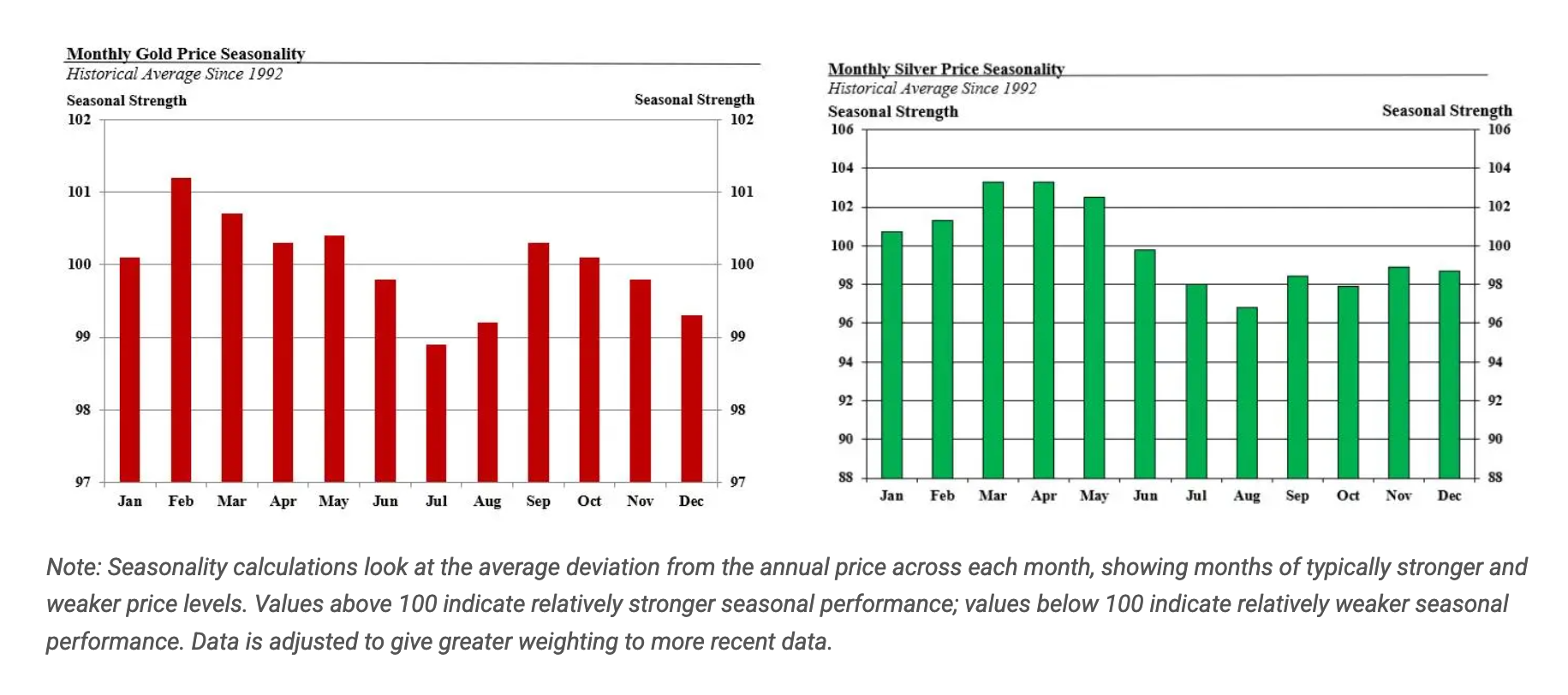
On the left, the red bar chart shows gold’s historical average monthly performance since 1992. A value above 100 indicates stronger seasonal performance, while a value below 100 points to weaker price development. On the right, the green bar chart shows the same for silver. Source: CPM Group.
“Sell in May and go away” is the American stock-market adage, which roughly means: sell your positions in May and go on holiday. The idea is that investors reduce their positions in equities and precious metals ahead of the summer period. Trading activity has historically often declined during the summer months. When market activity picks up again toward August and September, price development may also improve.
Selling in May is not good advice, CPM Group writes in an analysis. According to the group, there are indeed seasonal patterns whereby prices of assets such as gold and silver, on average, perform more strongly in the first four and final four months of the year. In between, prices tend to move lower or sideways on average. But the summer lull may actually be a golden opportunity to reposition the investment portfolio and buy more gold and silver.
In addition, an interesting article by our colleague Victor Maesen points to another seasonal pattern: cultural gold purchases in Asia. There, too, we see a quiet summer, with more demand in the first and final months of the year.
Be sure to take a look at our YouTube channel
On behalf of Holland Gold, Paul Buitink and Yael Potjer interview various economists and macroeconomic experts. The aim of the podcast is to give viewers a better understanding of, and more guidance in, an increasingly fast-changing macroeconomic and monetary landscape. Click here to subscribe.