9.3
8.923 reviews

English
EN


Now that Trump’s deal may have put peace on the horizon in the Middle East, the outlook for the energy market has quickly improved. That is also relevant for the gold market, as the earlier rise in oil prices had been seen as an important source of pressure on gold through higher inflation and interest-rate expectations. At the same time, pressure on Europe’s climate policy is building further, while the controversial reform of box 3 is also coming under renewed strain.
Kuwait has started increasing oil production and aims to exceed 2 million barrels per day within a week. The country is doing so in response to the temporary peace agreement between the US and Iran, which is reopening the Strait of Hormuz to shipping.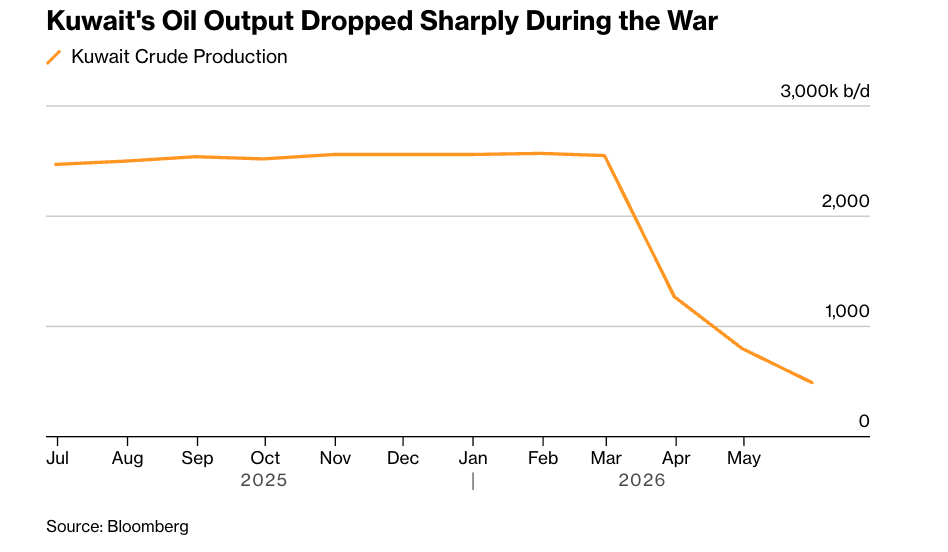
Kuwait oil production (source: Bloomberg)
Bloomberg writes that Kuwait has now carried out sufficient repairs to its previously damaged energy infrastructure to return to prewar production levels. Before the war, the country produced around 2.5 million barrels per day. Oil and gas shipments from the region are reportedly already accelerating, including the first tankers carrying Saudi oil since the start of the war.
Meanwhile, we are seeing, for example, jet fuel prices fall sharply as traders anticipate a resumption of exports from the Middle East. The north-west European benchmark for jet fuel fell this week to just $957 per tonne. That is almost 50% below its peak in early April.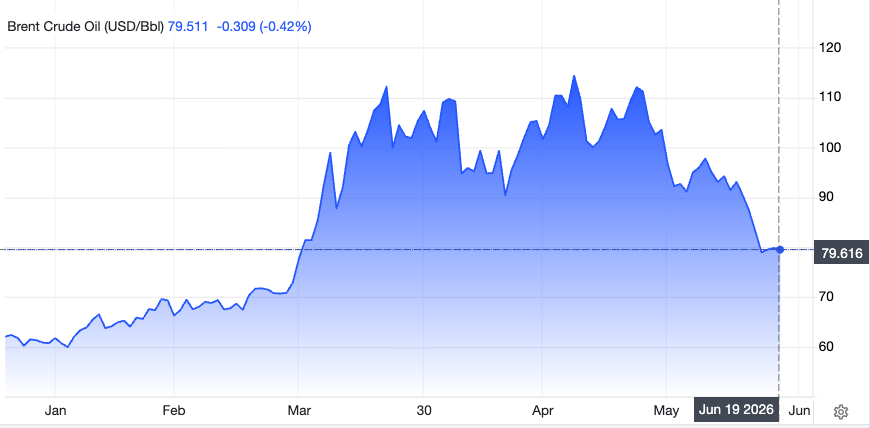
Brent Crude Oil price development (source: Tradingeconomics)
Whether the fall in fuel prices and the optimism about the recovery in production are justified will become clear in the coming days. Everything depends on whether Iran actually allows shipping through the Strait of Hormuz to normalize and whether oil and gas shipments from the Gulf restart quickly enough. Shipbrokers had already seen interest cautiously pick up earlier this week, while today Abu Dhabi National Oil reportedly instructed its customers to resume loading crude oil from ports inside the Persian Gulf.
Still, considerable uncertainty remains because of the fighting in southern Lebanon and the postponement of negotiations on a permanent peace agreement. Sea mines are also still an obstacle. Maritime traffic through the Strait of Hormuz will only return to normal levels once mines have been removed and traditional shipping routes restored.
Ole Hansen of Saxo Bank writes that gold is once again under pressure, despite the earlier rise in the gold price this week following the announcement of the agreement that paves the way for lower energy prices. According to Hansen, this is mainly because the market is still digesting the hawkish outcome of the latest Fed meeting. The stronger dollar remains the main headwind for gold.
According to Hansen, it remains an open question whether the Fed will ultimately still have room to raise interest rates further. Now that energy prices are falling sharply, inflationary pressure could ease in the coming months. ING is more explicit and expects no new rate hike for the time being, but rather a prolonged pause. In theory, this could be positive for the gold price.
Read more on this topic: Gold receives support from Iran deal, but faces new Fed headwinds
De Telegraaf wrote this week that the European steel industry could shrink by as much as 40 percent if the EU does not adjust its emissions trading system. The warning comes from Europe’s three largest steel producers: “Without adjustments to the current course, Europe’s industrial foundation risks being destroyed.”
The EU Emissions Trading System (ETS) works with a cap on the total CO₂ emissions of certain sectors. Companies that emit more than the allowances they hold must buy additional allowances; those that emit less can sell allowances. According to European steel producers, this creates an uneven playing field, because CO₂ costs for European steel are rising rapidly, while imported steel is only gradually being taxed through the European carbon border adjustment mechanism and ETS costs for exported European steel are not compensated. This could therefore have disastrous consequences for European steel producers.
The companies want the increase in ETS costs to be frozen at current levels for the time being. They are also calling for support from the revenues generated by the emissions trading system and are advocating a level playing field with producers from outside the EU.
Last week, EU countries and the European Parliament already reached an agreement on stricter price controls for ETS2, the new CO₂ market for transport and heating fuels. Those measures followed warnings from, among others, France and the Czech Republic that ETS2 could fuel opposition to climate policy if consumers start to feel the system in their fuel bills. Danish political scientist Bjorn Lomborg, president of the Copenhagen Consensus Center think tank, responded critically on X: “After years of high CO₂ taxes (ETS) driving up prices, EU now weakens its carbon market to lower costs. Translation: Climate action is important… until it costs votes.”
The European Commission will present a proposal next week to make investing through a private limited company more attractive in order to stimulate investment in Europe. Under the proposal, dividend withholding tax on distributions between companies would be abolished, allowing companies to retain more cash for investment.
If the proposal is adopted, investments in shares through a private limited company would no longer be subject to dividend withholding tax on received dividends. Investors in box 3 would not benefit from this advantage. As a result, experts say investing through a private limited company could become so lucrative that the current box 3 reform comes under pressure.
Edwin Heithuis, professor of tax economics at the University of Amsterdam, told BNR that more people are likely to start investing through a private limited company. “In any case, it will cause tax revenues from box 3 to fall further,” Heithuis said.
The proposal will only be approved if it receives support from all 27 member states. To be continued!
Be sure to take a look at our YouTube channel
On behalf of Holland Gold, Paul Buitink and Yael Potjer interview various economists and experts in the field of macroeconomics. The aim of the podcast is to give viewers a better understanding and more guidance in an increasingly fast-changing macroeconomic and monetary landscape. Click here to subscribe.


