English
EN


Government bond yields are rising sharply worldwide amid rising inflation expectations and higher energy prices. There is even talk of a Japanese debt crisis, now that the yield on thirty-year government bonds has risen above 4% for the first time. What is going on?
Government bond yields are rising worldwide. In this week’s podcast, we discussed the British thirty-year yield with economist Han de Jong, which has now risen above 5.8 percent. That is the highest level since the late 1990s. German Bunds with a thirty-year maturity now yield 3.6%, the highest level since 2011. The ten-year yield is also above 3%.
In the US, the yield on ten-year government bonds rose to more than 4.5 percent, the highest level since July. The US thirty-year yield now stands at more than 5.1 percent. This level was last seen in 2007, in the run-up to the financial crisis.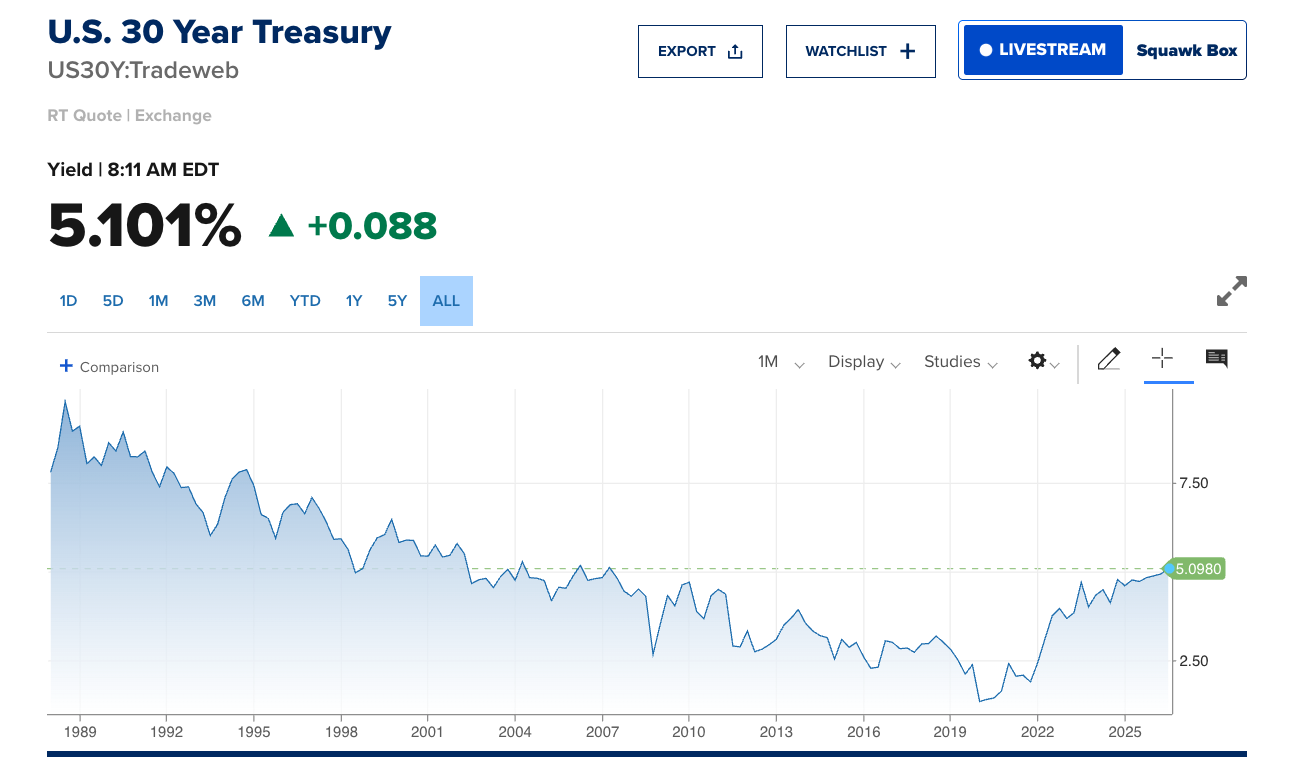
US thirty-year yield (source: CNBC)
Bloomberg wrote this week that investors are fleeing government bonds after two recently published US inflation reports pointed to rising price pressures. Producer prices posted their fastest increase since 2022. The PPI rose by 6% year-on-year in April, compared with a revised 4.3% in March. That was more than economists had expected. Consumer prices also rose more than expected, by 3.8% year-on-year.
The main cause is the conflict in the Middle East, which has led to higher energy prices. “The whole yield curve is currently being driven by inflation and oil,” Scott Buchta of Brean Capital told Bloomberg. “People are simply starting to price in more inflation.” The market increasingly appears to expect that the Fed will have to raise interest rates. Before the attack on Iran, markets were still pricing in two Fed rate cuts this year.
Japan is known as a country with an exceptionally high government debt of around 240% of GDP, something we have written about more often. With debt of that size, even a small rise in interest rates can have a major impact on the government budget. Yields also rose in Japan this week. The yield on thirty-year Japanese government bonds rose above 4% for the first time since their introduction in 1999. The twenty-year yield climbed to its highest level since 1996. The forty-year yield also reached its highest level since its introduction in 2007.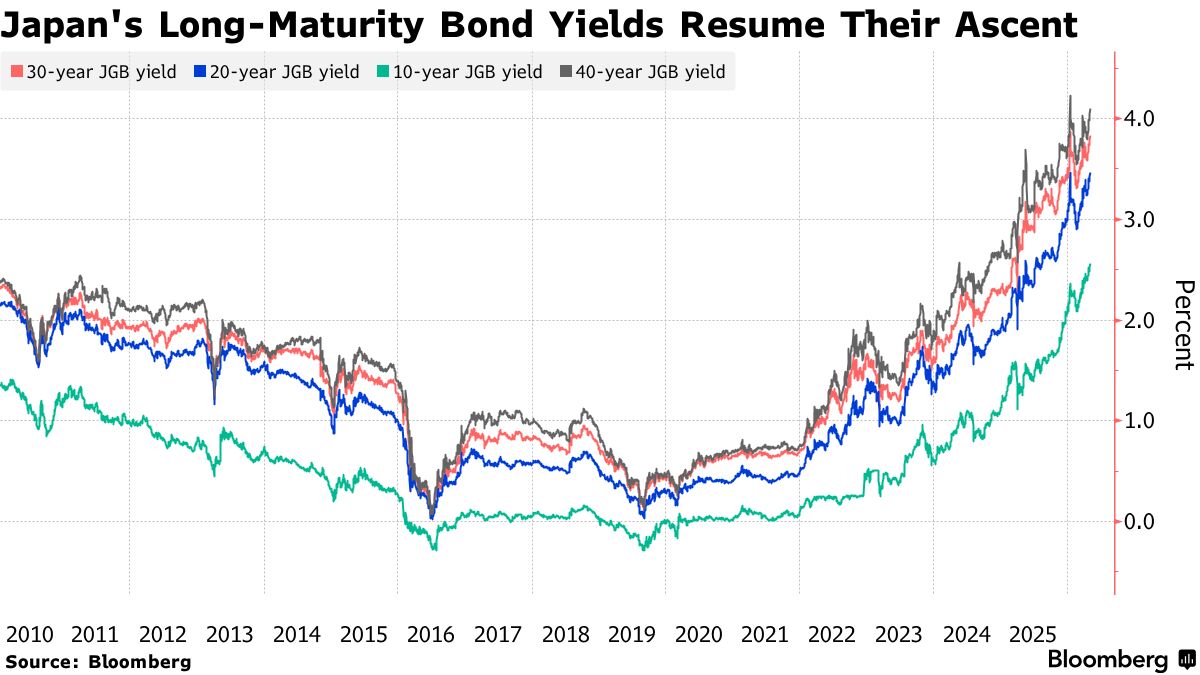
Various Japanese government bond yields (source: Bloomberg)
In Japan too, the rise in yields is being driven by inflation concerns, which are also being fuelled there by higher energy prices. On top of that come renewed concerns about Japan’s fiscal policy. In Japan, interest rates remained around zero percent for a long time, as can be seen in the chart above. According to Rinto Maruyama of SMBC Nikko Securities, this significant increase points to the possibility of persistent inflation in Japan, a country that was plagued by deflation for many years.
The influential economist Robin Brooks even writes that Japan is now in a debt crisis. “This (rise) is happening even as the Bank of Japan buys 3 trillion yen of Japanese government bonds every month. This is really bad.”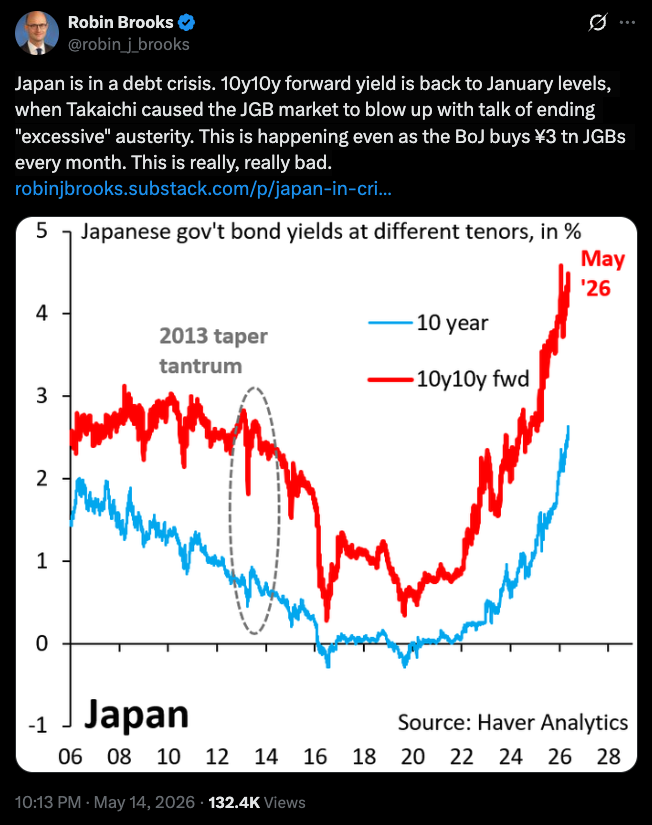
In a blog post, Brooks explains that Japan is trapped. Against the US dollar, the Japanese yen is once again approaching a low, even though the dollar itself has also weakened considerably. According to Brooks, the yen is falling because markets want to see higher interest rates: “Yields are still artificially low and offer investors insufficient compensation for what they see as a growing default risk.”
Only higher interest rates could prevent the yen from falling further, because they could increase demand for the yen, but higher rates also increase the risk of a fiscal crisis. According to Brooks, yields are far too low relative to the enormous government debt, and the increase we are now seeing is a correction of that. German government debt, for example, is significantly lower than Japan’s, while the German thirty-year yield has only recently and only slightly risen above Japan’s.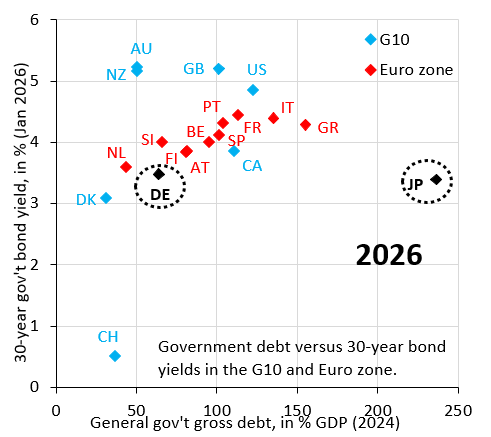
According to Brooks, Japanese yields are still far too low, image from January 2026 (source: Robin Brooks’ blog)
According to Brooks, there is no easy way out of this dilemma. If the Bank of Japan completely stops buying bonds, it could push the country into a fiscal crisis, because no one knows how far yields would then rise. The higher the interest burden, the less room remains for other government spending. According to Brooks, the only solution is for the Japanese government to sell assets in order to reduce its debt.
Peter Schiff writes about the rise in government bond yields: “Gold and silver are under pressure, but a bond market crash is actually the most bullish thing that can happen for precious metals. Traders just have not figured that out yet.”
In an earlier article, Jack Hoogland wrote that he has a similar expectation. He expects central banks will have to provide more stimulus to prevent a recession caused by the energy crisis. According to him, financial markets are ultimately driven mainly by liquidity, not by the economy. The global money supply is already increasing, and according to Jack this will also push precious metal prices higher again.
Next week we will record a podcast with Jeroen Blokland, in which we will discuss this topic in detail. What does Jeroen think is behind the rise in yields, what consequences could this have, and what does it mean for the gold price? Follow our channel on YouTube and Spotify!