English
EN


Gold rose by 3.3% and silver by as much as 6.3% in dollar terms, following reports that the US and Iran were moving closer to a peace agreement. At the same time, markets have remained extremely volatile in recent weeks. Every report about the Middle East can trigger a swift reaction in oil prices and, with that, in precious metals prices as well. The US expects a response from Iran in the next 48 hours to a one-page draft agreement, but doubts remain.
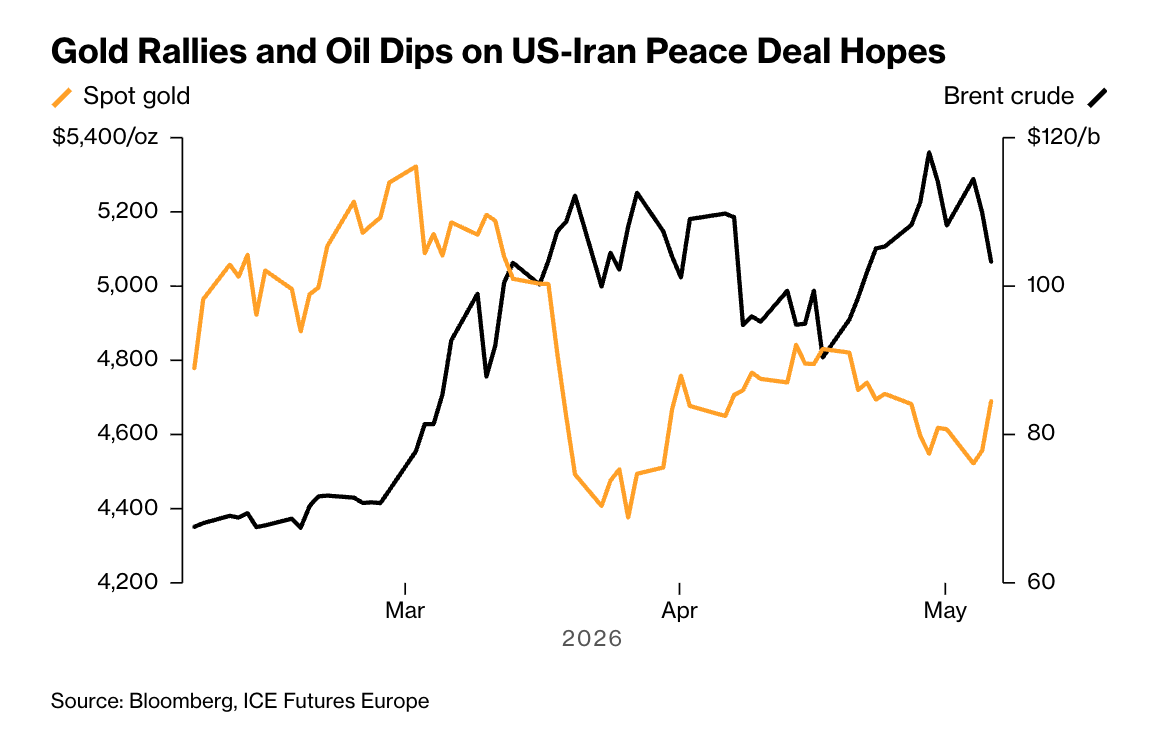 The gold price (yellow line) moves inversely to the oil price (black line), source: Bloomberg
Earlier today, gold once again reached a price of €4,000 per 1 troy ounce, while silver reached €65.85 per 1 troy ounce. This allowed precious metals to recover their losses from recent days. Now that the war with Iran has been dragging on for more than two months, the patterns are also becoming clearer. The gold price is moving inversely to oil prices. Oil prices fell by as much as 14% on Wednesday before climbing again amid doubts surrounding a possible deal. Gold investors are now betting that the Federal Reserve (the US central bank) will still lean toward a rate cut if inflationary pressure eases, according to Ewa Manthey, commodities strategist at ING, speaking to Bloomberg.
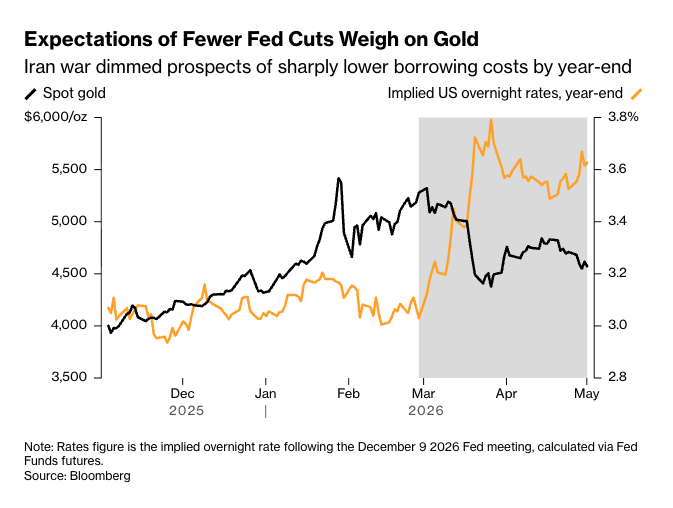 On 1 May, rate expectations still appeared to be rising. Here too, it is visible that gold (black line) moves inversely to the level of Fed rate expectations (yellow line), source: Bloomberg
The reasoning is as follows: higher oil prices feed through into overall inflation, and the longer inflation remains high, the more central banks such as the ECB or the Fed will consider raising interest rates. Higher interest rates are used to slow the economy and, as a rule, inflation as well. Higher rates also mean that dollars and interest-bearing US government bonds become a more attractive safe haven than gold, which pays no interest. Normally, geopolitical tensions lead to higher gold prices, but that is not the case in this specific conflict. Although we are seeing lower gold prices in the short term as a reaction to higher oil prices, the Iran war is likely to have a different long-term effect. Last week, we saw in the analysis by Deutsche Bank that America, through conflicts such as the one in Iran, is only increasing demand for gold, because central banks will buy more gold when the trusted world order comes under pressure.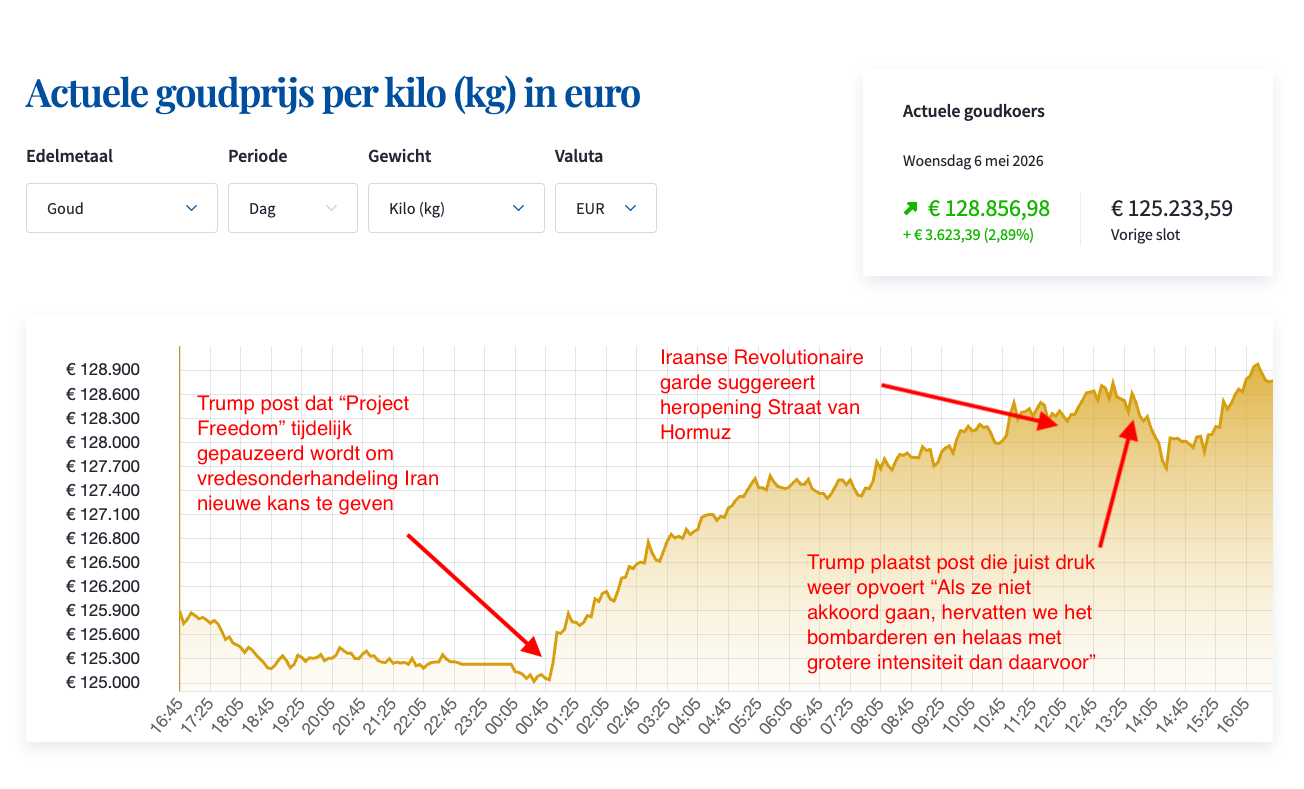
The gold price jumped after a message from Trump pointing to a renewed attempt at peace, showing direct reactions based on X and Truth Social posts.
The speed at which prices are moving up and down is unprecedented. Trump posted on Tuesday that “Project Freedom” would be temporarily paused to give peace negotiations with Iran another chance, triggering a rally in stock markets and precious metals. At 12:24 today, a message was released by the navy of Iran’s Revolutionary Guard that appeared to suggest the Strait of Hormuz had reopened: “Now that the threat from the aggressors has been neutralized and new protocols have been established, safe and stable passage through the Strait of Hormuz is guaranteed.” Shortly after the message, doubts emerged about its exact meaning, while Trump also increased the pressure again. “If [Iran] does not agree, we will resume the bombing and unfortunately with greater intensity than before,” he posted on Truth Social.
Developments are following one another so rapidly and are so erratic that it is difficult to identify a new direction in the markets from the price movements. We seem to have to get used to a reality in which, shortly after writing or reading a market update such as this one, markets may already look completely different. Still, analysts continue to see strong long-term reasons to invest in gold. David Morrison, chief market analyst at the US broker Trade Nation, summarizes it as follows:
“At this moment, investing in gold requires a deep understanding of the balance between short-term and long-term factors. Markets do not move on the basis of a single event, but through a complex interaction between politics, economics and investor psychology. From this perspective, I see gold retaining its appeal as an important hedging instrument. The current volatility should be viewed in the broader context of structural shifts in the global financial system, rather than merely as short-term reactions to news.”
Be sure to take a look at our YouTube channel
On behalf of Holland Gold, Paul Buitink and Yael Potjer interview various economists and experts in the field of macroeconomics. The aim of the podcast is to offer viewers a clearer understanding and guidance in an increasingly fast-changing macroeconomic and monetary landscape. Click here to subscribe.