English
EN


According to Jack Hoogland, European, Chinese and Kazakh plans will drive uranium demand sharply higher in the coming years. While Europe is revising its energy policy and China is accelerating the construction of nuclear reactors, Kazakhstan’s plans could also put further pressure on an already tight supply.
Over the past year, we have already shown you many examples of countries that first wanted to move away from nuclear energy, then decided to keep their nuclear power plants open for longer, and subsequently decided to invest even more in nuclear energy. Below, we see that Belgium may be making the most striking U-turn of all.
After all, Belgium, together with Germany, was known as one of the dumbest and most self-destructive countries in the world when it comes to energy policy. At first, all seven reactors were to be shut down, and then two reactors were to remain operational until 2035 after all. Now the current Belgian government wants even more nuclear energy.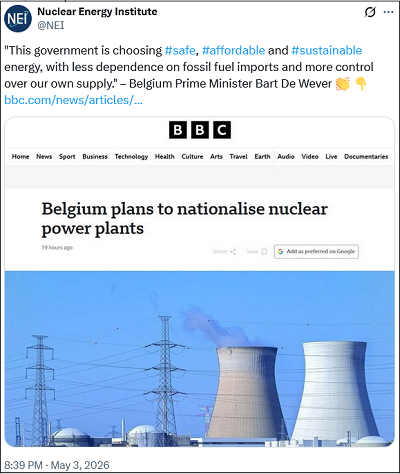
Because negotiations on reopening the five plants that have been closed since 2022 kept dragging on, the government has now decided to take them over from electricity company Engie.
The quote from Prime Minister De Wever in the tweet above perfectly shows how sentiment around nuclear energy has changed, and how sharply demand for uranium will rise in the coming years. What applies to Belgium applies to the whole of Europe.
Last month, EC President Von der Leyen already indicated that Europe will now also invest heavily in nuclear energy. And if you look at the image in the tweet below, you immediately see why this is so badly needed.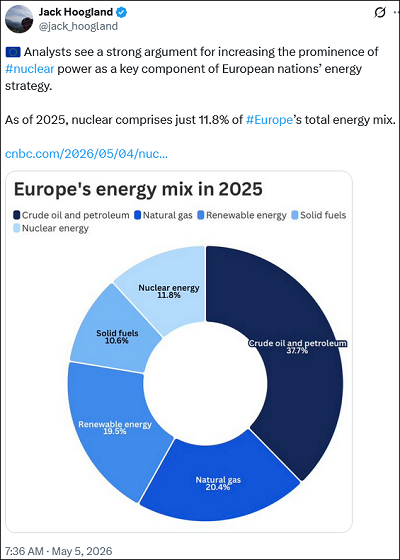
At present, fossil fuels still account for almost 70% of Europe’s energy mix, while dependence on the Middle East and the US is far too great. To seriously reduce that dependence, Europe must invest very heavily in nuclear energy. This will lead to an increasingly rapid rise in European demand for uranium.
Two weeks ago, we also saw fairly remarkable news from China. In the tweet below, we see that China has indicated it now has enough capacity to have 50 nuclear reactors under construction at the same time.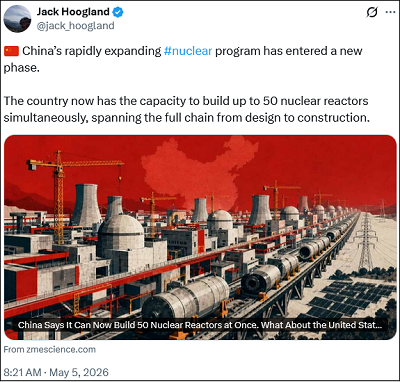
China currently has 38 reactors under construction, which means that China (as it also indicated last month) is going to accelerate the construction of new reactors. This will lead to an increasingly rapid rise in Chinese demand for uranium.
But for us as investors, the most important and most interesting news (which has not yet been picked up by Western media) came from Kazakhstan last week.
The tweet below concerns the quarterly trading update from Kazatomprom, the world’s largest uranium producer. It mentions Kazakhstan’s plans to invest in nuclear energy for the first time. In the tweet below, we see that Kazakhstan wants to build 9.2 GW of new nuclear reactors.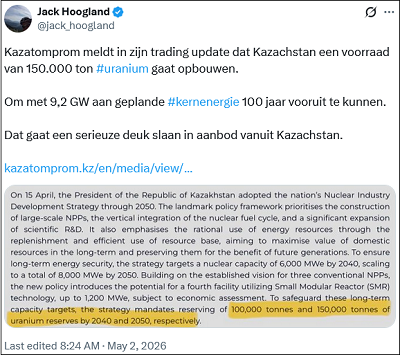
On top of that, the Kazakh government announced that it will build up a uranium stockpile of no less than 150,000 tonnes, enough for almost 100 years. That is more than twice the current total annual global production!
As a result, an average of 6,000 tonnes of uranium will disappear into Kazakh storage facilities every year until 2050. This means that 6,000 tonnes less uranium will be available each year for the rest of the world. This will cause the already rapidly rising annual uranium deficit to surge even more.
The uranium bull market will become the biggest, biggest, absolute biggest bull market we will see in our lifetime!
Jack Hoogland worked at the American bank Citigroup in Amsterdam, Düsseldorf, Madrid and Brussels as a Financial Analyst, Risk Manager and Finance Director. Jack has been following the financial markets since the late 1980s and, after the financial crisis, increasingly focused on macroeconomics and the financial system. Read more by Jack Hoogland.