English
EN


“Completely unacceptable,” Trump said on Monday, May 11, in response to Iran’s peace proposal, and since then a swift end to the energy crisis appears to be out of sight. Indian Prime Minister Modi is calling on the country to ration oil consumption and is asking citizens to stop investing in gold for one year. An energy crisis in Peru is putting pressure on the silver market and has driven prices higher in recent days. Despite a 40% chance of rate hikes by the Federal Reserve, the gold price appears to be holding up. A packed market update!
Gas and oil shortages are causing problems for Pakistan and India. After Trump rejected Iran’s peace proposal, both countries responded. On Sunday, Prime Minister Modi called on all of India to stop buying gold for one year, in order to protect the rupee from devaluation. Indian private individuals are among the world’s largest investors in gold, often in the form of jewellery and dowries, but increasingly also in gold bars and ETFs.
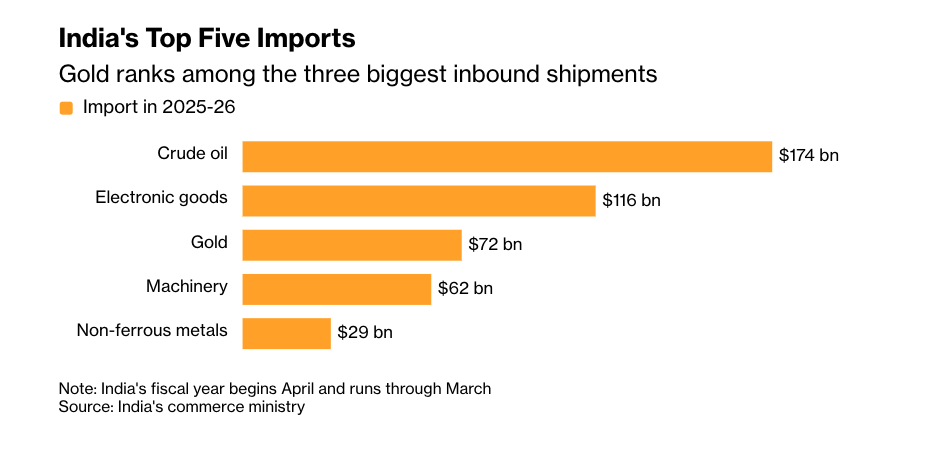 Gold is India’s third-largest import item. Between April 2025 and March 2026, the value of gold imports amounted to $72 billion. (source: Bloomberg)
Demand for gold in India is so strong that gold is the country’s third-largest import product, worth $72 billion over the past 12 months. Every time gold is purchased, it generally has to be settled in dollars, causing rupees to flow into the international money market. This contributes to India’s trade deficit of $330 billion. To reinforce Modi’s appeal, import duties on gold and silver were doubled on Tuesday from 6% to 15%. It is a remarkable emergency measure by the Indian government to steer the purchasing behaviour of its population.
The increased tariffs raise the risk of black markets and illegal trade in gold and silver, according to the chairman of India’s investment gold and jewellery association. Due to the energy crisis, Indian stock markets have come under pressure and Indians are fleeing into gold. In March, Indian gold ETFs saw a year-on-year increase of no less than 186%.
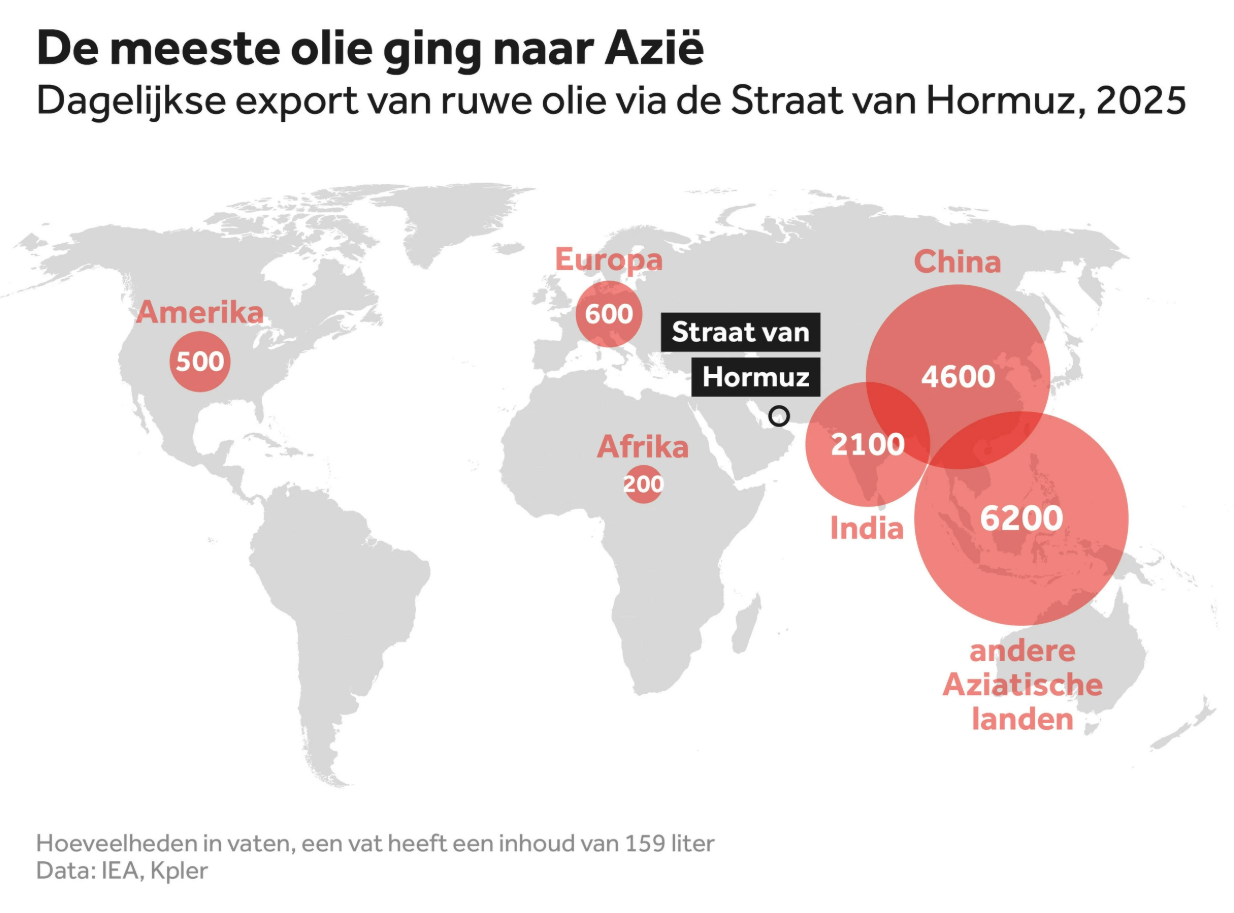
Oil exports flowing through the Strait of Hormuz to various parts of the world, source: NOS.
Pakistan announced on Monday that it would extend the emergency measures it had declared at least until June 13. The country had already introduced far-reaching measures to curb oil consumption, such as halving energy quotas for government vehicles and implementing a four-day working week.
In preparation for persistent shortages, an app is also being developed that would allow the government to enforce fuel quotas on citizens. Initially, the aim is to ensure that government fuel subsidies reach citizens who depend on mopeds or rickshaws, three-wheeled vehicles. The Pakistani government is distributing 24,000 smartphones across 12,000 petrol stations, where vouchers for fuel subsidies can be scanned. Everything is linked to citizens’ national IDs, allowing the authorities to check whether subsidy quotas are being exceeded.
According to Lau Vegys, this is the prelude to a digital system that could be used to ration oil consumption on a far-reaching scale. Vegys, who grew up in the Soviet Union, recalls the strict rationing of food, cigarettes and other basic necessities. He openly wonders how long it will take before governments use apps, CBDCs or other technologies to exert extensive control over citizens’ spending.
On Monday, May 11, silver rose by almost 7.5%, despite increased production by silver mines. Interest in silver may be returning, driven by demand for commodities and ‘hard assets’ at a time when inflation in the US is rising to 3.8% as a result of high energy prices. It could also be a response to the news from India, where private individuals may shift their focus from gold to silver.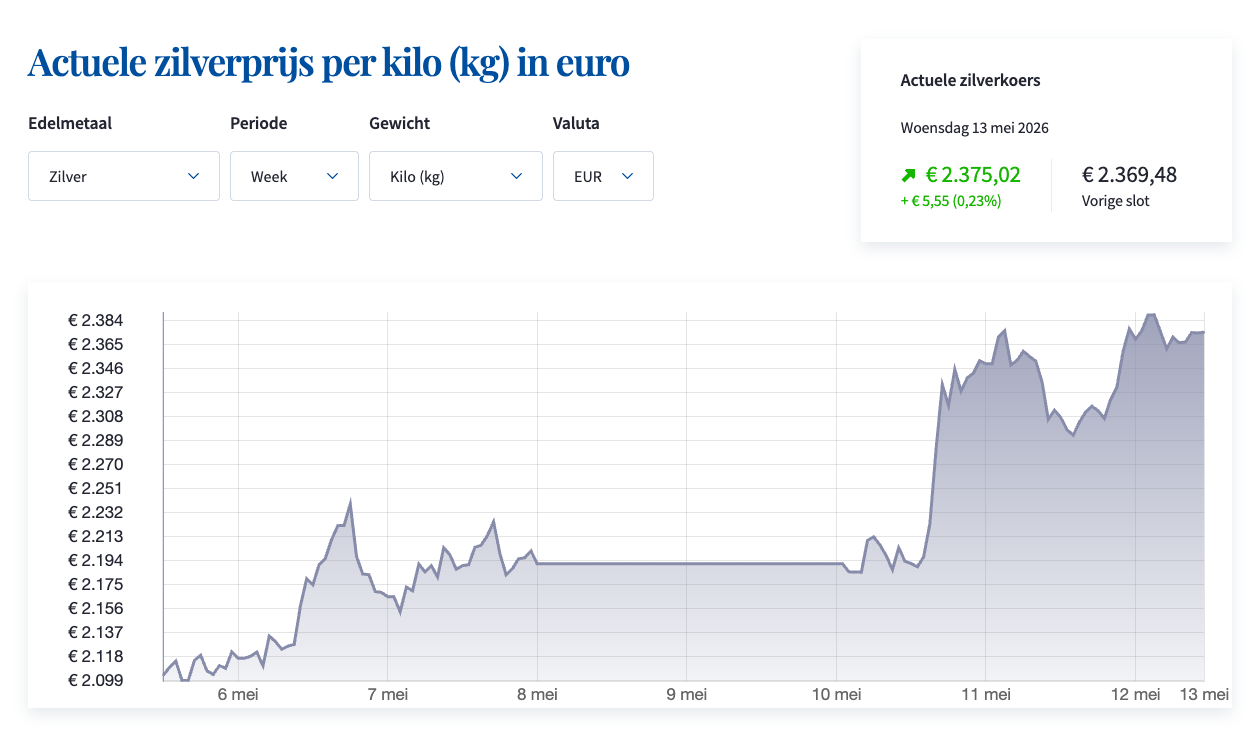
The silver price rose by almost 7.5% on Monday, May 11
Another explanation, according to Gregor Gregersen, CEO of Silver Bullion, is the expectation that major shortages are on the way due to declining silver production in Peru. As a result of a ruptured gas pipeline, 90% of the gas supply has been lost, while turmoil at the top of Petroperu has also sharply reduced oil supplies. This drives up costs for miners, an energy-intensive sector that is highly dependent on energy prices and supply. Social unrest in the country is also playing a role, with the government only expected to make a decision at the end of 2026 on REINFO legislation that could potentially declare a large part of silver mining illegal. At a time when we are also heading for a silver deficit of 46 million troy ounces in 2026, a supply shock can quickly move markets.
Recently, we have seen the gold price fall as the oil crisis pushes up inflation expectations and bond yields. Whereas central banks were until recently still expected to cut rates, markets now see a 40% chance of a rate hike by the US Fed. The higher interest rates rise, the more attractive safe havens such as government bonds become, because they offer both the safety of the dollar and an interest payment. Gold, which does not pay interest, depends on price appreciation. 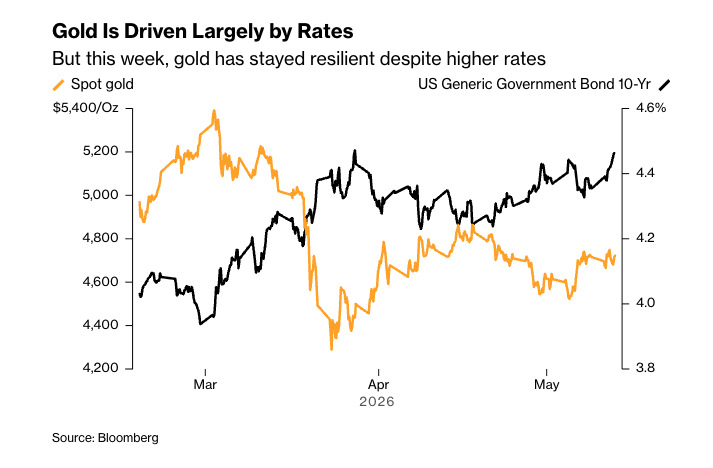
Gold price (yellow) reacts inversely to rising government bond yields (the black line in the chart shows US 10-year Treasuries), source Bloomberg
However, this is not the whole story. Despite rising interest rates, gold has remained fairly stable after an initial price correction. Where one might expect sharp price declines, these have so far failed to materialise. This asymmetrical relationship is not new, says Yuxuan Tang, head of rates and FX strategy at JP Morgan Private Bank: “We saw the same pattern very clearly from 2022. The gold price remained resilient when interest rates rose sharply. And gold tended to rally when rates fell.”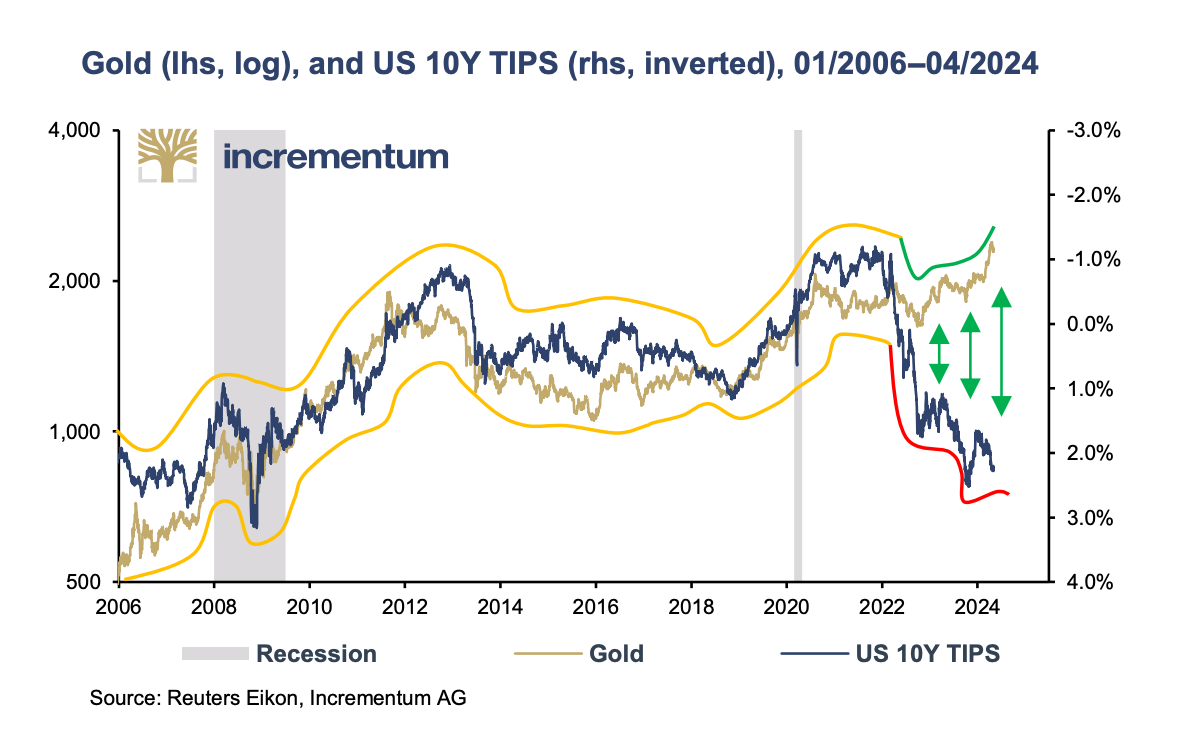
The blue line shows the inverted yield on TIPS, US 10-year government bonds, versus the gold price, source: In Gold We Trust)
The fact that the historically strong relationship between interest rates and gold was broken from 2022 onwards was already discussed extensively in the 2024 In Gold We Trust report. Since 2022, we have seen interest rates rise while the gold price also increased. In the years before that, the gold price still moved inversely to interest rates.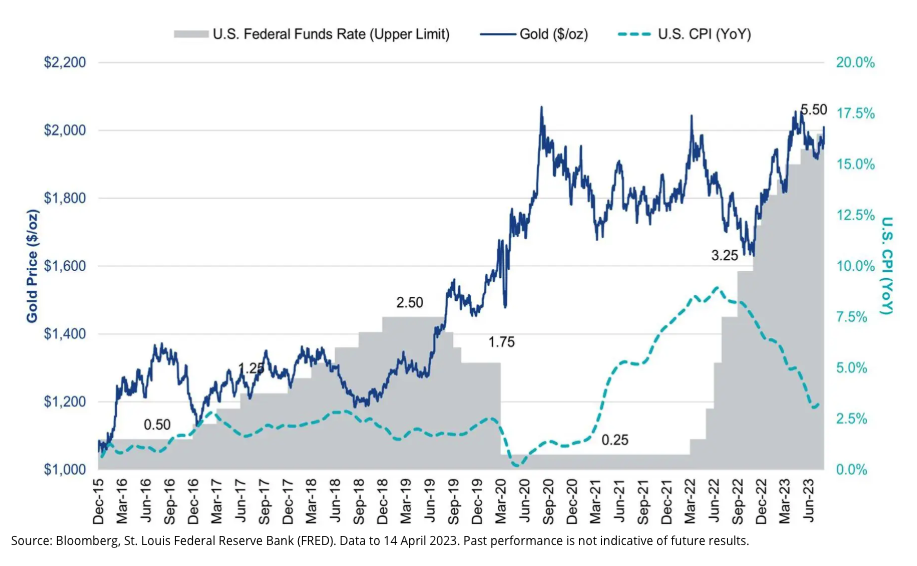
Gold price (dark blue), US inflation rate (blue-green), Fed interest rate (grey). While rising interest rates still caused a dip in 2022, gold and interest rates became increasingly decoupled from the summer of 2022 onwards. Source: VanEck)
What matters, Landsberg Bennett argues in an extensive article, is the difference between nominal interest rates and real interest rates adjusted for inflation. An interest rate of 2.0% simply does little good if inflation is meanwhile 2.5%. You are still losing purchasing power. According to the article, one should therefore look at the course of inflation and interest rates over a longer period. What stands out is that despite the rate hikes from 2022 onwards, real interest rates, adjusted for inflation, only became meaningfully positive with a delay of two years. From 2022 to 2024, the Fed raised its policy rate from nearly 0% to almost 6%. In those same years, gold initially suffered from higher interest rates, but the gold price subsequently rose strongly due to geopolitical tensions. In dollars, gold still fell by -0.43% in 2022, but rose by 13.8% in 2023. In euros, the figures were +5.79% and +10.16% respectively.
The main reason gold is also reacting less strongly to higher interest rates now is central bank buying, Tang of JP Morgan continues: “This in turn supports our view that gold can provide a return pattern that is uncorrelated [with interest rates].”
Several major conferences on platinum and palladium will take place in London next week.
- May 15 – Oxford Platinum Lectures
- May 18 – 19 – Platinum Week 2026 by the LPPM, the LBMA-affiliated London Platinum and Palladium Market
- May 18 – WiPGMs Event
Jeffrey Christian of the leading CPM Group has repeatedly pointed out that these conferences can drive up platinum and palladium prices. Last year, the rally in platinum began after similar conferences reported structural shortages in the platinum and palladium markets. Although Christian disputes whether these shortages really exist, he points out that fear of such shortages can still lead to price increases. He expects platinum traders to speculate on new shortages at the upcoming events.
Would you like to know more about the opportunities in platinum? Then also read the articles written for Holland Gold by analyst Jeroen Vandamme.