English
EN


New attacks on Saudi oil tankers are putting more than just the energy market on edge. The rising oil price is fuelling inflation fears and pushing bond yields in the US and Europe to new highs. What are the consequences for Europe, and what does this escalation mean for gold?
Last week, we wrote that the oil price had risen towards 86 dollars as the conflict in the Middle East escalated once again. This rise continued this week, with a barrel of Brent crude briefly trading above 100 dollars. This happened after the Iran-backed Yemeni Houthis claimed to have attacked two Saudi oil tankers in the Red Sea.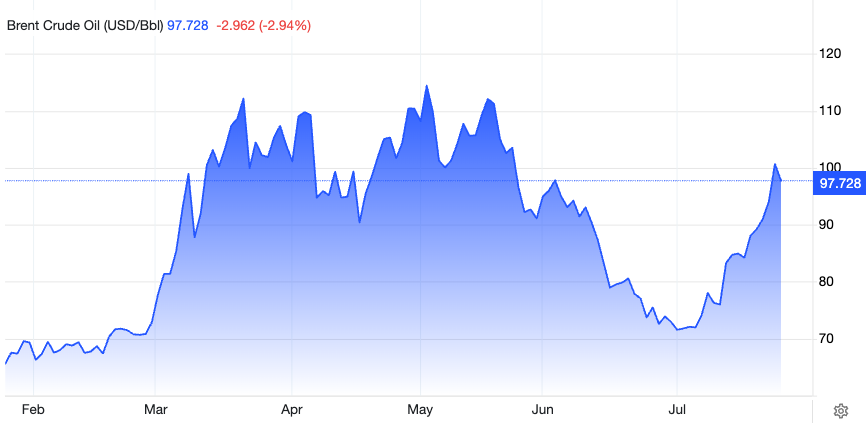
Brent crude oil price performance (source: Trading Economics)
The attacks threaten to bring an end to the four-year-old ceasefire between the Houthis and Saudi Arabia. This means that, in addition to the Strait of Hormuz, shipping through the Bab el-Mandeb Strait is also at risk of disruption. According to the Financial Times, there are concerns that the Houthis will work with Tehran to close Bab el-Mandeb, thereby increasing the pressure on energy markets and global trade.
The Suez Canal, the Red Sea and the Bab el-Mandeb Strait together form the shortest shipping route between Europe and Asia. Before the Houthis launched their first attacks in 2023 in response to the war between Israel and Hamas, almost 10 per cent of global seaborne trade passed through this strait each year. By last year, that share had already fallen to around 3 per cent, as many shipping companies decided to avoid the Red Sea and sail around the Cape of Good Hope instead. This route is thousands of kilometres longer and more expensive and can add two weeks to the journey.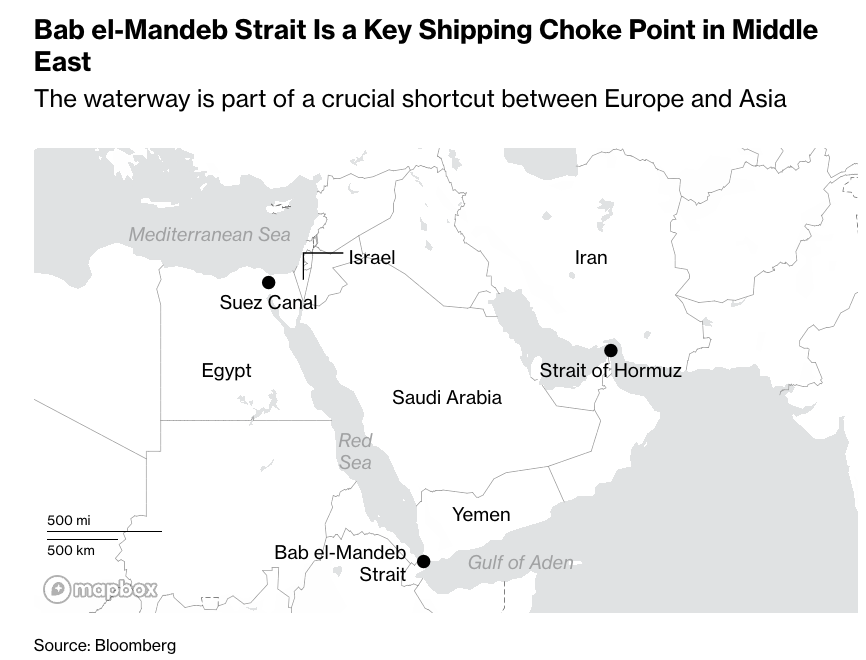
Bab el-Mandeb & Hormuz (source: Bloomberg)
Economist Han de Jong writes today that a barrel of Brent crude and a megawatt-hour of gas in Europe are respectively 64 and 119 per cent more expensive than at the beginning of the year. What stands out to him is that the European gas price is rising much faster than the oil price, while the gas price in the United States is actually falling. As a result, the gas price in Europe is now around seven times as high as in the US, with all the consequences this entails for the competitiveness of European industry.
This is particularly bad news for Dutch consumers, as our gas reserves are very low and need to be replenished ahead of the winter. Norway, our largest gas supplier, warned earlier this week that the Netherlands and the rest of Europe face a ‘vulnerable winter’. According to De Telegraaf, the fill level of the Netherlands’ underground gas storage facilities stands at just 33.4 per cent, the lowest level in Europe.
Meanwhile, oil inventories are falling. According to economist Robin Brooks, however, all this does not mean that the oil price can continue rising indefinitely. He describes it as a race against the clock: the United States must tighten the blockade as quickly as possible and put pressure on the Iranian economy before the global oil price rises too far. Even in the event of further escalation, Brooks expects Brent crude to peak at around 125 dollars per barrel.
The rising oil price is triggering a global sell-off in bond markets, according to the Financial Times. US Treasury yields consequently reached their highest level in eighteen months. The yield on ten-year US Treasuries, which serves as a benchmark for financing costs in global debt markets, rose to 4.71 per cent. Higher oil prices fuel inflation, prompting investors to anticipate higher policy rates and sell existing bonds, resulting in falling prices and rising yields.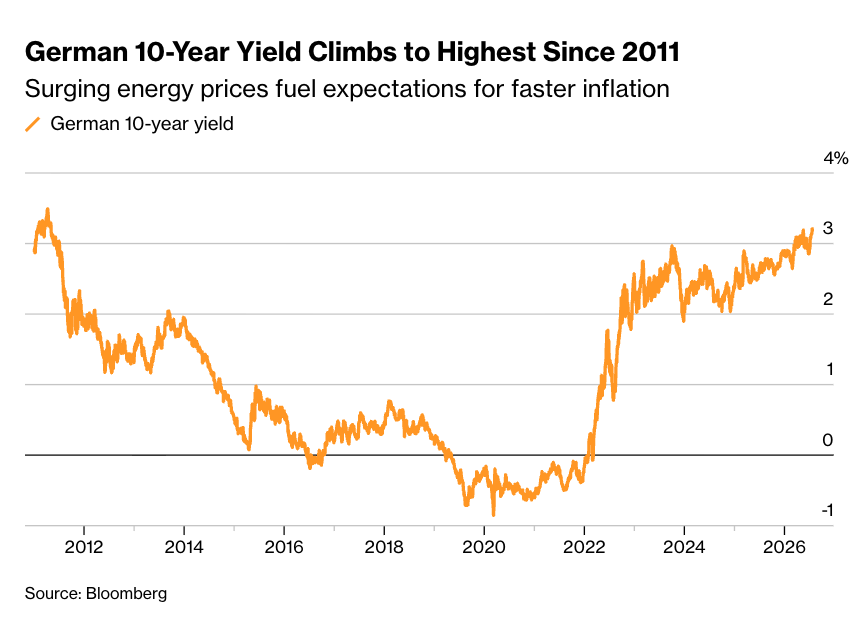
Rise in German bond yields (source: Bloomberg)
European bond yields also rose. Driven by the rising oil price, the German ten-year yield reached its highest level in fifteen years this week. The yield was already under upward pressure because Germany is investing billions of euros in defence and infrastructure and issuing more government bonds to finance this spending.
The French bond yield also rose sharply this week. The yield on ten-year French government bonds even climbed above 4 per cent. “France already had a financing problem, and that problem is becoming increasingly serious,” writes Corné van Zeijl on X, referring to the combination of a rising national debt and increasing interest costs. The market now demands a higher interest rate from France than from Greece.
Earlier this summer, the French finance minister promised to reduce the budget deficit. At the beginning of this month, we explained why this would probably turn out to be an empty promise (and why France is pushing for new European taxes). This week, the IMF also said that it expects the French budget deficit to increase this year.
Higher energy prices slow economic growth, reduce tax revenues and force the government to introduce additional support measures. The IMF does forecast a slight decline in the deficit next year, from 5.2 to 4.9 per cent of GDP, but the question is how realistic that forecast is. France’s high national debt and political paralysis make the country a major risk to the eurozone. We will therefore continue to closely follow developments in the run-up to the French presidential election in April 2027.
In response to rising US interest rates, Jeroen Blokland writes that rates will ultimately have to come down again to keep the growing mountain of debt affordable. This could deliver substantial capital gains for bondholders, but if central banks once again create money on a large scale to achieve this, a new wave of inflation could follow. As a result, investors may lose purchasing power in real terms despite earning positive nominal returns.
This finally brings us to gold. Last week, we explained that rising inflation figures and increasing inflation expectations can put pressure on the gold price, as they increase the likelihood of central banks raising interest rates (whether such increases would be sensible in this case is another question). Interest-bearing investments, such as bonds, then become relatively more attractive compared with gold. We saw this again this week: after rising to more than €117,000 per kilogram on Wednesday, the gold price fell to just over €114,000 per kilogram on Friday.
Despite the rising oil price, gold is so far holding above the important threshold of 4,000 dollars per troy ounce. According to Bart Melek, global head of commodity strategy at TD Securities, the price rise earlier this week was “unusual” given the sharp increase in energy prices following the latest escalation in the Middle East. According to him, the rise during the first half of the week was mainly driven by the closing of short positions and buying following the earlier price decline, after key technical support levels had held. The question now is whether gold will hold firm if the oil price rises further; we will therefore continue to closely monitor this relationship.
On 8 October, Holland Gold is bringing well-known podcast guests to Theater Figi in Zeist for Freedom & Wealth 2026. View the programme and book your ticket for an evening about the future of the Netherlands, Europe and your wealth.