English
EN


Warsh used a lot of words, but said very little. Does he want financial markets to do the Fed’s work? The yield on 30-year US Treasury bonds surged to its highest level since 2007. What does this mean for gold?
The Fed did not raise its policy rate last night (July 29), and the gold price breathed a sigh of relief. Immediately after the announcement, losses in gold and silver turned into gains. The dollar prices of the precious metals rose by 1.7% and 2.88%, respectively.
However, analysts’ comments and the market’s reaction were far from mild. Fed Chair Warsh’s explanation of the interest rate decision was widely viewed as inadequate. Investors are wondering whether Warsh is bluffing with his tough rhetoric on fighting inflation and whether the Fed will actually follow through. Short-term yields plunged, while long-term yields surged to their highest level in nineteen years.
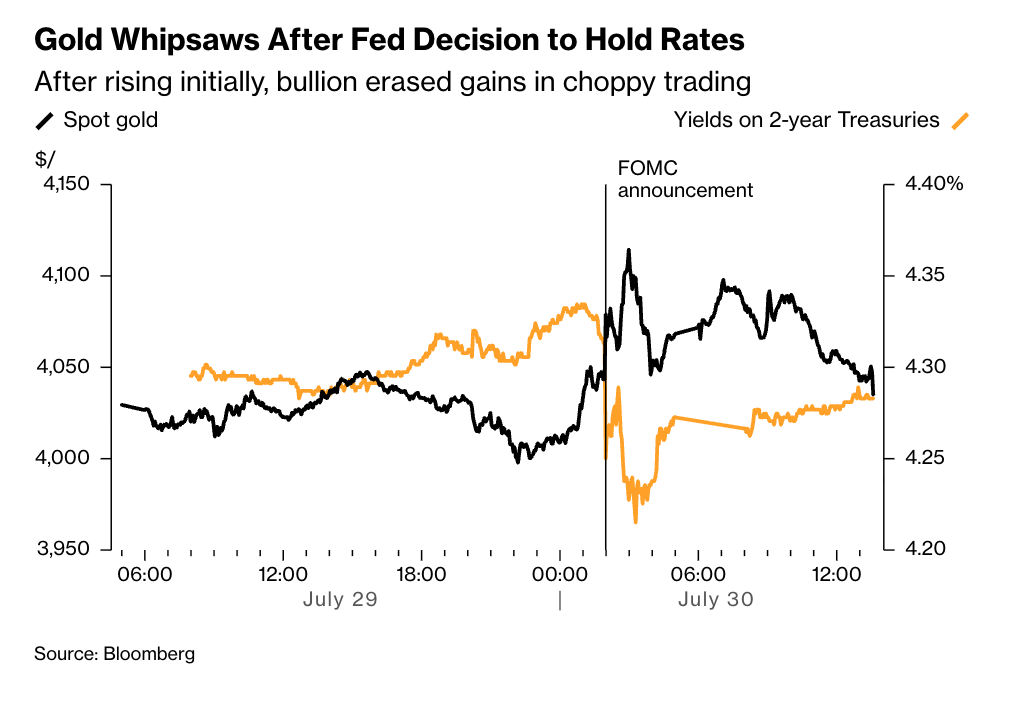
Black line: gold price in dollars per troy ounce. Yellow line: US two-year Treasury yield. The FOMC decision marks the point after which prices and yields reacted sharply. (Source: Bloomberg).
Fed explainer: The Federal Reserve (Fed) is the US central bank and makes a decision on its policy rate eight times a year. More precisely, the decision is made by the Federal Open Market Committee (FOMC), a committee comprising seven governors and five regional Fed presidents. The relevant rate is the federal funds rate, at which banks lend money to one another overnight. This rate for banks effectively determines the ‘price of money’ and feeds through into all kinds of loans, from mortgages to credit cards. Put simply, gold and silver often perform better when real interest rates are lower, because this makes other safe havens, such as bonds, less attractive.
The FOMC once again kept the rate unchanged at 3.50–3.75%, for the seventh consecutive month, in a 9–3 vote. All three dissenting votes came from regional Fed presidents, who wanted to raise the rate by a quarter of a percentage point. Are these three more regionally focused Fed officials seeing something in the real economy that Washington is not yet willing to acknowledge?
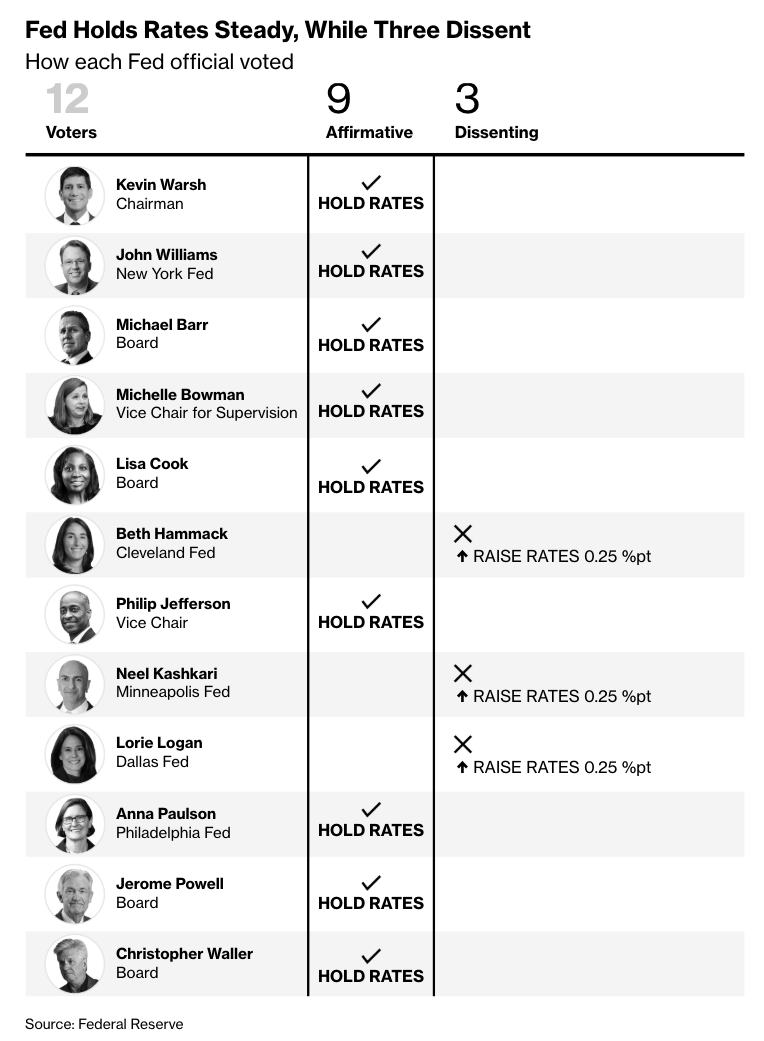
FOMC interest rate vote by individual Fed official (Source: Bloomberg).
The announcement is followed immediately by a press conference, during which analysts scrutinise every word spoken by the Fed Chair. This was the second interest rate decision under Fed Chair Kevin Warsh. He reiterated in forceful terms that the Fed is determined to bring inflation back to its 2% target. He also emphasised that inflation has been too high for five consecutive years.
Unlike his predecessor Powell, Warsh has decided to stop providing ‘forward guidance’, meaning that he no longer offers context or an outlook regarding future interest rate decisions. According to Warsh, markets had become too dependent on the Fed’s messaging and were not thinking enough for themselves. He elaborated on this point at greater length this time. He argued that bond markets had already pushed interest rates higher of their own accord in recent weeks, without the Fed having to lead them by the hand. This is an unusual line of reasoning: Warsh appears to be implying that market forces will resolve the interest rate issue, even though setting monetary policy is precisely the Fed’s responsibility.
No explanation of inflation developments was provided, meaning that the most logical justification for leaving interest rates unchanged was missing. Journalists were met with evasive answers when they asked why rates had not been raised, given Warsh’s emphatic assertion that the Fed would achieve its 2% inflation target.
Markets reacted sharply. Investors are questioning whether the Fed under Warsh will actually take decisive action to curb inflation. He also appears to be shifting responsibility for conducting interest rate policy onto the bond markets. “The press conference damaged his credibility to some extent,” said Stephanie Roth, chief economist at Wolfe Research. “His communication style appears to be backfiring, and the market is calling his bluff.”
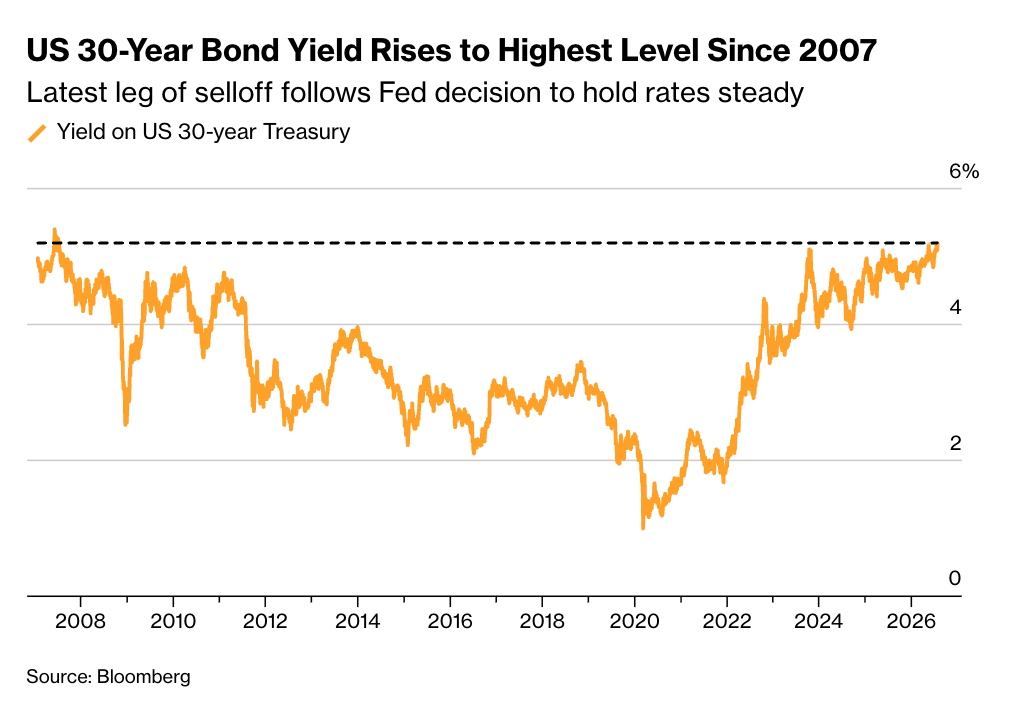
The yield on thirty-year US Treasury bonds rises to its highest level since 2007 (Source: Bloomberg).
The yield on short-term two-year US Treasury bonds fell sharply, while the yield on thirty-year US Treasury bonds rose to 5.23%, its highest level since 2007. These rising long-term yields are relevant because they act as a brake on the economy. This reflects market expectations that the Fed will once again act too late to curb inflation. Shortly after the press conference, markets put the probability of a September rate hike at just 60.4%, compared with almost 78% immediately beforehand.
Is it wishful thinking on Warsh’s part that, in the absence of ‘forward guidance’, the market will resolve the interest rate issue itself? And will the Fed keep interest rates unchanged while investors believe a hike is necessary? Or did Warsh miss the mark with his presentation, causing markets to misinterpret his words?
It probably did not help that Trump told reporters that “[Warsh] would like to see lower interest rates, but he has a board, and it is a political board, and they want to keep interest rates high.” Whether Warsh genuinely wants this remains open to question. This statement, combined with last night’s Fed press conference, has damaged Warsh’s credibility.
Gold could benefit from the erosion of confidence in the Fed. In addition, the absence of an interest rate hike, or even a rate cut, however unlikely, could push the gold price higher. The World Gold Council has calculated that a 25-basis-point decline in the yield on ten-year US Treasury bonds causes the gold price to rise by 1.75%.
Running directly counter to this trend are the escalating tensions in the Middle East. A definitive end to the war between Iran and the United States does not yet appear to be in sight, and oil prices are fluctuating sharply. Gold, silver, platinum and palladium are currently highly volatile as a result of these developments. Persistently higher oil prices and rising inflation could make it unavoidable for the Fed to raise interest rates.
This tension was visible in the hours following Warsh’s press conference. The gold price initially surged, then gave up its gains before beginning to climb again the following day. According to Nicky Shiels, head of research and metals strategy at MKS PAMP SA, the current Fed decision could give investors the green light to return to gold on a larger scale. She regards a gold price of $4,200 per troy ounce as the crucial tipping point. If the gold price breaks through that level, the path higher will be open once again.
On October 8, Holland Gold will bring well-known podcast guests to Theater Figi in Zeist for Vrijheid & Vermogen 2026. View the programme and reserve your ticket for an evening about the future of the Netherlands, Europe and your wealth.
One-third of the tickets have already been sold, so book yours soon!