9.3
8.900 reviews

English
EN


Central banks may have purchased significantly less gold than previously thought. What exactly is behind this, and is gold demand holding up? At the same time, inflation is rising again across the eurozone. Will the ECB raise interest rates?
According to revised figures from the World Gold Council (WGC), central banks purchased far less gold in the first quarter of 2026 than previously thought. Estimated gold purchases were revised down from 244 tonnes to 57 tonnes in the quarter in which the gold price reached a record high. According to the WGC, purchases rebounded sharply in the second quarter, reaching a net 289 tonnes. As a result of the revision, central bank demand in the first half of the year fell to its lowest level since 2022..png)
Central bank gold purchases according to WGC figures (source: Bloomberg)
The Financial Times reports that it has become increasingly difficult to track central bank activity because their purchases are becoming less transparent. Major buyers such as China disclose only a portion of their gold purchases. “These kinds of errors will occur from time to time,” the WGC’s John Reade told the British newspaper.
The figures have become increasingly unreliable in recent years. Since the United States imposed sanctions on Russia in 2022, many emerging economies have disclosed less information about their gold purchases.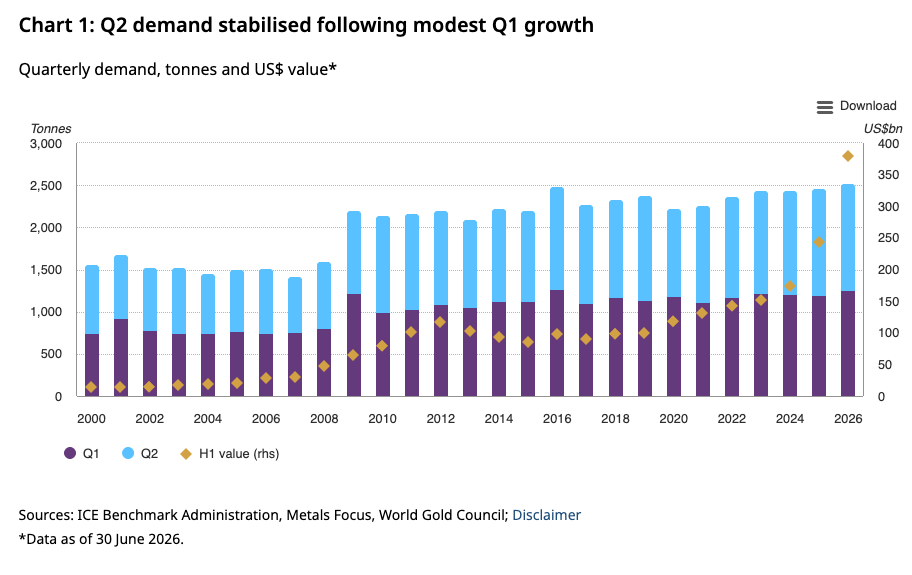
Gold demand in the first half of the year (source: WGC)
According to the WGC, total gold demand is holding up for now. It reached 2,522 tonnes in the first half of the year, 2% more than a year earlier. Due to the higher gold price, the value of that demand rose to a record $380 billion.
The WGC expects investment demand, supported in part by Asian buying and demand in the OTC market, to remain the main growth driver in the second half of the year. Central banks once again appear to be buying substantial amounts of gold, although their purchases will probably be lower than in 2025.
Your euro is still losing purchasing power. Inflation reached 3.1% in July 2026, according to a flash estimate published today by Statistics Netherlands (CBS). In June, inflation was still 2.9%, having fallen compared with May. Energy and motor fuel prices rose particularly sharply, increasing by almost 10% compared with a year earlier. Last week, we wrote about how the further escalation in the Middle East is affecting financial markets.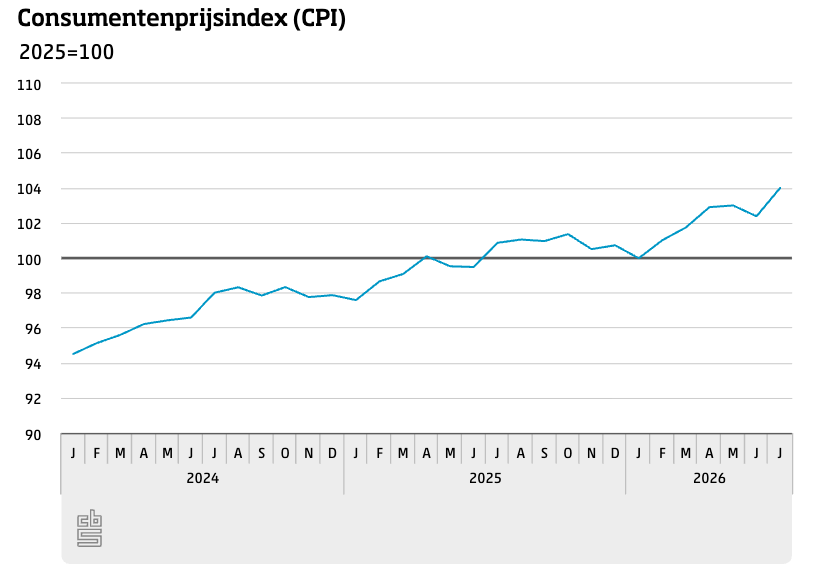
CPI developments since 2024 (source: CBS)
The decline in inflation also proved short-lived in the eurozone. The average inflation rate edged up again in July, from 2.8% to 2.9%. There were striking differences between eurozone countries. Lithuania recorded the eurozone’s highest inflation rate in July at 5.6%, followed by Bulgaria at 4.1% and Cyprus at 4.0%. This was considerably higher than in Estonia (2.0%), Malta (2.1%) and France (2.4%). Even in these countries, however, inflation was at or above the ECB’s 2% target.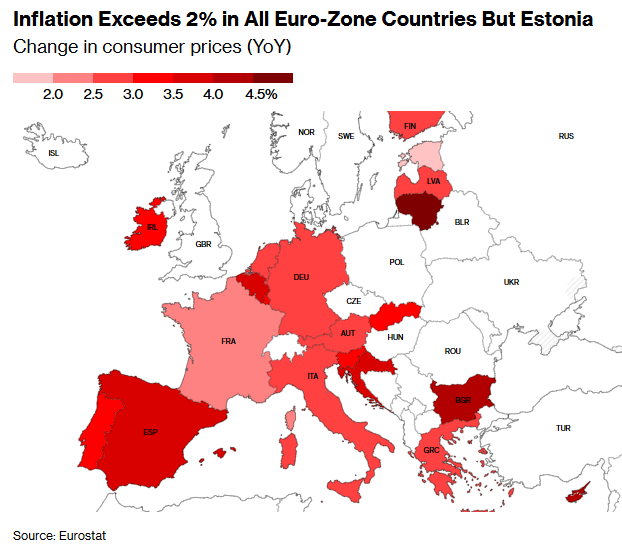
Eurozone inflation (source: Bloomberg)
This raises the important question of what the ECB will do with interest rates in the coming period. “Today’s figures and developments in the Middle East throughout July clearly put the ECB on course for an interest rate hike in September,” Kamil Kovar of Moody’s Analytics told Bloomberg. One more set of inflation figures, covering August, will be released before the next interest rate meeting.
Lithuanian central bank governor Gediminas Šimkus considers the likelihood of an interest rate hike much greater than the likelihood of rates remaining unchanged. His Slovak counterpart Peter Kažimír went a step further: according to him, the ECB should raise interest rates at least once, even if the situation improves somewhat.
We will, of course, continue to monitor these developments closely!
On 8 October, Holland Gold will bring well-known podcast guests to Theater Figi in Zeist for Freedom & Wealth 2026. View the programme and reserve your ticket for an evening about the future of the Netherlands, Europe and your wealth.


