English
EN


In times of geopolitical tensions, gold typically acts as a safe haven for financial markets, but the current war in the Middle East is having a very different effect. Precious metals are being hit from two sides: 1. markets expect potentially higher interest rates from central banks and 2. liquidity problems among investors, forcing them to sell gold to cover losses. The turning point was not so much the closure of the Strait of Hormuz, something that could have been easily reversed if the war ended. Instead, the reciprocal attacks on gas and oil installations in the Gulf region and Iran are causing long-term damage. As a result, this oil crisis could last much longer than initially expected. In this article, we explain the background.
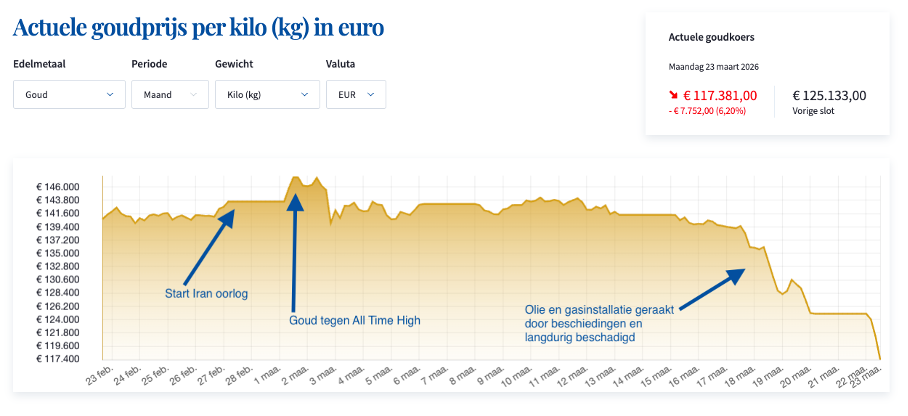 Gold price remained stable during the closure of the Strait of Hormuz, only afterward
Gold and silver prices rose sharply on the first day after the weekend in which Iran’s supreme leader Khamenei was eliminated. Since then, the metals have declined significantly. The war between Israel and the U.S. against Iran has escalated rapidly. The Strait of Hormuz has been closed, cutting off 20% of global oil production. Gulf states have several options to reroute oil, such as transporting 5 million barrels via pipelines in Saudi Arabia to ports on the Red Sea. This still leaves a shortfall of 15 million barrels. Some analysts describe this as a potentially more severe crisis than the oil crisis of the 1970s. Others argue that Western economies are less dependent on oil than they were back then, and therefore the damage may be less severe.
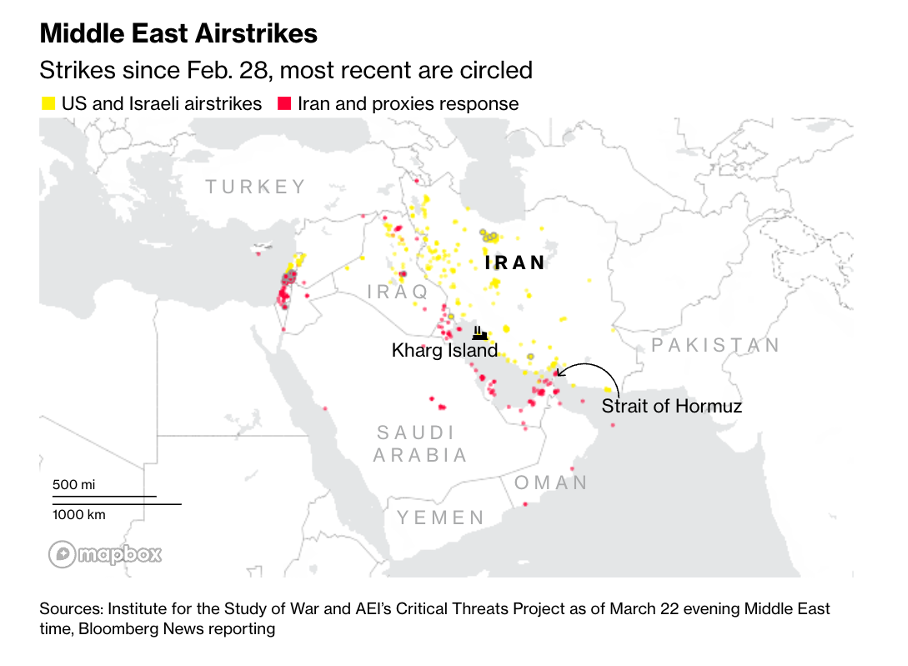 Overview of reciprocal attacks, yellow by the U.S. and Israel, red by Iran. Source: Bloomberg
The immediate effect is rapidly rising oil prices. Markets initially seemed to expect that once the Strait of Hormuz reopened, stability would quickly return. However, this expectation has changed in recent days. Ongoing attacks have damaged gas and oil installations in Iran and the Gulf states. Key gas facilities affected include the Iranian South Pars installation and Qatar’s Ras Laffan. Ras Laffan alone accounts for one-fifth of global LNG production. Meanwhile, more than 40 installations in the region have been damaged. Repairs can take several years. Oil and gas facilities are already hazardous under normal conditions, let alone when targeted during war. The result is a long-term disruption in oil and gas production. Whether the Strait of Hormuz reopens or not, reduced production capacity remains. This is pushing oil prices to new highs and suggests this oil crisis could last much longer than initially assumed.
Back to precious metals. High oil prices may trigger an inflation wave, which in turn could lead central banks to raise interest rates. The Fed and the ECB have kept rates unchanged in recent decisions, largely due to uncertainty. If the conflict had ended quickly and the Strait of Hormuz reopened, the oil shock would likely have been temporary. Central banks typically raise rates to slow the economy and bring inflation down. However, a supply shock like an oil shortage is a very different cause of the same symptom: inflation. This puts central banks in a dilemma: should they raise rates to fight inflation or lower them to stimulate an economy weakened by the oil crisis?
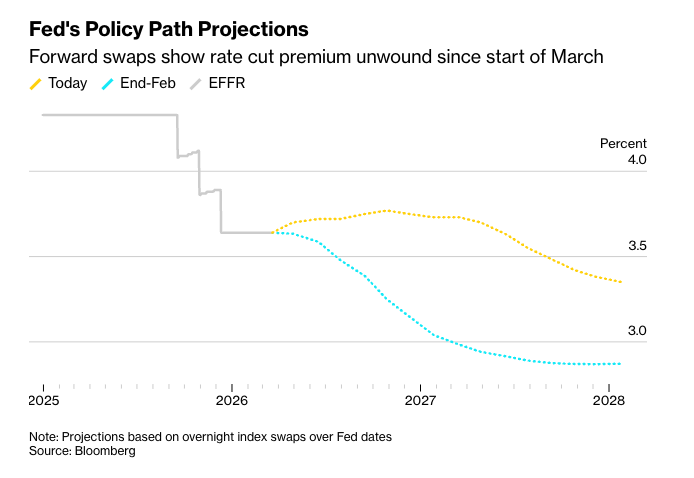 Fed interest rate expectations: in blue the expected rate as priced in by markets at the end of February. The yellow line shows expectations since the outbreak of the Iran war. Source: Bloomberg
In any case, gold and silver are declining due to rising rate expectations. Precious metals tend to become more attractive when interest rates are low, as they compete better with bonds and other interest-sensitive investments. The opposite is now happening.
Another consequence of higher rate expectations is rising borrowing costs for companies. Additionally, higher oil prices have pushed global stock markets into the red, especially in Asia where the impact is strongest. This region is the most dependent on Middle Eastern oil and gas. This also has major implications for investors in the wealthy Gulf states and Asia. Investors from China, India, and the Middle East have traditionally been major buyers of gold and silver. Now that they are facing losses, they are turning to their reserves: precious metals.
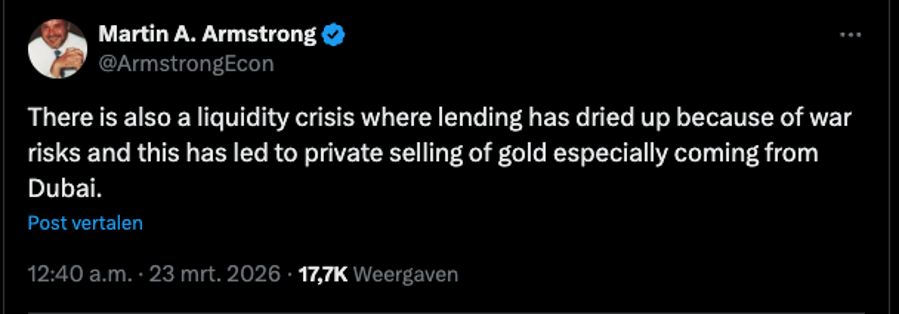 “There is also a liquidity crisis where lending has dried up due to war risks, leading to gold sales particularly by investors from Dubai,” says M.A. Armstrong on X.
As in 2008, we see that during liquidity stress gold can temporarily decline. However, the long-term outlook remains strong due to structural concerns about the sustainability of the dollar as the global reserve currency in a changing world order with increasing influence from BRICS countries. Many major currencies and economies, including the eurozone, are also burdened by excessive debt. As a result, interest rates cannot rise too much, and central banks will likely have to return to low rates and quantitative easing to prevent systemic collapse. This is all positive for gold. Silver is expected to follow gold with some delay.
Paul Buitink, CEO of Holland Gold: “We currently see roughly equal numbers of buyers and sellers. Sellers are taking profits after the strong rise in precious metals over the past year. Buyers are trying to take advantage of a bottom. Our long-term outlook for gold and silver remains positive, but we always advise investors to remain cautious and diversify their portfolios.”
For some investors, lower prices present a good buying opportunity. For others, it may be important to sell precious metals to prevent further losses in their portfolio. If you wish to sell your gold or sell silver, please contact us by phone to lock in your price. Buying or selling precious metals can be done easily 24/7 via the Holland Gold app on your precious metals account. You can also easily order gold coins and gold bars directly through our website, delivered safely and insured to your home. We also offer various secure storage options in the Netherlands, Switzerland, and Singapore. If you would like advice, feel free to call or email us.