English
EN


The energy crisis is beginning to spread globally. Shortages of fuel and raw materials are disrupting production and supply chains, while Europe is moving ever closer to an energy shortage. At the same time, the risk of stagflation is rising rapidly. What will happen to the European economy?
This week, the first reports are emerging on social media about the global consequences of the energy crisis. In Thailand, shortages are leading to price increases and, according to reports, to chaotic scenes, with people rushing en masse to obtain fuel. Thai farmers and fishermen are also being severely affected as they are unable to obtain diesel. As a result, food production in one of the world’s largest exporters of products such as rice, sugar, and canned and processed fish is coming under pressure. This is further exacerbated by problems in the fertilizer market. The Persian Gulf is a key hub for global fertilizer production and exports.
Australia is also facing fuel shortages. According to various reports on social media, hundreds of gas stations no longer have fuel available. The first images of stranded truck drivers are an ominous signal: once transport comes to a halt, supply chains are disrupted as well. On Friday, the Australian government announced an emergency measure. For the first time in decades, the country ordered ‘emergency fuel’ from the United States.
Reuters reports that industrial production in Asia is also under pressure. This is due to shortages of raw materials, particularly oil derivatives such as naphtha, which mainly come from the Gulf region and are essential for refineries to produce plastics and other petrochemical products that are used in virtually every industrial good. Consumers anticipating price increases have already begun hoarding oil-related products, such as garbage bags and food in plastic packaging, such as noodles. Microchip production may also face problems, as a significant portion of the helium used in the process originates from the Persian Gulf.
Europe must also prepare for similar scenarios. According to Wael Sawan, CEO of Shell, the continent could face energy shortages as early as April. And he is not alone in this warning. Germany’s Minister for Economic Affairs, Katherina Reiche, also stated that shortages in the energy supply could emerge in late April or May if the conflict continues. She called the phase-out of nuclear energy a major mistake and sees LNG as an important part of the solution. However, LNG supply also appears to be disrupted in the coming period.
France’s Minister of Finance, Roland Lescure, said on Wednesday that between 30 and 40 percent of refining capacity in the Gulf region has been damaged or destroyed. This has created a shortfall of 11 million barrels per day in the global oil market. Even in the event of a ceasefire, that supply will not return quickly. It could take up to three years for the damaged facilities to be fully restored.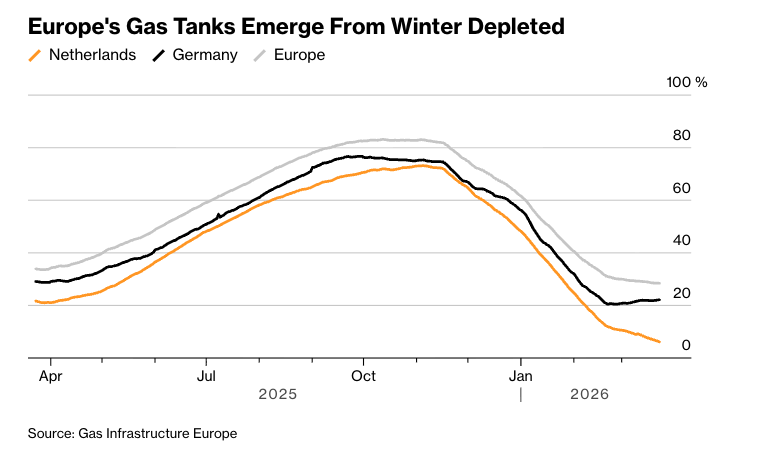
European gas reserves (source: Bloomberg)
European gas prices have risen by around 70 percent this month to approximately €54 per megawatt hour. At the same time, the end of the winter season is approaching. This means that gas storage levels, which are currently exceptionally low, will need to be replenished in the coming months at significantly higher prices. In the Netherlands, reserves are the lowest, with a fill level of just 6 percent.
According to Goldman Sachs, prices could rise further in the second quarter to around €72 per MWh, as Europe and Asia compete for the same LNG cargoes. In a more severe scenario, where damage to infrastructure in Qatar proves more prolonged, gas prices could exceed €100 per MWh during the summer months, when storage must be refilled for winter. If the Strait of Hormuz were to be closed for six months, prices could rise to €145 to €240 per MWh, according to Swedish bank SEB, making it virtually impossible to refill storage for the next winter.
According to analysts, the oil price could rise to $200 per barrel if the war continues until June. They estimate the probability of this scenario at around 40 percent. That would amount to nearly a doubling compared to the current price level. Larry Fink, CEO of BlackRock, warned in an interview with the BBC that a persistent threat from Iran and prolonged high oil prices could lead to a global recession.
Christine Lagarde, President of the ECB, said this week that financial markets are still underestimating the severity of the situation. She warned that the shock from the Iran war is “greater than we can currently imagine.”
In the week selection of March 6, we already wrote that a prolonged conflict with Iran could result in an economic disaster for Europe. That scenario now appears to be gradually unfolding. Germany now fears a halving of economic growth in 2026 due to the Iran crisis. Inflation in Spain has risen to its highest level since June 2024 due to the war. Spain is the first major eurozone economy to publish inflation figures this month. Figures for the entire eurozone are expected on March 31. Stagflation, a situation of high inflation and stagnant growth, is becoming increasingly likely in Europe.
Not every country has an economic interest in a swift end to the war. Robin Brooks concludes that a longer war could actually be economically beneficial for oil-exporting Saudi Arabia.
Russia has abandoned plans to significantly lower its growth forecast for 2026, as the war with Iran is boosting oil revenues. The government is also no longer planning major cuts to the federal budget and is even considering higher defense spending if the war in Ukraine continues. Russia is therefore clearly benefiting from the disruptions in the Gulf region.
Putin is positioning Russia as a reliable energy partner and this week told Europeans that the country is ready to supply oil and gas. While the German military association is calling for a war economy due to the threat from Russia, Putin emphasized that he could resume gas deliveries to Berlin as early as tomorrow if requested. The Russians appear to expect that Europe will eventually beg for Russian oil and gas.
How long the conflict will last remains uncertain, but a key factor to watch is Israel’s capacity to continue fighting. Kees de Kort predicted this immediately after the start of the war in our podcast.
An Israeli military official warns that the armed forces are overstretched. Reports indicate a shortage of combat troops. At the same time, Israel and the US are running low on interceptor missiles, putting defensive capabilities under pressure.
Finally, a brief note on gold. We previously wrote that the decline in the gold price can partly be explained by an increasing need for liquidity. In times of heightened uncertainty, market participants tend to seek cash. This week it became clear that Turkey has been a notably large seller.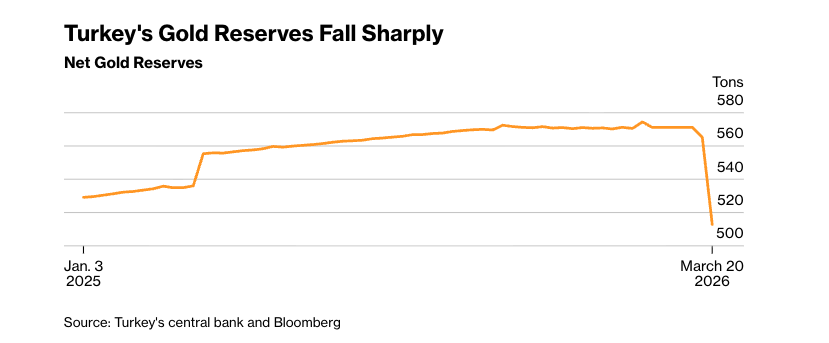
Turkey’s gold reserves (source: Bloomberg)
The central bank of Turkey sold and swapped approximately 60 tonnes of gold in the two weeks following the outbreak of the war with Iran, with a total value exceeding $8 billion. This was done to provide liquidity and stabilize domestic demand, according to Bloomberg. To be continued!
Also take a look at our YouTube channel
On behalf of Holland Gold, Paul Buitink and Yael Potjer interview various economists and macroeconomic experts. The aim of the podcast is to provide viewers with better insight and guidance in an increasingly fast-changing macroeconomic and monetary landscape. Click here to subscribe.