English
EN


Gold fell nearly 3.3 percent in dollar terms yesterday after the opening of U.S. markets, an exceptionally large market correction. Equities and crypto also turned red. All of this was linked to the war surrounding Iran, but there was more at play. What should have been a dull Fed press conference proved anything but. The U.S. central bank left interest rates unchanged, but Chairman Powell, with a subtle response to Trump’s pressure on his office, had all journalists on the edge of their seats. What is the connection between all these developments, and why did the gold price fall?
Financial markets run on sentiment and expectations. Few things appear as important in that regard as the interest rate decision of the Federal Reserve (Fed), the U.S. central bank. Alongside its rate decision, the Fed also provides guidance on its outlook for the economy. The fact that the Fed kept rates unchanged yesterday at 3.5 to 3.75% went against earlier expectations. Or rather, against expectations that prevailed before the war between Israel, the U.S. and Iran. Markets had previously been pricing in possible rate cuts. Lower interest rates tend to benefit gold, because in a low-rate environment gold becomes relatively more attractive than simply holding bonds or currencies that yield less interest.
The Fed does not cut rates without reason: it usually does so to stimulate the economy when growth weakens. That is precisely the type of moment when gold prices can rise. The expected rate cut had already been priced into the gold price, and now that it suddenly failed to materialize, gold fell, as did crypto.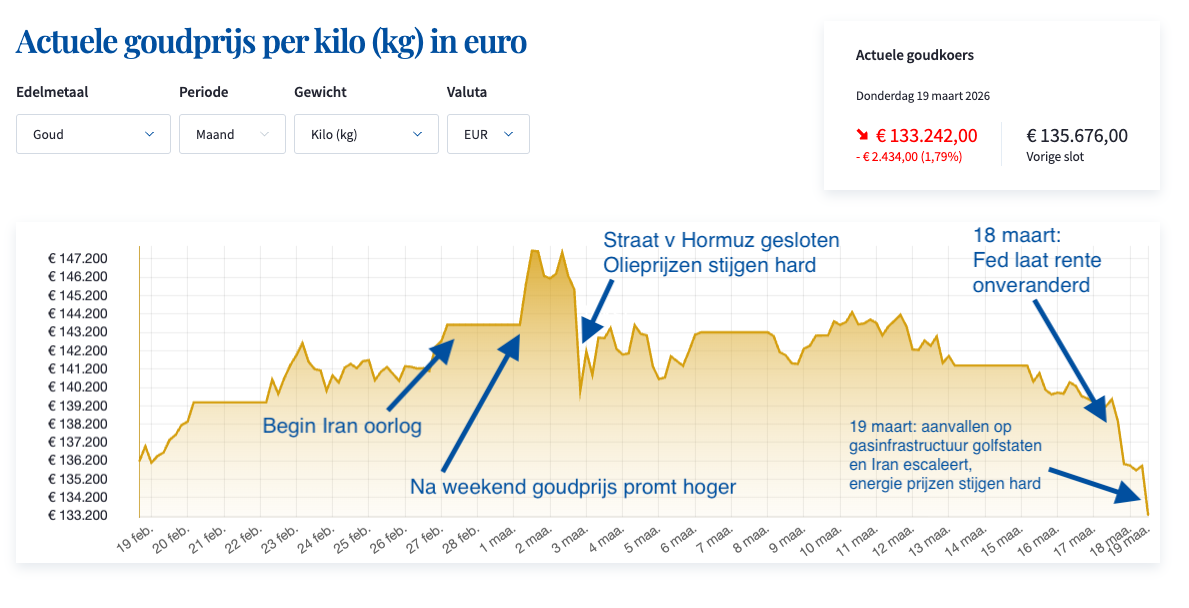
Gold price movement since the beginning of the war against Iran
Gold is considered a safe haven in times of geopolitical tension, so it would seem logical for gold prices to rise when a conflict breaks out between America and Iran after decades of mounting tensions. For that reason, gold initially rose shortly after the outbreak of the new war. After that, however, it began to decline steadily. This is because markets began to expect that elevated oil prices would persist for a longer period. Higher oil prices mean more inflation, and therefore also a Fed that is likely to keep interest rates high in order to fight that inflation.
The situation in Iran does not appear to be nearing an end for now. Although it was initially expected to be a short conflict, Trump indicated that it would take at least five weeks. Meanwhile, analysts see a risk that the conflict may last much longer. The reasoning is as follows:
Iran can block the Strait of Hormuz using relatively cheap drones and mines. Around 20 percent of global oil production passes through this strait. The fact that the strait is already effectively closed is pushing oil prices sharply higher, along with prices at the pump. In addition, oil and gas facilities inside Iran are being hit, while Iran in turn is targeting facilities in the Gulf states.
Trump may believe he can end the conflict at any moment, but Iran may not allow that. Analysts fear that Iran could sustain this form of guerrilla warfare in the Gulf region for a long time, which would make continuation of the war necessary in order to reopen the Strait of Hormuz. In addition, other analysts expect that the Iranian regime has been pushed so far into a corner that it may have no option but to keep fighting until the end.
This dangerous combination means the conflict in the Middle East may last much longer than expected. That also implies elevated energy prices for a prolonged period, pressure on inflation, and stress on financial markets. Higher inflation means higher interest rates. Initially, that is negative for gold.
But as Jeffrey Rosenberg of BlackRock told BloombergTV, high oil prices lead to more inflation in the short term, but over the longer term they slow the economy to the point where the Fed may once again be forced to cut rates to support growth. That would in turn be positive for gold.
Fed Chairman Powell’s press conference took several unexpected turns. First, the main takeaways:
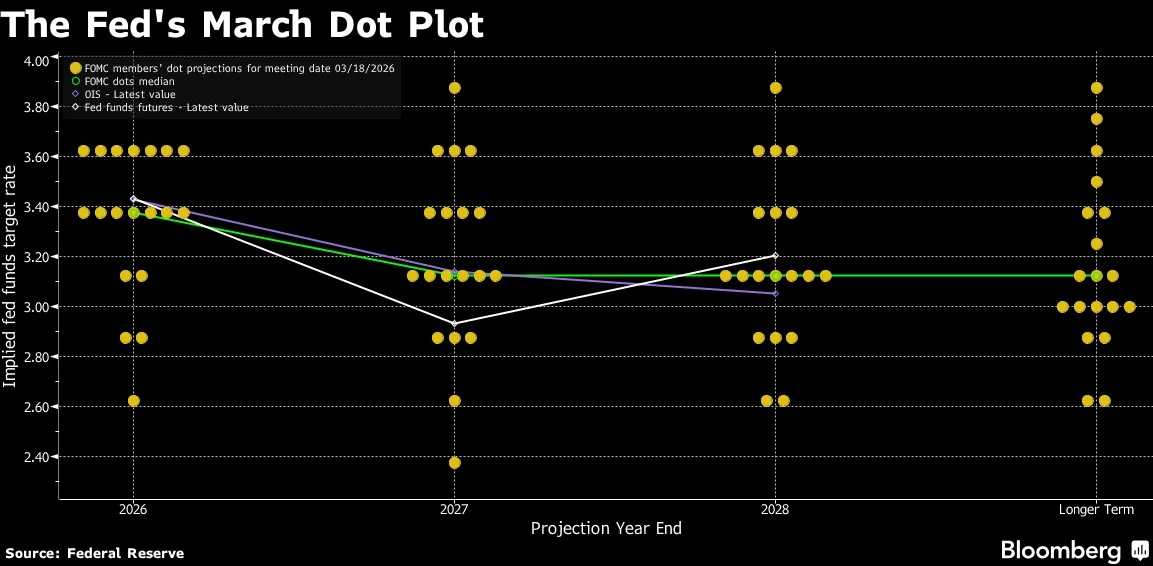 The dot plot shows with dots how different Fed members expect to vote on interest rate levels in 2026, ’27 and ’28. (source: Bloomberg)
Although Powell always expresses himself in highly factual terms, his remarks appeared clearly directed at Trump, while also defending the office of the independent central banker. The notable moments from the press conference:
What he meant by this is the following: Trump has been pressuring the Fed chairman for some time to lower rates. When Powell did not comply, the U.S. Department of Justice suddenly launched an investigation into his possible corrupt role in the renovation of the Fed headquarters. Financial markets interpreted this as a direct attack by Trump on the independence of the Fed. This triggered such anger that Republican senator Thom Tillis vowed to block the appointment of Trump’s preferred new Fed chairman, Kevin Warsh, for as long as pressure on Powell continues.
Powell’s resistance to Trump’s pressure is also relevant for gold prices. On the one hand, Trump’s attack on Fed independence is a reason for financial markets to move toward gold. On the other hand, Trump is pushing for rate cuts, which would also support gold prices. Powell’s resistance, and the resulting possible delay in Kevin Warsh’s appointment, appears instead to safeguard Fed independence and reduce the likelihood of politically driven rate cuts — which in turn may weigh on gold prices.
Also take a look at our YouTube channel
On behalf of Holland Gold, Paul Buitink and Yael Potjer interview economists and macroeconomic experts. The aim of the podcast is to give viewers more perspective and guidance in an increasingly fast-changing macroeconomic and monetary environment. Click here to subscribe.