9.3
9.038 reviews

English
EN


Is the energy crisis the starting signal for a major European recession? Europe’s economic challenges have of course been present for quite some time and are often the result of its own policies; for example, revisit this weekly selection on the subject. Now, as a result of the war in Iran, yet another economic shock is being added on top of that. What can we expect in the period ahead?
It takes time before higher energy prices fully filter through the economy. Economist Han de Jong published an article this month, Silence Before the Storm, in which he writes that nearly all published macroeconomic figures still relate to the period before the rise in energy prices.
Meanwhile, more and more alarming reports are emerging for the European economy. Han also notes that gloomy reports often receive more attention than positive ones. It is good to be aware of that before drawing overly hasty conclusions from the reports below.
The PMI (Purchasing Managers’ Index by S&P Global) is an important monthly indicator that measures the state of the economy based on surveys among purchasing managers. These purchasing managers have good insight into matters such as production, new orders and developments in employment. A reading above 50 indicates growth, while a reading below 50 points to contraction.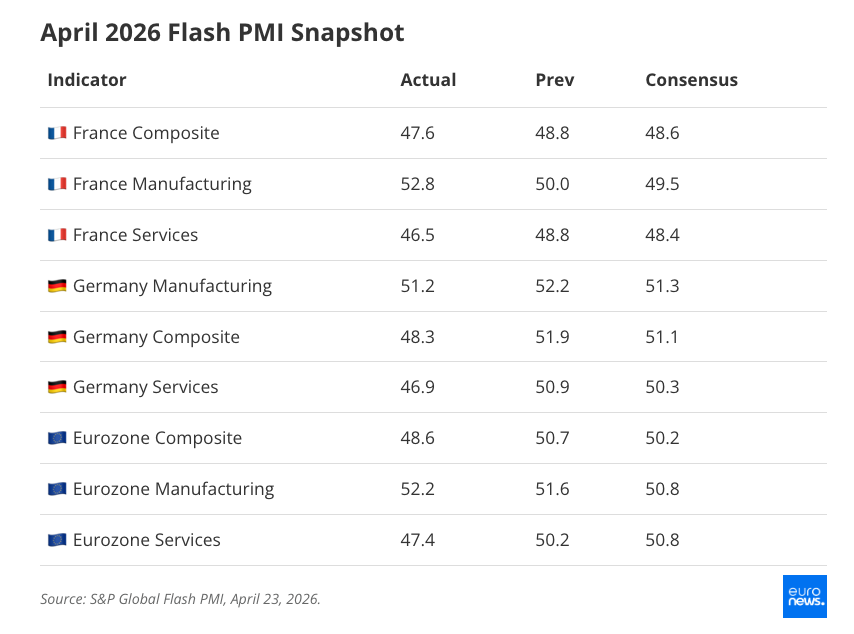
Eurozone PMI April 2026 (source: Euronews)
The composite PMI for the eurozone fell to 48.6 in April, compared with 50.7 in March. This brings the index to its weakest level in roughly a year and a half. For the services sector, it was even the weakest reading since the coronavirus lockdowns of 2021, clearly signalling contraction.
The manufacturing PMI did rise, but gives a distorted picture. Companies in the eurozone are currently ordering additional raw materials and components in anticipation of expected shortages and further price increases. “The eurozone is facing mounting economic problems due to the war in the Middle East. The conflict pushed the economy into decline in April while inflation is rising sharply,” said Chris Williamson, chief economist at S&P Global Market Intelligence.
Stagnating economic growth combined with high inflation is what we call stagflation, and according to Euronews, we are now seeing an unmistakable signal of it. Both input costs and selling prices are rising rapidly, while every major European economy is disappointing in terms of growth. Politico writes that the European economy is becoming increasingly trapped by a toxic combination of stagnating growth and sharply rising prices.
The IMF lowered its European growth forecasts this week. Without the war, those growth expectations would actually have been raised. Expected eurozone growth for 2026 now stands at just 1.1 percent, and 1.3 percent for the EU as a whole.
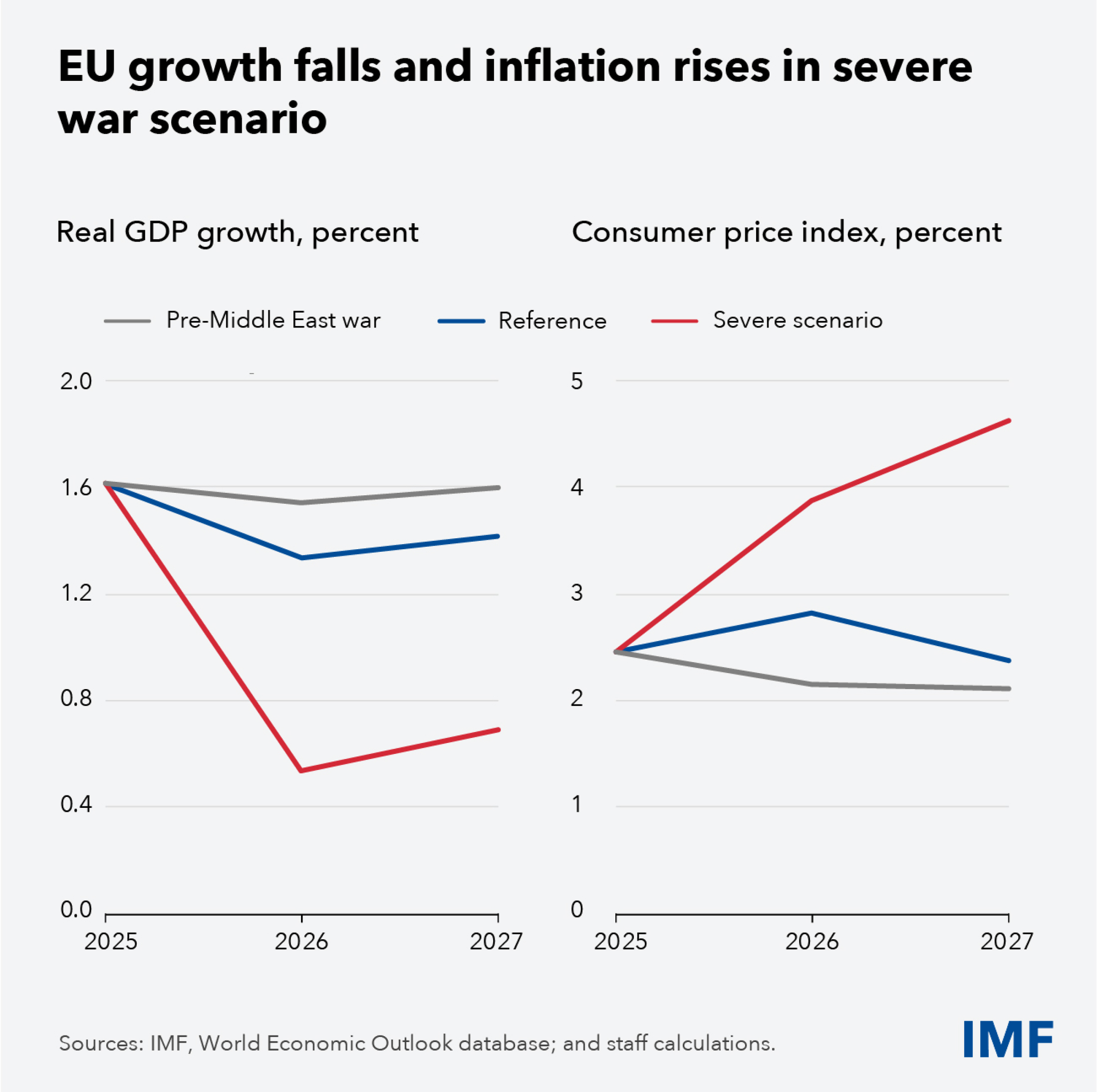
Growth and inflation figures including severe scenario (source: IMF)
These are still relatively mild figures, but the IMF writes that there is a high degree of uncertainty surrounding this forecast. In a more severe scenario, in which the supply shock persists and financial conditions tighten, the EU could come close to recession and inflation could rise toward 5 percent.
The IMF sees clear differences between countries and governments in their ability to absorb this shock. Thanks to their much lower debt ratios, countries such as Denmark, Sweden and also the Netherlands can support their economies more easily than countries with higher debt ratios, such as Italy and France.
But the former group of countries will also face mounting pressure from higher defence spending, ageing populations and the energy transition. The IMF also notes that government bond yields in various markets have already risen.
If we zoom in on reports concerning Europe’s most important economy, the outlook does not become any brighter. The risk of Germany falling into recession has increased sharply due to the war in Iran.
The monthly business cycle indicator of the Institut für Makroökonomie und Konjunkturforschung (IMK) showed a recession probability of 33.5 percent for the second quarter, compared with 11.6 percent at the start of March. The indicator also shifted for the first time since October from “yellow-green,” indicating moderate growth, to “yellow-red,” signalling elevated economic uncertainty.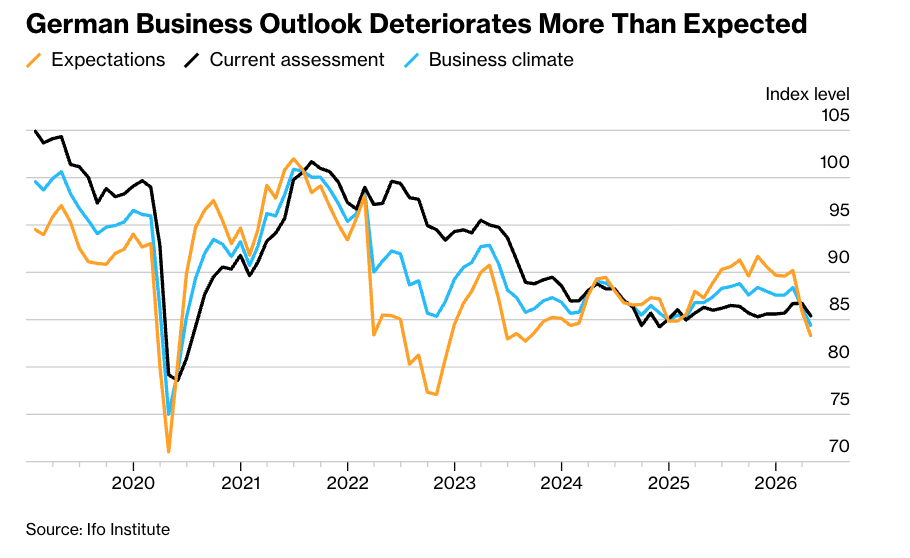
German business expectations index fell faster than expected (source: Bloomberg)
The outlook for German business has also deteriorated sharply. The expectations index of the Ifo Institute fell to 83.3 in April, compared with 85.9 a month earlier. “Companies are significantly more pessimistic about the coming months,” said Ifo President Clemens Fuest in a statement on Friday. “The German economy is being hit hard by the crisis surrounding Iran.”
Germany’s Ministry of Economic Affairs in Berlin announced on Wednesday that it had halved its growth forecast for this year. According to the new projections, the economy will grow by only 0.5 percent this year. The forecast for next year was also revised downward: from 1.3 percent to 0.9 percent.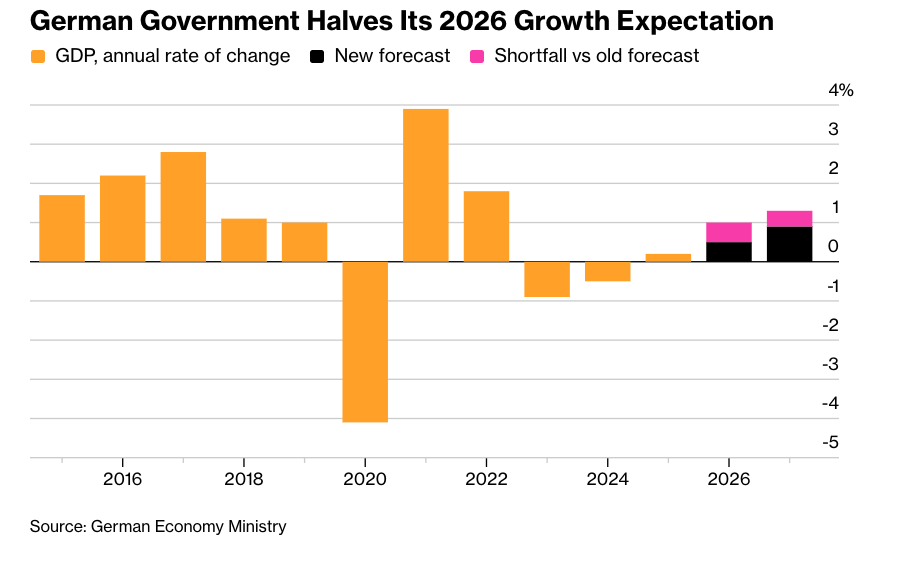
Germany growth forecasts halved (source: Bloomberg)
The conflict in the Middle East is a major blow to Germany, but not the country’s biggest economic problem, as we read at Reuters. Germany’s economy has seen virtually no growth for six years and has structurally underperformed the rest of the EU in recent years. Over the past five years, German growth lagged the EU average by 1.8 percentage points per year.
There are several reasons why the German economy, so important to the Netherlands, is lagging behind. Energy costs remain high due to the nuclear phase-out, the energy transition and the loss of cheap Russian gas after the conflict in Ukraine. In addition, Germany’s labour force is shrinking because of ageing demographics. According to Destatis, the number of people aged between 20 and 66 will decline from 51 million in 2024 to 41 million in 2070. On top of that, Germans already work the fewest average hours per employee per year within the OECD.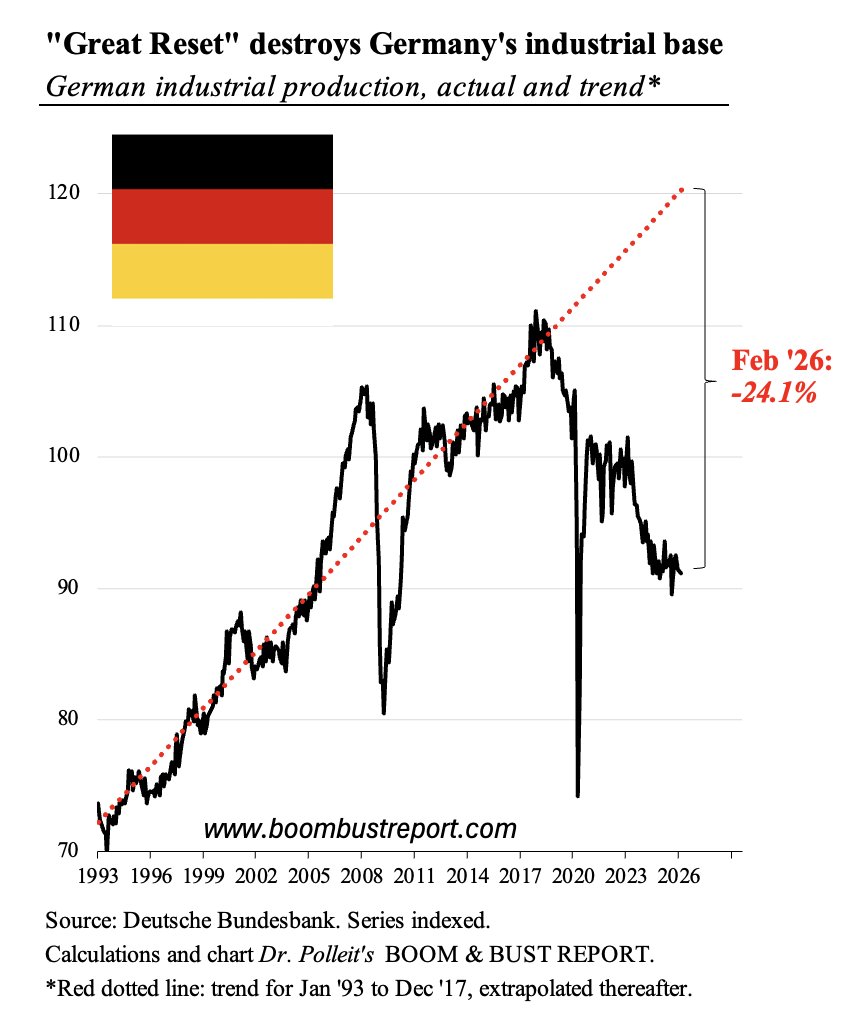
German industrial production is now 24 percent below its (former) long-term trend (source: Thorsten Polleit)
The situation is further worsened by low investment and weak productivity growth, two other important drivers of economic growth. Productivity is even expected to continue declining by around 0.1 percent per year in the coming years. Public investment is on the agenda, but any revival is likely to proceed slowly. Governments do not everywhere have sufficient implementation capacity to spend the money quickly and effectively, while plans also risk becoming bogged down in the abundance of rules and bureaucracy that has long stifled the economy.
How long the situation in the Middle East continues remains crucial for the scale of the blow to the European economy and the inflation wave, as we already concluded in early March. It is also becoming increasingly clear that the energy market will remain disrupted over the longer term. Even if the Strait of Hormuz reopens, the situation could still deteriorate for months before any real improvement occurs. On top of that, Europe begins implementing its ban on Russian gas imports this weekend.
This energy crisis comes on top of the economic challenges Europe was already facing. Stagflation appears increasingly likely, and the expectation is therefore that much gloomy economic news will follow in the months ahead.
Also take a look at our YouTube channel
On behalf of Holland Gold, Paul Buitink and Yael Potjer interview various economists and macroeconomic experts. The goal of the podcast is to give viewers a better understanding of and guidance within an ever more rapidly changing macroeconomic and monetary landscape. Click here to subscribe.