English
EN


From 1 July, ABN Amro will extra charge for cash withdrawals. If you want to withdraw more than €10,000 in cash per year, you have to pay €5 per transaction for the amount above that limit, plus half a percent of the amount withdrawn. For depositing, the bank will charge a fee of €5 per transaction plus 1% of the deposited amount from €10,000. At the moment, that is still half a percent of the deposited amount. By increasing these costs, the bank is actively trying to discourage the use of cash.
The same rates apply to students and young people, but the limits are much lower at €6,000 and €2,000 respectively. The bank will inform customers when they are at 50%, 75% or 95% of this limit. Consumers who prefer to use cash and entrepreneurs who receive a lot of cash will therefore be saddled with higher costs as a result of this adjustment. ABN Amro is taking this measure to discourage the use of cash for large transactions. In this way, the bank believes it can contribute to the fight against fraud and money laundering.
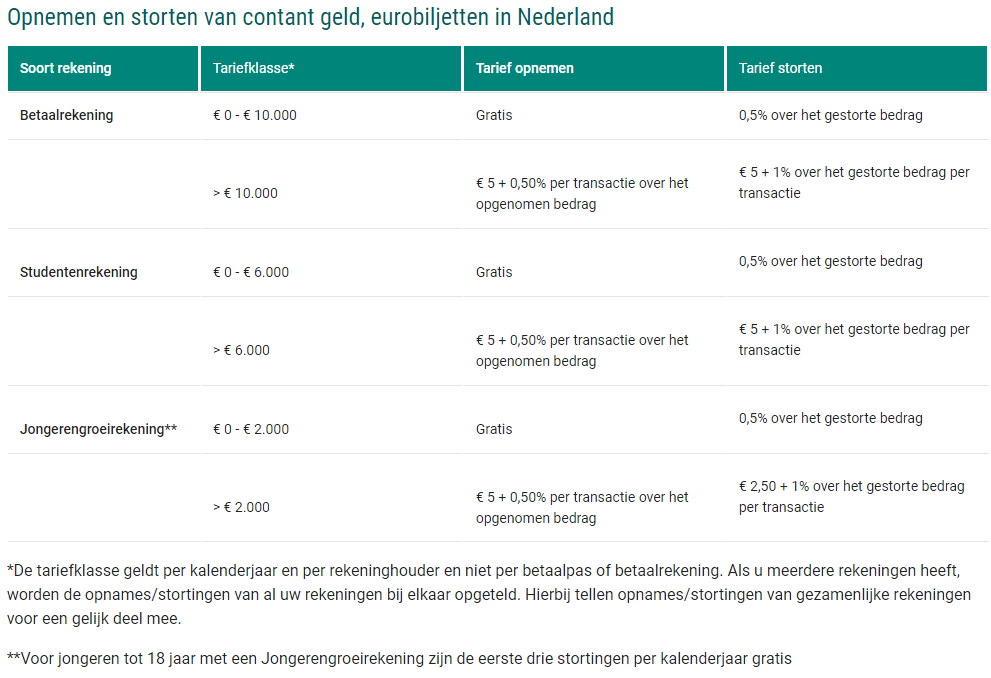
ABN Amro charges higher fees for withdrawing and depositing cash (Source: ABN Amro)
In recent years, governments and banks have gone further and further in discouraging cash. Because of its anonymous nature, cash lends itself well to financial crime, such as fraud and money laundering. However, that is not the only reason, because cash also appears to be a popular safe haven in times of crisis. After all, you don't pay negative interest on cash. The counterparty risk of cash is also lower than with a balance in a bank account. If a bank fails, you will not get any money back from the deposit guarantee scheme above €100,000. You don't have that problem with cash. Also, in an extreme scenario, banks can restrict withdrawals, as happened in Greece and Cyprus during the European debt crisis.
This also explains why during the credit crisis of 2008 - and also during the corona crisis of 2020 - suddenly so much more cash came into circulation. Worried savers withdrew more money from their accounts to hedge against a possible banking crisis. Fortunately, that didn't happen, but it did show that cash still plays an important role as an alternative safe haven. Although we are using cash less and less as a means of payment, we are using it more as a safe haven.
Now Banks Passing on more and more negative interest rates To savers, they try to discourage a flight to cash. It is therefore not surprising that banks such as ABN Amro continue to increase the costs for withdrawing and depositing cash. It is likely that other banks will follow suit and also start charging more fees for cash processing. As a result, it becomes more expensive to pay with cash.
The government is also trying to discourage the use of cash. Last year, a Bill to prohibit cash payments above €3,000. Due to the fall of the cabinet, these plans have been put on the back burner, but eventually these plans will be put back on the table. At the European level, governments are trying to discourage the use of cash for large transactions. So Reduced Germany last year increased the limit for purchases of precious metals with cash from €10,000 to €2,000.
This contribution was made from Geotrendlines