English
EN


Despite sharp daily fluctuations, gold and silver remain within their existing trading range for now. Lower US inflation figures initially supported the gold price, but rising oil prices and ongoing unrest surrounding Iran are once again causing uncertainty.
Not much has happened on the precious metals markets in terms of price over the past few weeks. The daily stream of macroeconomic and geopolitical news is interpreted sometimes positively and sometimes negatively. On balance, this results in sideways movement. Compared to the start of this year, gold is down 5% in dollar terms. Due to the rise of the US currency, this figure stands at -2% in euros. The 12-month return, however, remains comfortably positive at 22%.
The silver price fell back below 55 dollars earlier this month, its lowest level since the end of November. The price decline since the start of this year amounts to 18% in dollars and 15% in euros. Despite halving since its historic record price at the start of this year, silver is still trading 52% higher than 12 months ago. The gold-silver ratio initially rose sharply, but fell back again as the silver price climbed back toward 60 dollars.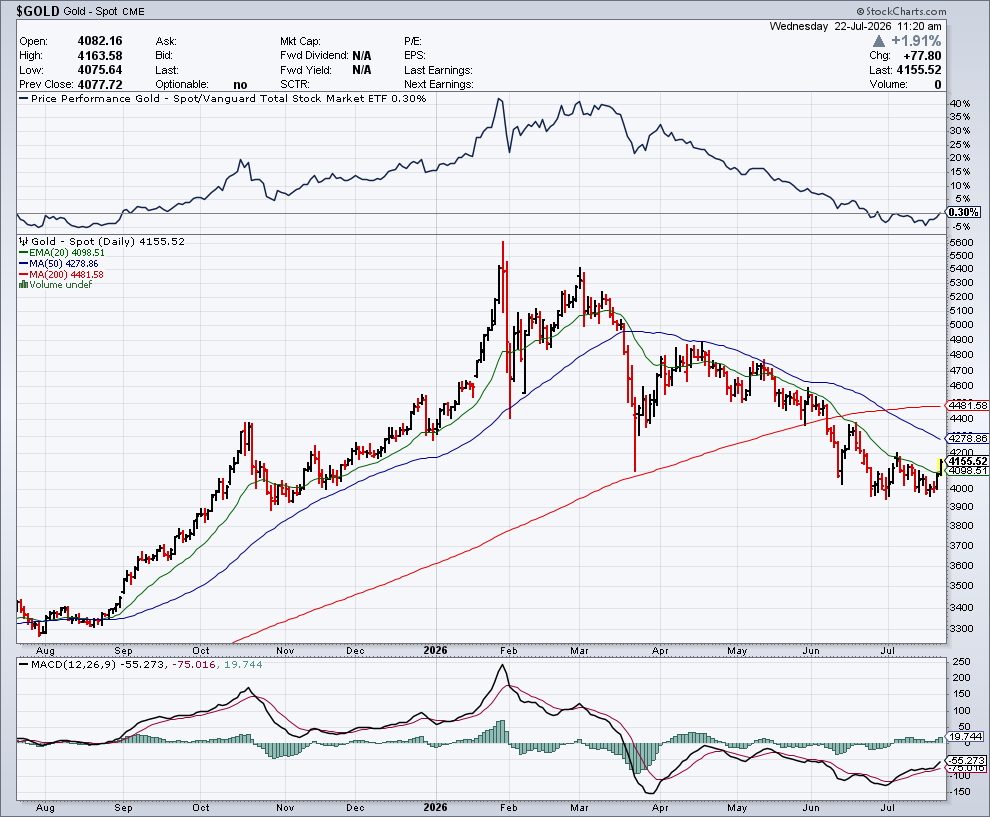
Chart: gold price over 1 year with 50-day and 200-day averages (Source: StockCharts)
Gold briefly dipped below 4,000 dollars again following renewed unrest in the Middle East. This wiped out an earlier rally following better-than-expected inflation figures. However, the move below that threshold was short-lived. The 50-day average now serves as the first technical resistance level for the time being.
In the US, the June inflation report showed a smaller-than-expected price increase. The consumer price index rose by 3.5% last month, compared to a consensus expectation of 3.8% and 4.2% in May. On a monthly basis, there was even a decline of 0.4%, compared to a rise of 0.5% in May. Core inflation (core CPI, excluding food and energy) showed a similar trend, falling year-on-year from 2.9% to 2.6%. On a monthly basis, core CPI remained unchanged after a 0.2% increase in May.
These lower-than-expected inflation figures had an immediate effect on interest rate expectations, but President Trump threw a spanner in the works with new attacks on Iran. In the meantime, we are already at 11 consecutive nights of attacks, raising the risk that the conflict will grow into a 'forever war'. Meanwhile, the oil price has been rising for almost 2 weeks, which is once again fueling inflation expectations.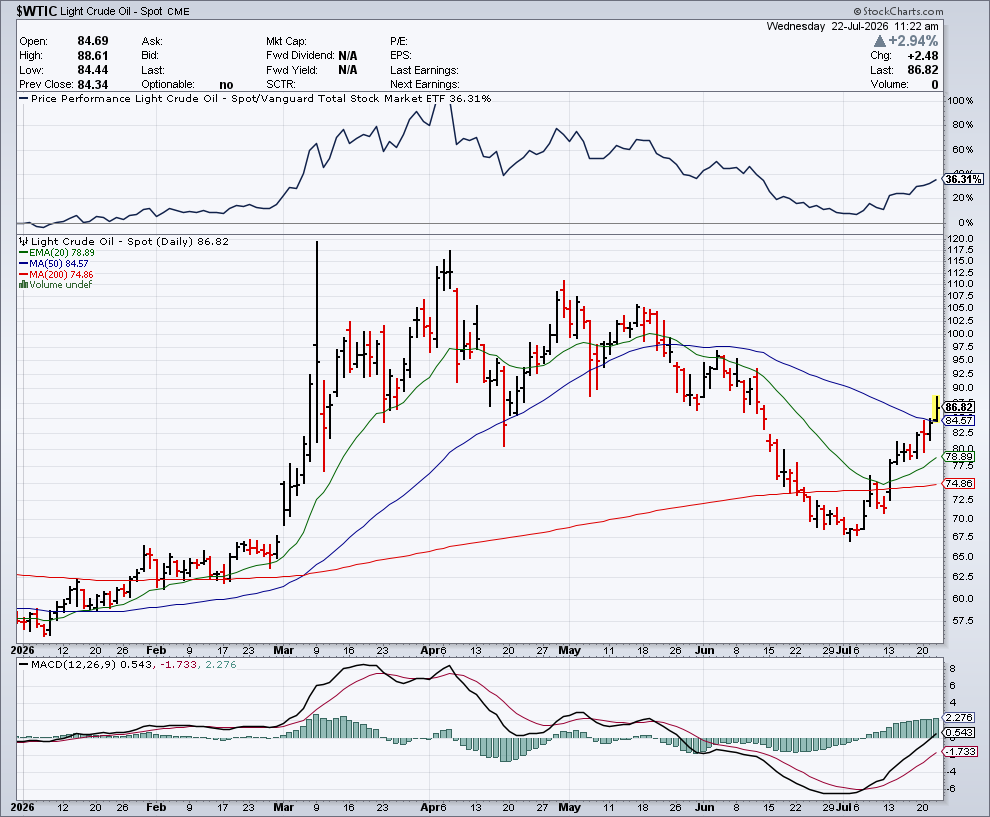
Chart: oil price (WTI) since the start of this year, in dollars (Source: StockCharts)
According to the CME FedWatch Tool, 74% expect the monetary committee, led by Fed Chair Kevin Warsh, to leave the policy rate unchanged at the upcoming meeting on 29 July. About a quarter expect a 25 basis point increase. For the following meeting on 16 September, 68% expect a first increase of 25 or even 50 basis points. Recent history shows that these estimates can change very quickly under the influence of geopolitical rhetoric and new macroeconomic figures.
The yield on two-year government bonds (US 2 year note), which has a high correlation with the Fed funds rate, has already anticipated a rate hike, climbing from 3.5% to 4.25%. Yet the gold price appears to be looking past the inflationary impact of higher oil prices in the short term, since if these persist, there will also be negative consequences for economic growth, which would naturally lead to lower inflation.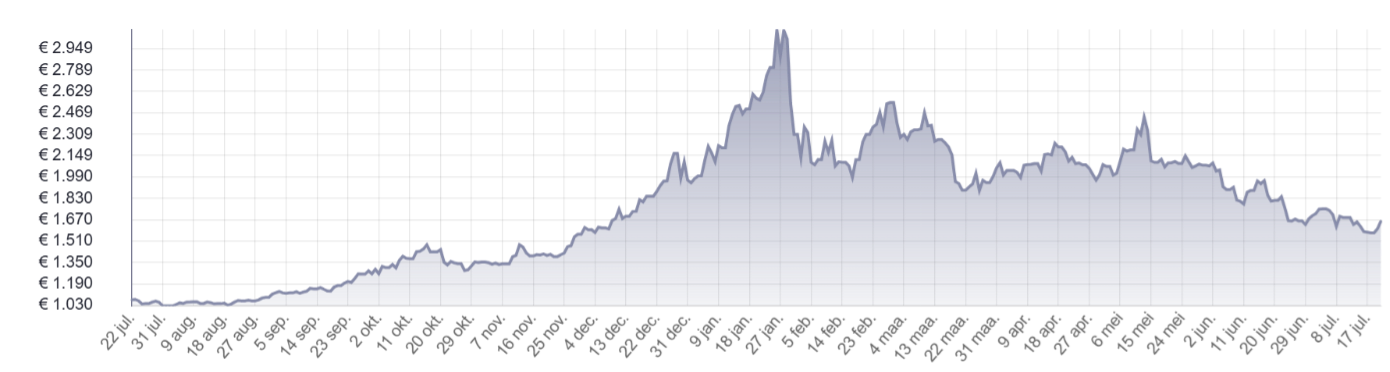
Chart: silver price over 12 months, in EUR per kg (Source: HollandGold)
In recent weeks, a persistent misunderstanding arose regarding gold trading for private investors in China. As of 24 July, several Chinese commercial banks are stopping the offering of certain derivative products for investing in gold on credit or with leverage on the Shanghai Gold Exchange (SGE). These include the Industrial and Commercial Bank of China (ICBC, the world's largest bank by assets), Postal Savings Bank of China, Ping An Bank, China Guangfa Bank, and several others.
The measure is being taken as part of risk management and was announced a month ago. This gave investors a month to close out existing positions, sell them, or convert them into physical gold, insofar as this was possible. After this date, no new leveraged positions can be opened, and access to existing positions will be restricted, with the banks able to liquidate them unilaterally.
However, this does not mean at all that Chinese private investors can no longer invest in gold. Nothing changes for gold ETFs and physical gold; only the leveraged component disappears. Institutional investors, moreover, are not affected by the new rules and can still trade with margin and leverage on the SGE.
On 8 October, Holland Gold is bringing well-known podcast guests to Theater Figi in Zeist for Vrijheid & Vermogen 2026 (Freedom & Wealth 2026). Check out the program and reserve your ticket for an evening about the future of the Netherlands, Europe, and your wealth.