9.3
8.064 reviews

English
EN


Following in the footsteps of ING, more and more banks are lowering the threshold for negative interest rates. The ABN Amro recently lowered this limit from half a million euros to €150,000, while the Volksbank lowered the limit from €250,000 to €100,000 this week. Customers of SNS, ASN Bank and RegioBank will have to pay half a percent interest on balances above €100,000 from 1 July. If this trend continues, negative interest rates will soon become the rule rather than the exception. This means that savers have to take action if they want to protect their assets.
Rabobank is the only bank that has not recently lowered the limit for negative interest rates, but that seems only a matter of time. All banks are struggling with the same problem, namely a surplus of savings. These funds are parked by banks at a deposit rate of -0.5% at the European Central Bank.
It does not yet look like interest rates will rise any time soon, so banks will increasingly pass this on to customers. They do this by further lowering the threshold above which you pay interest. "Although negative interest rates are annoying for savers, it is obvious that banks will start charging negative interest rates for more customers if interest rates remain low for a long time," this is what the Dutch Central Bank wrote in its latest annual report.
At present, the limit is ahead of Negative interest rates At many banks at €100,000, but that could drop even further in the future. This is because it costs banks money to hold savings, while banks' revenue model is under pressure due to low interest rates and higher costs for supervision. Banks must also build up additional buffers to absorb any write-downs on their loan portfolios. The corona crisis has hit various sectors of the economy hard.
Banks don't want your savings at all. In this way, ING encourages its customers to especially to save with another bank, where it may earn a little more interest. The only problem is that no major bank in the Netherlands still gives interest on savings. To do this, savers have to go on an adventure in countries on the outskirts of the Eurozone, where some banks still offer interest. Banks that are not always covered by a deposit guarantee scheme, so they are a risky business.
It's also possible to lock up money in a savings deposit for a longer period of time, but that means you won't be able to access that money for years. Depending on the term, you can still receive almost one percent interest, but that is not enough to compensate for the decrease in the value of the money.
Savers not only lose purchasing power through negative interest rates, but also through inflation and wealth tax. As a saver, you therefore pay an increasingly higher risk premium to park your savings at the bank, where they are guaranteed up to €100,000. As a result, it is becoming increasingly attractive to consider alternatives that yield higher returns. Consider, for example, a stock portfolio, which generates more income in the form of dividends. Or an investment in real estate, although renting out also involves extra hassle. Moreover, house prices in the Netherlands are currently at Record.
Then there are plenty of alternative investments such as watches, jewellery or classic cars. These can be very interesting, but only for connoisseurs who know what to buy. And then there are virtual currencies, which are becoming increasingly popular among a large group of investors. However, due to the enormous volatility, cryptocurrencies are not suitable for savers. Then precious metals such as gold and silver are a safer alternative. Although these do not generate any income, they also have much less risk. In fact, over the long term, precious metals prove to be more stable in value than government fiat money.
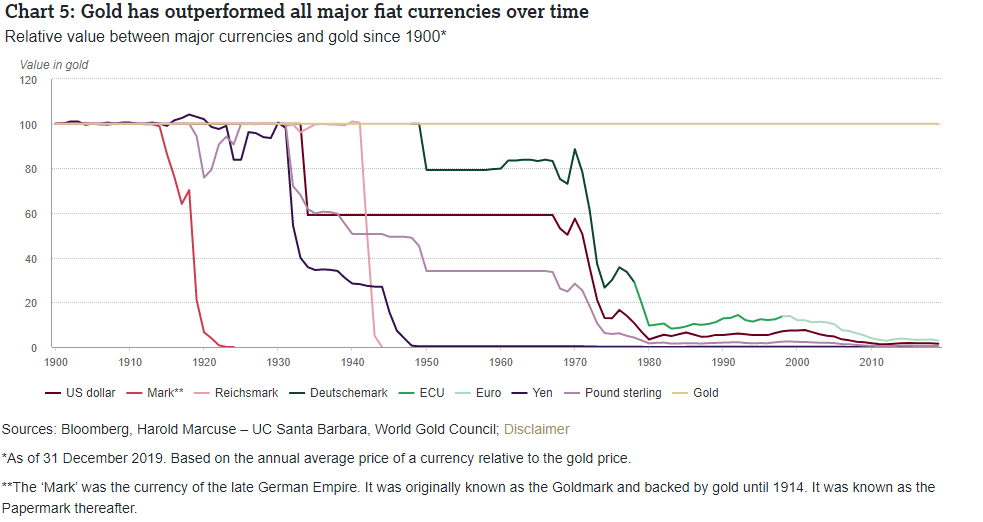
Gold vs. Currency Since 1900 (Source: World Gold Council)
Especially now that governments are throwing money around and central banks are buying government bonds on a large scale, savers should be concerned about the purchasing power of their money. This is even more problematic in the long run than negative interest rates, because it undermines confidence in the value of money. Monetary history contains numerous examples of this.
At Goudstandaard you can buy physical bullion safely and easily. If desired, also in combination with storage. In that case, the precious metal is not stored at your home, but in a well-secured storage location. Moreover, it is then fully insured. Saving in gold as an alternative to the savings account.
Would you like to know more about the storage of precious metals? Click here For more information or view our range of gold, silver and platinum in combination with storage.


