English
EN


In early July, Holland Gold visited the Rick Rule Symposium on mining and natural resources in Florida, USA. Two keynote speakers took the audience back to the fundamentals: why do people believe in mining, commodities and ‘hard assets’? What is the true value of gold compared with fiat money? Grant Williams drew an analogy with the wolf, while Lynette Zang used the Ship of Theseus. What do these two have to do with the value of gold?
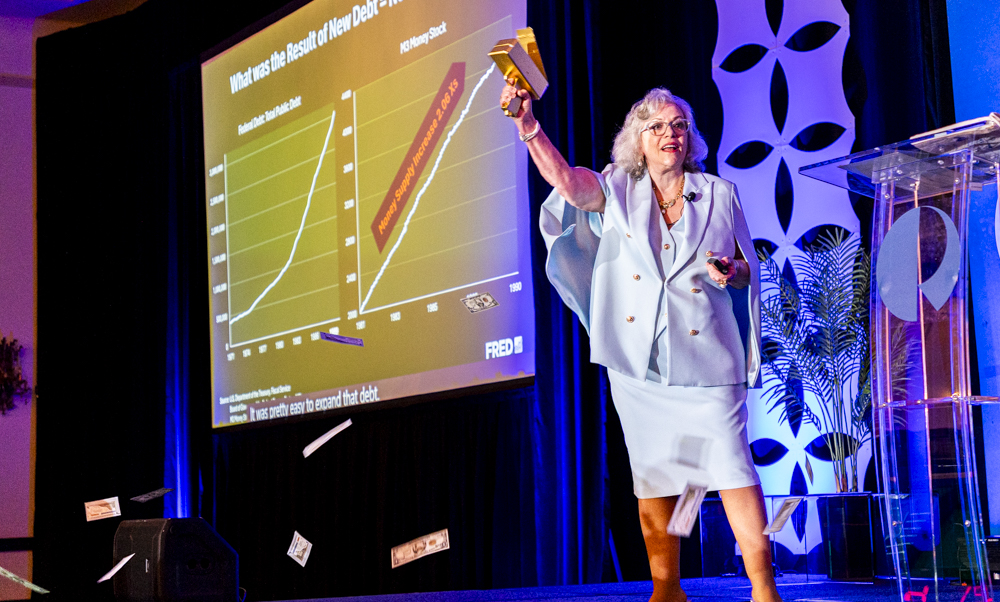 Lynette Zang fires dollar bills from a money gun during her presentation at the Rule Symposium 2026, photographed by Holland Gold
Lynette Zang, founder and CEO of Zang International, spoke passionately and, with a money gun in her hand, showered the audience with dollar bills. Governments continue printing fiat money until the dollar returns to its intrinsic value: zero. Zang argues that governments have very carefully and gradually accustomed citizens to a system that moves them ever further away from real money: physical gold.
To explain this, she draws an analogy with the Ship of Theseus. This is a philosophical concept: if, after years of maintenance and repairs, every plank of a ship has been replaced one by one, is it still the same ship? According to Zang, governments have replaced the old gold-backed system plank by plank since 1913, turning it into a debt-based system. This happened so slowly that the general public did not notice and the two systems merely appeared to be the same. Zang explains this process in three stages: creating money, debasing money and replacing money.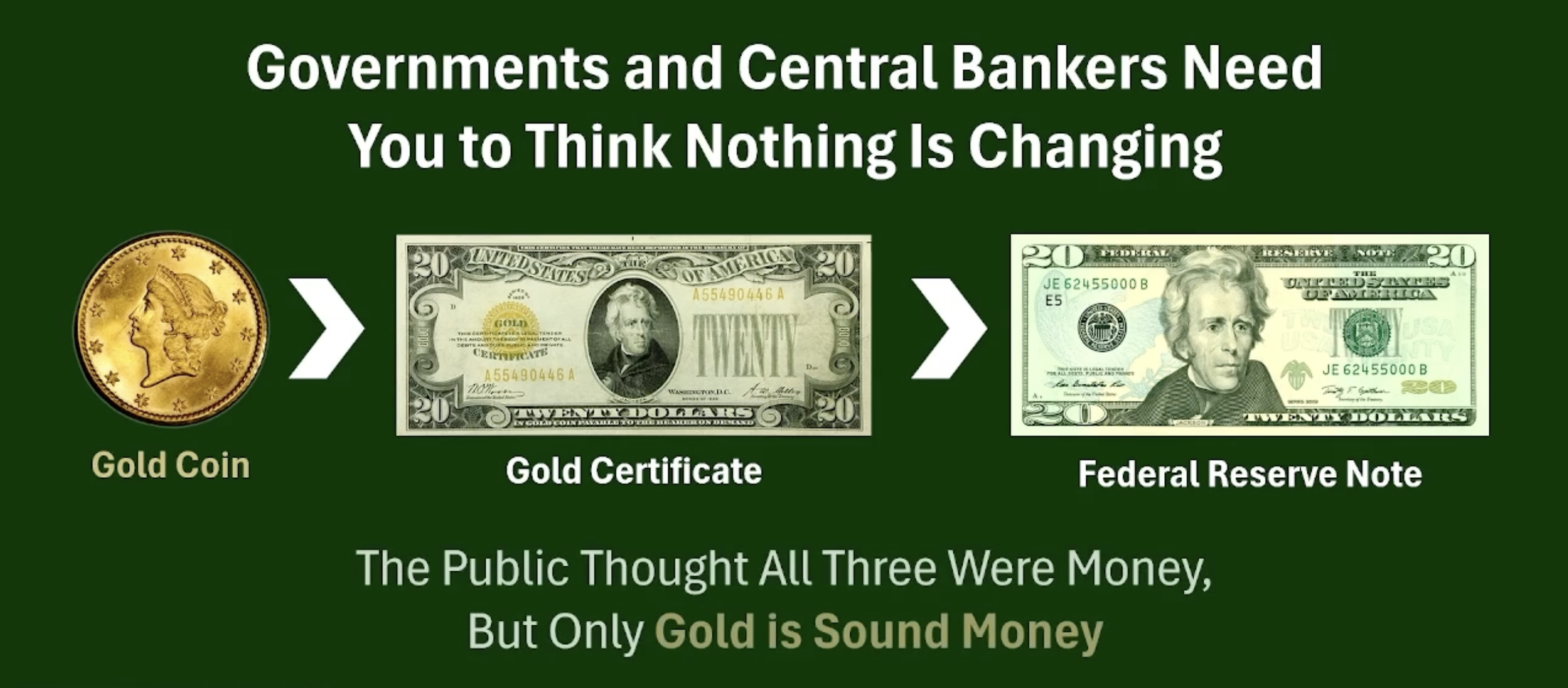
The stages from physical gold to a gold certificate and then to a Federal Reserve note, taken from Lynette Zang’s presentation at the Rick Rule Symposium 2026 (source: Rule Symposium).
1913 – Establishment of the Federal Reserve: The gold standard had long prevailed within the US financial system. This meant that paper dollars could be exchanged for gold at a fixed official rate, and vice versa. Certain banknotes were therefore gold certificates. A physical $20 gold coin, such as the $20 Liberty Head Double Eagle, could be exchanged for a 20-dollar gold certificate. One year after the establishment of the US central bank, the Federal Reserve or Fed, a third ‘kind’ of $20 was put into circulation in 1914: the Federal Reserve Note. The Fed was allowed to back these notes with assets other than gold!
1933 – The first ‘major plank’ is actually replaced: President Roosevelt’s Executive Order 6102 removed gold from public hands: citizens were no longer generally permitted to own investment gold privately, although certain coins and collectables were exempt. Zang sees a strategy behind this: the public had been given twenty years to become accustomed to a system in which a $20 gold coin, a $20 gold certificate redeemable for physical gold and a $20 banknote existed side by side. With the stroke of a pen, the first two forms were largely removed from public hands. In the minds of many people, however, a $20 banknote still had the same value and backing. ‘Nothing could be further from the truth,’ Zang argues.
1965 – Silver is removed from the American dime and quarter, with the result that a post-1965 US dime still has a face value of 10 cents, whereas, in Zang’s example, a pre-1965 dime had a silver value of $6.72, based on the price on 27 February 2026.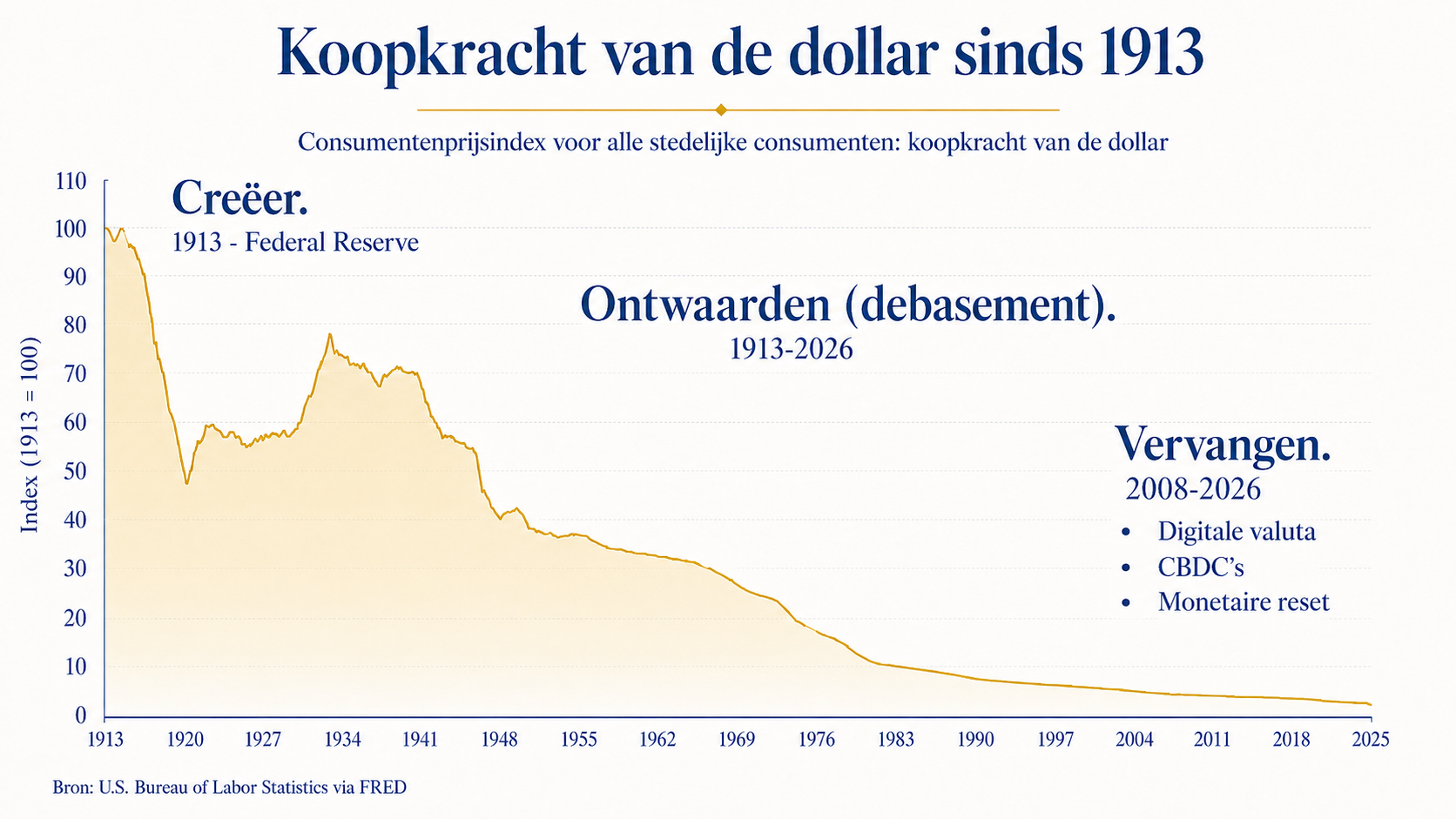
The stages of creating money, debasing money and replacing money, shown in a chart depicting the development of the dollar’s purchasing power, based on Lynette Zang’s presentation at the Rick Rule Symposium 2026 (source: Rule Symposium; edited by Holland Gold).
1971 – Debasing money: the second ‘major plank’ is replaced. With the Nixon shock, the United States severed the dollar’s link to gold in two stages, also bringing about the end of the Bretton Woods system. At the time, Nixon promised American citizens that a dollar would still be worth the same the following day. That proved to be a lie, Zang argues. Until the Nixon shock, foreign monetary authorities could convert dollars into gold at a fixed official rate of $35 per troy ounce. Other major currencies within the Bretton Woods system were, in turn, linked to the dollar through fixed exchange rates. Once this system was abandoned, the dollar became a fiat currency that moved more freely in international trade and, according to Zang, is essentially anchored in US government bonds, in other words, debt. From that moment onwards, she argues, the currency was subject to severe monetary depreciation, or debasement.
2008 to the present – Replacing money: According to Zang, money itself is the next plank to be replaced. She expects us to transition to digital currencies through bitcoin, stablecoins, CBDCs or other cryptocurrencies. She finds this frightening because an increasing number of doors are being placed between citizens and their savings. At every door, there is an institution that must grant permission or access before people can reach their money.
The functions of money are disappearing
In her presentation, Zang describes how money is being transformed from physical gold, via certificates and banknotes, into digital currencies. At every stage, the ‘money’ loses one of its monetary functions. Zang lists the core functions of money as follows:
According to Zang, only physical gold fulfils all four monetary functions. It cannot be printed without limit, can be owned privately, is decentralised and lies beyond the reach of central banks, commercial banks and governments. With the transition to fiat money, she argues, the store-of-value function has disappeared as a result of monetary depreciation. With the transition to digital currencies, Zang believes that the function of a fair means of payment will also disappear. She bases this on the claim that central banks no longer apply a lower bound to interest rates, meaning that, in her view, rates could become negative without limit. As a result, your salary could already lose value at the moment it is paid due to policy decisions made by a central bank.
Zang therefore urges those listening in the auditorium always to own some form of physical gold or silver. ‘If you cannot hold it, you cannot truly own it,’ she argues.
British-Australian investment strategist Grant Williams, founder of the well-known newsletter ‘Things That Make You Go Hmmm…’, took the audience into the natural world during his presentation: to Yellowstone National Park in the United States.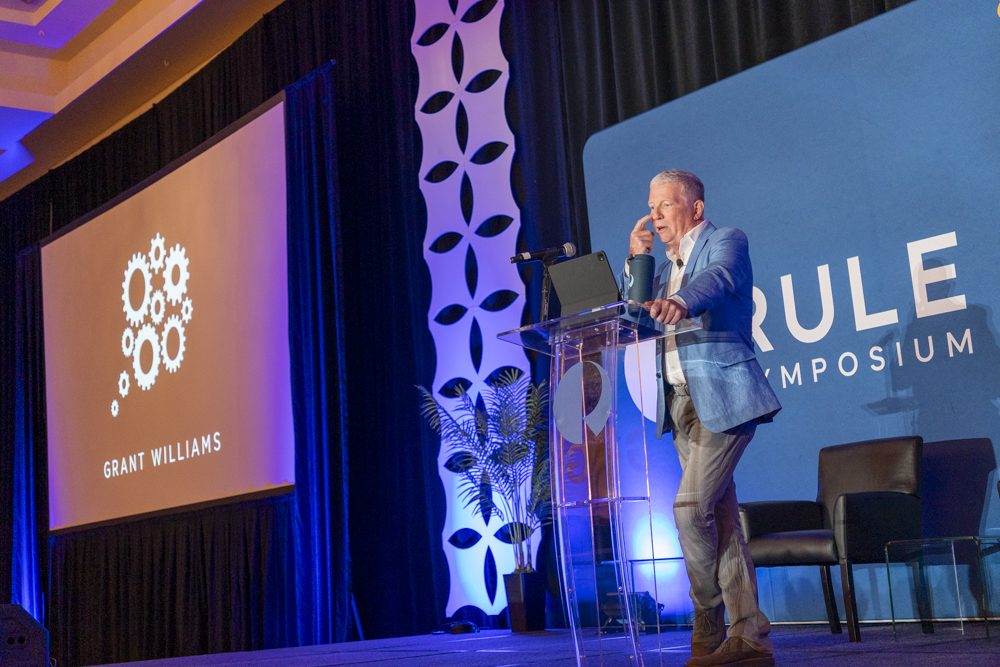
Keynote speaker Grant Williams at the Rick Rule Symposium 2026, photographed by Holland Gold
In the 1990s, a proposal was made to reintroduce wolves to the park, after the apex predator had been absent for approximately 70 years. During that period, deer and elk populations had exploded, overgrazing the entire national park and causing deforestation. The proposal prompted considerable protest and controversy, but the wolf returned. The reintroduction of wolves brought the deer population under control. The animals consequently changed their grazing routes through the park. They avoided open areas where they were vulnerable, such as riverbanks. Vegetation recovered and other animals, including beavers and otters, returned. In Williams’ account, this even changed the course of rivers because the restored vegetation helped prevent water erosion.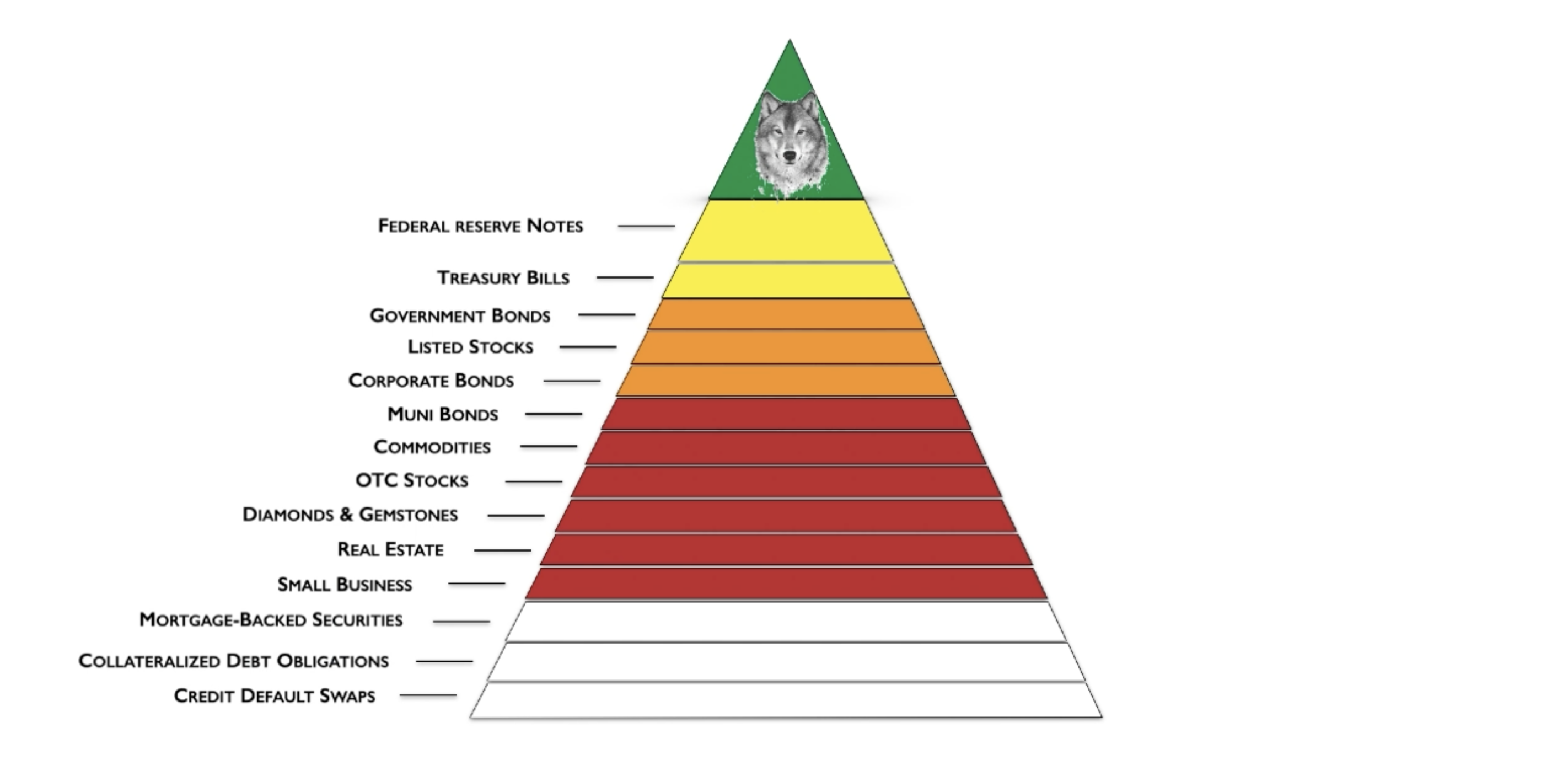
Exter’s inverted pyramid, taken from Grant Williams’ presentation at the Rick Rule Symposium 2026 (source: Rule Symposium).
The wolf, as you will have gathered, represents gold; Yellowstone represents an untamed financial system characterised by excessive credit growth, debt and speculation, but lacking a corrective mechanism. In the form of a gold standard, gold can curb the uncontrolled overgrazing taking place within our financial system. Williams illustrates this by inverting Exter’s pyramid. This pyramid categorises asset classes according to risk and size, with gold at the narrow base: small in size, but, according to Williams, the most reliable store of value. Williams instead places gold, as the wolf, at the top of the system. During the period without the wolf, Williams sees the dollar ‘marching relentlessly towards worthlessness’.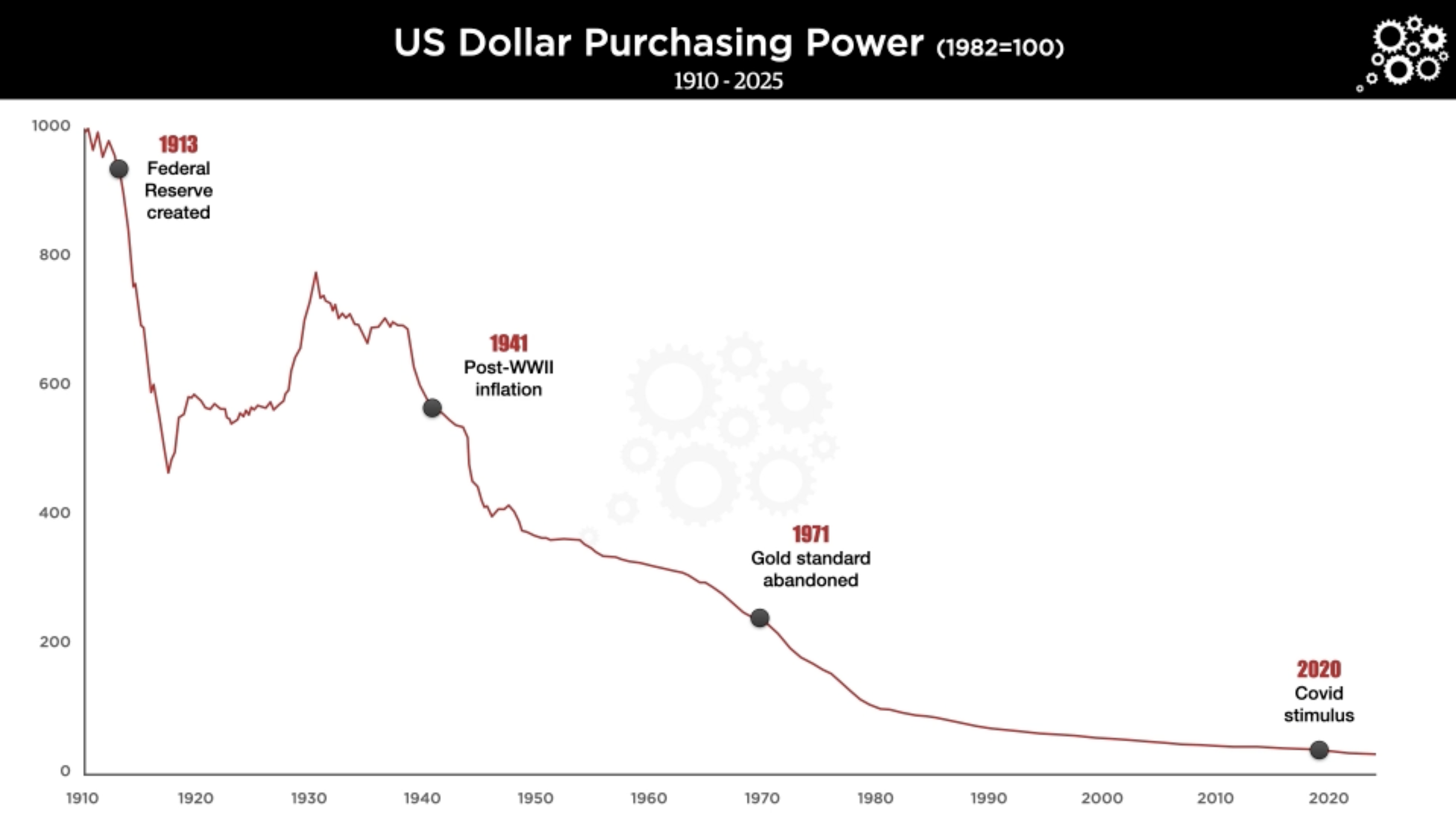
Purchasing power of the US dollar, taken from Grant Williams’ presentation at the Rick Rule Symposium 2026 (source: Rule Symposium).
No politician or policymaker will simply reintroduce the gold standard, Williams argues. For that to happen, social, political and financial unrest must converge. In 2020, the COVID crash brought about such a convergence, but an unprecedented amount of money was injected into the system. As a result, the crash turned into a bull market for equities and risk assets such as bitcoin and meme stocks like GameStop. At the same time, government bonds fell sharply in value. US government debt grew rapidly. Williams emphasised that the federal government’s net interest costs in the 2025 fiscal year were greater than the budget of the Department of Defense.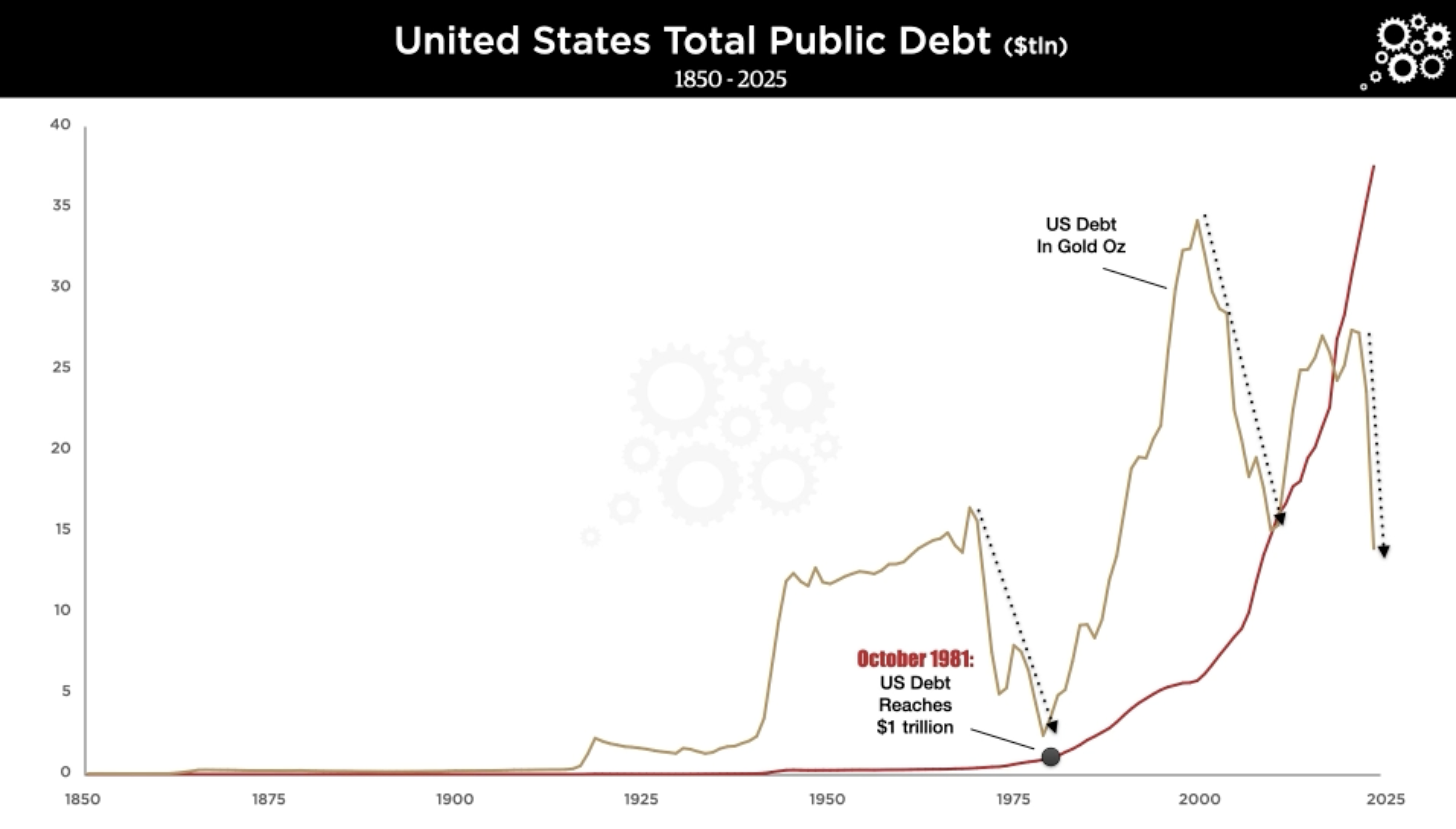
Red line: US government debt; yellow line: the same debt expressed in troy ounces of gold (31.1 grams per ounce). Taken from Grant Williams’ presentation at the Rick Rule Symposium 2026 (source: Rule Symposium).
If we express US government debt in ounces of gold rather than dollars, Williams argues, we see an entirely different development. Expressed in gold, government debt has risen much less sharply. According to him, this demonstrates how the dollar’s relative value against gold has declined.
“Gold tells you what your currency is worth, not the other way around.” – Grant Williams.
The main lesson from Williams’ presentation is that we must reverse our way of thinking: it is not the gold price that is rising, but fiat currencies such as the dollar and the euro that are losing value. A bull market in gold is therefore a bear market in fiat currencies. After his presentation, Williams stressed to us that what matters is real value: not whether you buy gold, but whether you own it. In his thinking, the gold price barely matters; gold is the standard against which everything else is valued. Only gold allows you to preserve value.
On 8 October, Holland Gold will bring well-known podcast guests to Theater Figi in Zeist for Vrijheid & Vermogen 2026. View the programme and reserve your ticket for an evening about the future of the Netherlands, Europe and your wealth.