English
EN


The gold price fell below $4,000 per troy ounce this week, while the rising oil price is further fuelling inflation concerns. Oil traders are also warning of a new supply crisis. Despite the sharp decline in prices, do experts remain positive about gold?
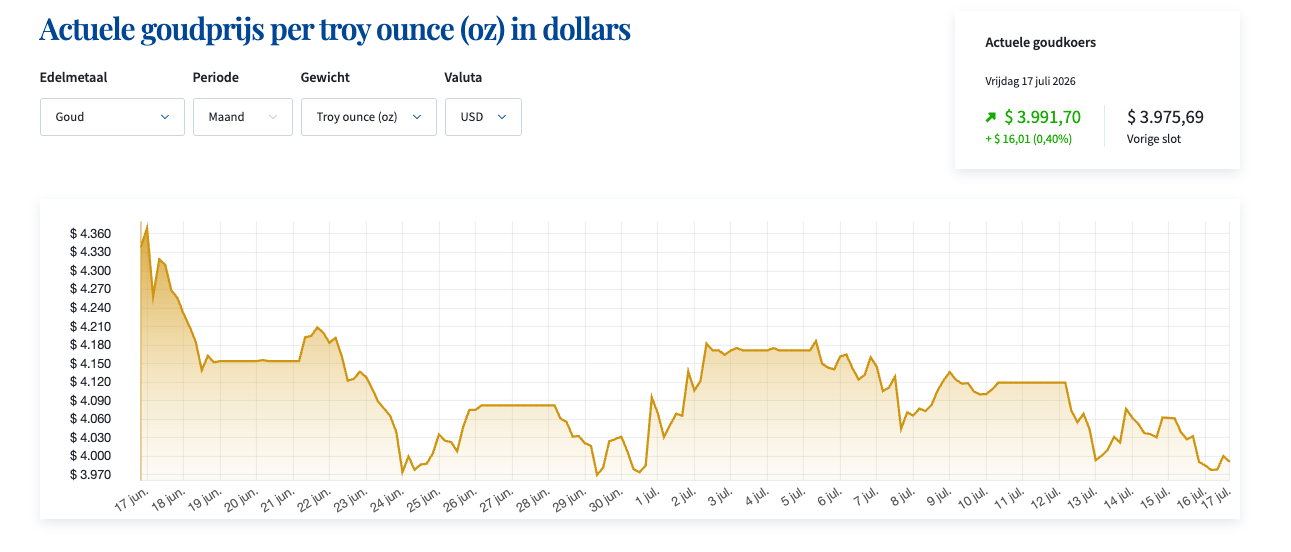
The gold price in dollars per troy ounce on Friday, July 17 (source: Holland Gold)
The gold price fell below €112,000 per kilogram and $4,000 per ounce this week. According to Bloomberg, the escalating hostilities between Iran and the United States are playing an important role in this decline. Trump said the bombing campaign would be intensified until Iran stops attacking ships in the Strait of Hormuz. The gold price is now approximately 26 percent below its January peak of $5,600 per troy ounce. This is only the fifth time since 1960 that gold has fallen by more than 25 percent.
The oil price has now risen for several consecutive days and has climbed above $86. This is fuelling concerns that higher energy prices will translate into rising inflation. That is putting pressure on the gold price, as it also increases the likelihood that the Federal Reserve will raise interest rates. Interest-bearing investments, such as bonds, would then become relatively more attractive than gold, which does not pay interest. “Precious metals have come under selling pressure as the oil price has once again risen above $80 per barrel,” a senior commodities strategist told Bloomberg.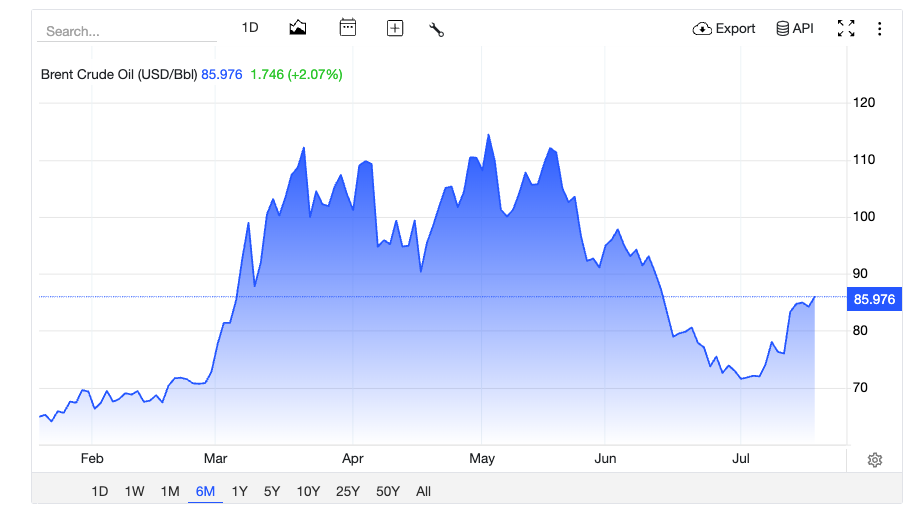
The oil price is rising again (source: Trading Economics)
Oil traders warned in the Financial Times this week that the escalating tensions in the Middle East threaten to trigger a supply crisis in the oil market. The reserves that previously helped cushion the impact of the war have now been almost entirely depleted. “We have used up all our buffers. Every last one,” a trader told the British newspaper.
Western countries have recently released record quantities of oil from their strategic reserves onto the market to prevent the supply shortage from undermining the global economy. The International Energy Agency reported last week that its member countries have now released almost three-quarters of the planned 400 million barrels from their emergency reserves. This additional supply is expected to dry up within a few weeks.
If the Strait of Hormuz were to remain closed for months again, it is unclear where the oil needed to offset the resulting shortage would come from. The oil price could therefore rise considerably further. “The market had been assuming an optimistic scenario for the recovery of oil flows. That scenario is now clearly off the table, at least until a new round of diplomatic talks takes place,” said Joel Hancock, senior commodities analyst at Natixis Bank.
Bank of America has not yet written off gold over the longer term, according to Kitco. The bank’s technical analysts note that the gold price is struggling to remain above the important support level of $4,000 per troy ounce. According to Paul Ciana, the correction could continue for some time and the gold price could eventually fall to around $3,600 before establishing a firmer bottom. Based on technical indicators, he expects the gold price to remain under pressure this summer. We also discussed this scenario in our podcast with Jeroen Vandamme.
Like Jeroen Vandamme, Ciana regards the lower prices as a buying opportunity. He advises investors to add to their positions gradually. Bank of America recently lowered its forecast for the average gold price in 2026 by 14% to $4,360 per troy ounce. Nevertheless, the bank still considers a gold price of $6,000 achievable in 2027.
Fidelity International, a major international asset manager, plans to rebuild the gold position it reduced earlier this year. According to portfolio manager Ian Samson, the structural factors supporting the gold price over the long term remain intact, although the right time to enter the market has yet to become clear.
“I expect the gold price to be slightly higher at the end of the year than it is now,” Samson said. He expects a return to a bull market during 2027. According to Samson, that outlook would only be undermined if governments returned to strict fiscal discipline and central banks made a genuine effort to bring inflation down. He considers such a shift unlikely, however.
According to Samson, when and to what extent the gold price begins rising again will depend on several factors, including developments in the oil price, the Federal Reserve’s interest-rate decisions and gold’s ability to regain upward momentum. Continued gold purchases by central banks could also provide further support for the gold price.
We conclude this weekly selection with a brief report on silver. As regular readers and viewers of our podcast know, silver is not only a monetary precious metal, but also an important industrial commodity. The metal is used in electronics, electric vehicles and solar panels, among other applications. Last year, the solar energy sector even accounted for 17% of global demand for silver.
China’s largest solar-panel manufacturer has begun producing solar cells in which silver, which has risen sharply in price, is replaced with copper. Longi Green Energy Technology’s new production facility in Shaanxi province is now operational. Longi managed to bring the plant into operation within three months and says the new solar cells are also more efficient.
The switch follows a surge in the silver price to a record of more than $121 per troy ounce in January, almost three times its level a year earlier. Like silver, copper has good electrical conductivity, but the copper price has also reached a record this year. In addition, the market is facing a global shortage of copper ore. The switch therefore reduces dependence on silver, but does not entirely eliminate the risk of rising raw-material costs.