

English
EN


Europe can still gain a lot of ground by combating fragmentation, according to a report by Enrico Letta, former prime minister of Italy. According to Letta, various issues, such as the financial sector, energy companies and the telecommunications sector, are still far too nationally organised. As a result, Europe is falling behind other power blocs. What exactly does Enrico Letta mean and what needs to be done to move Europe forward?
Since the war in Ukraine, many economists have been writing about the bloc formation that the world is increasingly falling into. The Economist Zoltan Pozsar For example, two major power blocs are emerging, with the G7 on the one hand and many Asian and African countries on the other. The latter block is based on the New Silk Road, a development strategy of the Chinese government, aimed at connecting and cooperating between countries in Africa-Eurasia. Both blocks focus on internal integration. Typical of this is the choice of currency. Increasingly, countries such as China and India no longer use the dollar, but have to rely on alternatives, such as the Chinese renminbi.
Other analysts, on the other hand, see Four power blocs America, Europe, China and India. Europe is therefore increasingly up against other great powers. And that is not possible when Europe is so fragmented. 'The problem is that we are too small in this new world. If we don't integrate further, there will be an economic downturn," Letta said in an interview with the Financial Times Monday.
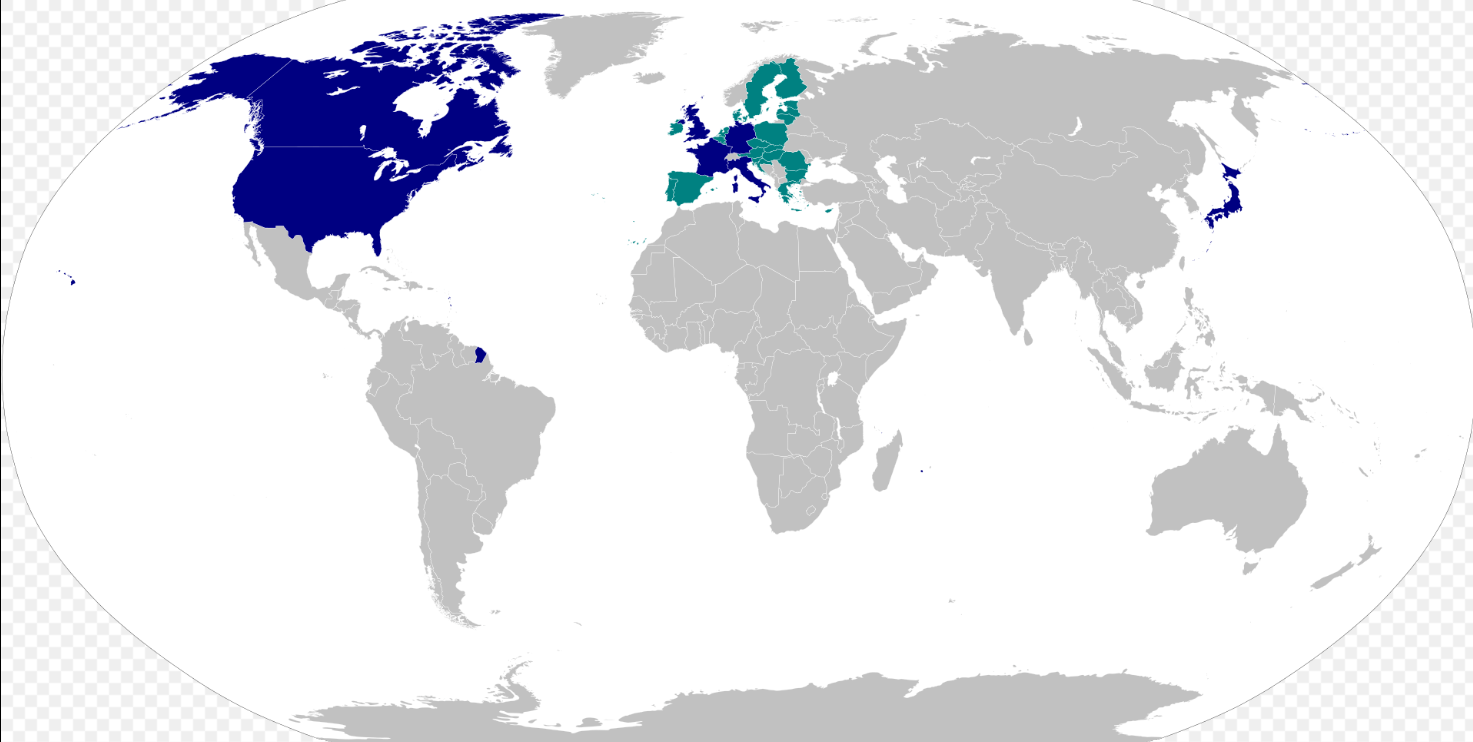 World map depicting the G7. (Source: Wikipedia)
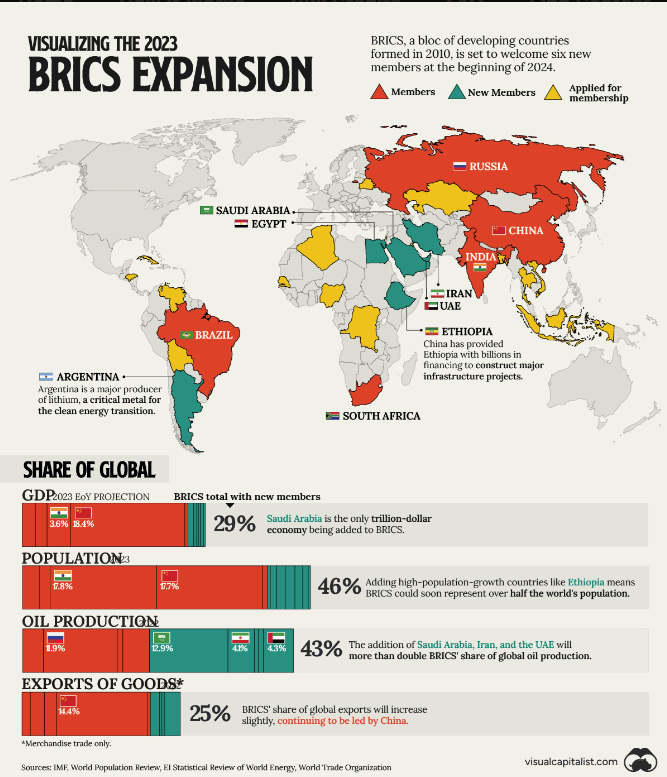
World map depicting the BRICS (Source:: Visual Capitalist)
This is already manifesting itself in The numbers. Growth in Europe is lagging behind that in the United States. Since 1993, Europe's wealth has increased by 30%, while that of Americans has increased by 60% over the same period. Relatively speaking, therefore, Europe is losing ground. Whereas in 1993 the EU was responsible for more than 20 percent of world GDP, this has now fallen to 13 percent. The European Union's share is therefore shrinking due to the strong growth of countries such as China and America.
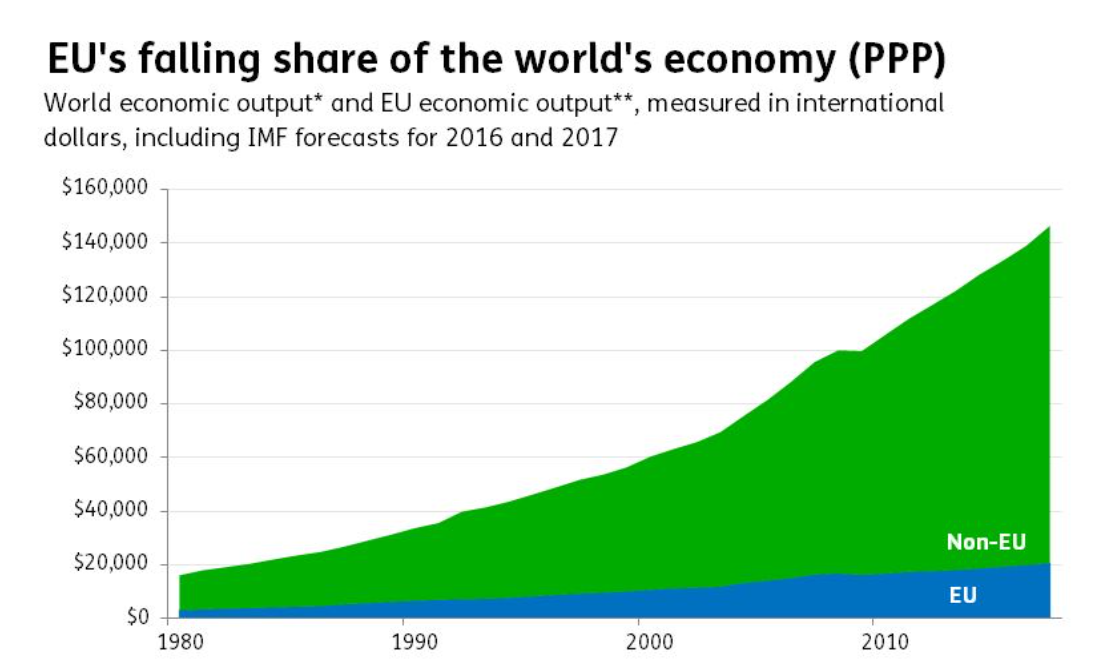 Europe's share of global GDP is decreasing. (Source: Full Fact)
A Look at The largest companies in the world also shows that Europe can still make a big difference. The top ten is dominated by America, with six American companies. China is also doing well, with three companies in the top ten. The other company in the top ten is Saudi Arabian Aramco. In the entire top 2000, Europe is not doing badly with 416 companies, narrowly ahead of China, which has 346 companies on the list. With 611 companies, including many tech companies, America remains the absolute frontrunner.
The fragmentation that Letta describes takes place in different areas. Especially with the possible arrival of a second term of Trump, the EU is forced to optimize the internal market. Because at the moment, according to Letta, there is no question of a Single Market, although this term is widely used in Europe. According to Letta, the European train connection is illustrative of this. It is still far too complicated to travel by train between European capitals, according to the report: 'It should be so easy in a densely populated continent. But it is typical of the problems of the internal market. The high-speed train has been developed quickly and effectively, but has remained within national borders, except for the Paris-Brussels-Amsterdam route.
And so it goes for more areas. For example, the financial sector, energy companies and the telecommunications sector are still far too nationally organised. Also for the financing of the Energy transition European plans should be drawn up. The costs involved in the transition are estimated at an annual 500 billion. According to Letta, this cannot be done with public money alone: 'If we don't find a way to use private capital, these needs will not be met'.
We also need to create European giants, companies that are large enough to compete with companies from other power blocs. Currently, there are rules that prevent acquisitions, which hinders companies from growing further. But it is precisely large players who need mega-mergers in order to continue to grow. As an example, the aerospace industry at mentioned. The sector is not yet sufficiently able to compete with its American counterpart in Europe, but if Europe joins forces, it may be able to compete.
Letta's analysis seems to be in line with economist's analysis Wim Boonstra, who was also a guest of Holland Gold. Boonstra said that China is incredibly strong in strategic thinking, while in his opinion Europe still has a lot to gain. 'The difference between China and Europe is that China thinks a long time ahead. When China wanted to become an economic power bloc in 1979 and started opening up the economy, there was a chuckle in Europe and America. Twenty years later, it is thanks to China that the global poverty reduction goals have been met. Ten years later, China had become a world economic power. They know exactly where they want to go. While Europe has been asleep for ten years when it comes to strategic thinking, otherwise we really wouldn't have been so dependent on Russian gas or Arab oil,' says Boonstra.
Rabobank also wrote at the end of last year a report where it highlighted Europe's vulnerabilities. The first Achilles' heel is the lack of raw materials, because the continent is very dependent on a small number of countries. Declining industrial production was the second vulnerability, followed by military weakness. Finally, there is often a lack of internal cohesion, because there are major differences between different European countries. This is reflected, for example, in different views on budgetary standards, but also in the area of migration.
For example, the call for a renewed strategy for Europe appears to be increasingly widespread. Europe must therefore think carefully about how the continent can continue to measure up to the other major powers in the world. Many economists agree: the current design of European cooperation is not working optimally. Then there are two camps that argue either for further integration or for more national freedom with the possibility of cooperation. The debate on the future of Europe must therefore be held above all. It will be interesting to see what the reactions are to Enrico Letta's report.
On Thursday 16 May 2024, Holland Gold will host a event on Gold and world politics in the Georg Kessler Lounge at the AFAS AZ Stadium.
The event consists of three parts: one interview, one presentation and a Q&A session for the audience. For example, the gold rush is discussed in World Politics, the geopolitical tensions that are rising every day; in Ukraine, the Middle East, in West Africa and around Taiwan. What impact does this have on the financial system? Central banks seem to be caught in a gold rush. The yellow metal achieves a Record price. How long will the US dollar remain dominant?
Have a look at us YouTube channel
On behalf of Holland Gold, Paul Buitink and Joris Beemsterboer interview various economists and experts in the field of macroeconomics. The aim of the podcast is to provide the viewer with a better picture and guidance in an increasingly rapidly changing macroeconomic and monetary landscape. Click here to subscribe.








_Countries.svg)