9.3
8.683 reviews

English
EN


The European Central Bank (ECB) cut the policy rate by a quarter of a percentage point on Thursday Increased. As a result, the refinancing rate, the ECB's policy rate, now stands at 3.75 percent. With this interest rate hike, the ECB wants to curb inflation, which was higher again in April. What does this interest rate decision mean for precious metals?
The interest rate decision follows the announcement by the FED, the US central bank, which raised interest rates on Wednesday evening. For the Fed, this could be the last rate hike. Recently, fears of a recession have increased, as Jeroen Blokland also showed in a podcast by Holland Gold know. ING therefore expects the Fed to raise interest rates again later this year. lower to avert the possible recession. The US central bank has a dual mandate and is responsible not only for price stability, but also for employment. A further increase or a possible reduction in interest rates later this year therefore depends not only on inflation, but also on other factors.
Central banks around the world have been raising interest rates for some time now. The Fed started doing so in March of 2022, but the ECB didn't start raising interest rates until months later. A year ago, the ECB's interest rate was still at zero percent, while inflation had already risen sharply. It was only in July that the ECB raised interest rates by half a percentage point. Since then, interest rates have been multiple times Increased. So now the interest rate is already at 3.75 percent.

ECB policy rate (Source: Trading Economics)
By raising interest rates, central bankers are trying to slow down inflation. Higher interest rates will make it more expensive to borrow, which will reduce spending. Also, in the long run, the higher interest rates will lead to higher interest rates on customers' savings accounts with commercial banks, which will reward savings. This also cools the economy, causing the price level to rise less rapidly and to move back to the policy target of two percent.
This week it was announced that prices in the Netherlands with 5,9 percent were higher than in April 2022, while inflation was still higher in March 4,5 percent on an annual basis. The increase in inflation is mainly due to high food prices and the prices of services and industrial goods that have increased. Energy prices have been falling for a while, but we see that the high energy prices of last year are increasingly seeping into the prices of other products and that workers are now demanding higher wages. As a result, the general price level is still rising sharply.
Inflation in the eurozone also rose in April. Prices in the twenty euro countries rose by seven percent in April year-on-year. Core inflation, the price increase excluding the strongly fluctuating prices of products such as food and energy, fell slightly to 5.6 percent, while core inflation for the euro area March 5.7 percent on an annual basis.
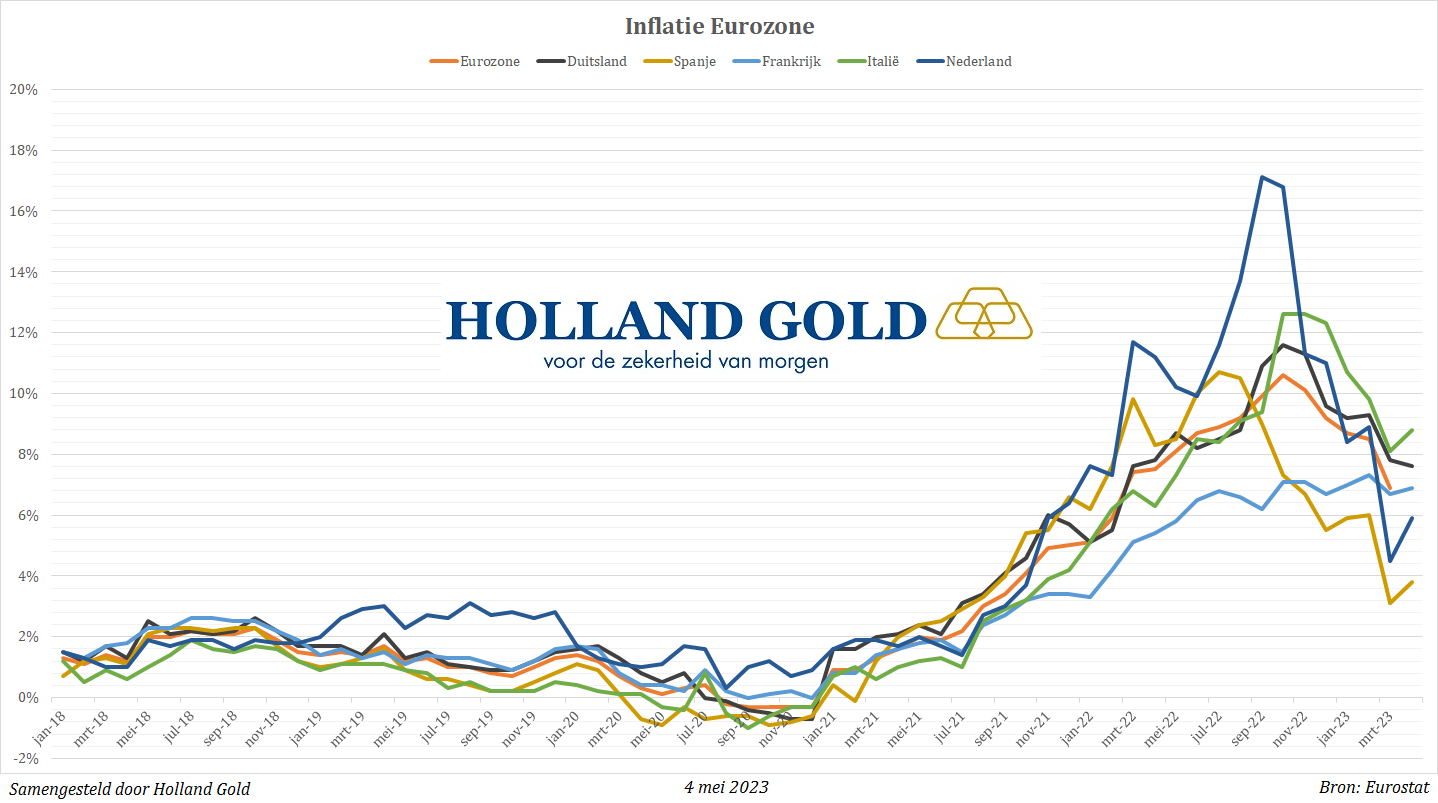
Inflation in Europe is lower than last year, but still strong (Source: Eurostat)
Although April's inflation rate is lower than the peak of 17 percent inflation in September last year, the current inflation rate is still well above the ECB's policy target. Given that the ECB is targeting an annual inflation rate of 2 percent, Directs, interest rates also seem to have to rise further in the coming months. In countries such as the Netherlands, the economy is overheated This is partly the result of the expansionary monetary policy of recent years. Higher interest rates curb that demand.
On the other hand, the central bank must also be careful not to raise interest rates too much and thus worsen the possible recession later this year. The effects of a rate hike are always felt with a delay and the recent rate hikes are now starting to be noticeable, according to an article in the Financieel Dagblad (FD). Activity is already declining due to the rise in interest rates. Entrepreneurs are now less likely to take out new loans and banks are also more cautious about granting credit. The interest rate hike has also led to a decline in demand for mortgage loans, which has caused house prices to fall. The policy is therefore bearing fruit, according to the FD.
The debate over the rate hike also revolves around the effectiveness of the policy. For example, some economists wonder whether the interest rate instrument is a good way to deal with the current inflation The right tool as this inflation has been partly caused by supply-side problems such as high energy and container prices. The interest rate instrument mainly affects the demand side of products and may therefore not be the right tool to fight inflation. The ECB is therefore in a difficult situation and is navigating between high inflation and a recession.
At the beginning of 2022, we wrote down Holland Gold already an article on the implication of an interest rate hike for the price of precious metals. It is also important to look at the real interest rate, the interest rate adjusted for inflation. Due to high inflation, the real interest rate is negative, but even before inflation skyrocketed, we already had a negative real interest rate, as no or even a negative interest rate was levied on deposits.
Negative real interest rates make it attractive to gold to possess. Precious metals, while not earning interest, are known to be a good hedge against inflation. Since 1971, the price of gold has averaged annually by Up 8.1 percent, while the money supply has increased by an average of 7.1 percent. The graph from an article by Holland Gold from last year shows that money growth and the gold price show a similar pattern. In the long run, the price of gold moves in line with the money supply. This is not always immediately visible in the short term, as the gold price is also dependent on factors such as interest rates, geopolitical developments and gold purchases by central banks.

Gold vs. money supply (Source: St. Louis Fed)
Last year wrote World Gold Council that an interest rate hike is generally positive for gold. Although the price of gold may drop slightly in the run-up to the rate hike (as saving money becomes more attractive due to higher interest rates), the gold price generally rises once the rate hike has taken place.
We saw that this year as well. Although interest rates have been steadily rising since the outbreak of the war in Ukraine, the price of gold is now higher than a year earlier. The turmoil in the banking sector in particular caused the gold price to rise in recent months. Central banks also bought a lot of gold last year, which also had a price-pushing effect. The chart below clearly shows the relationship between interest rate hikes, market turmoil and the gold price.
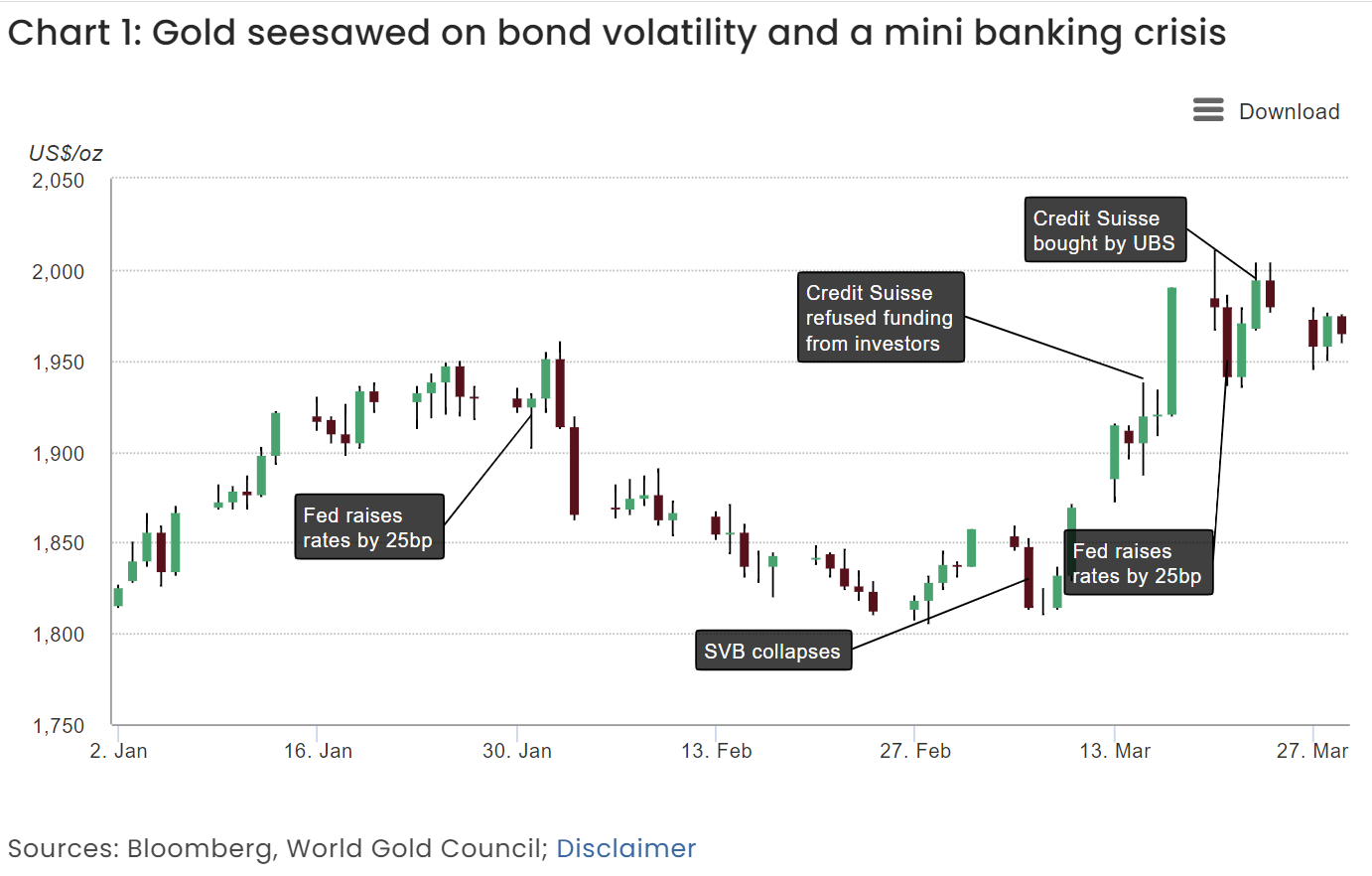
The link between the interest rate hikes, the turmoil in the banking sector and the gold price (Source: World Gold Council)
It is difficult to say exactly how the gold price will develop in the near future. The fact remains, however, that the outlook for gold prices is positive if fears of a recession increase and central banks may stop raising interest rates due to turmoil in the banking sector. This will become clearer in six weeks' time when the next ECB meeting is scheduled.


