9.3
8.683 reviews

English
EN


Inflation in the Eurozone in the month of March fell to 6,9 percent, according to new data from Eurostat. In the previous month, this figure was 8.5 percent. This is a positive trend, but economists are anything but confident about the situation. The ECB's next interest rate decision will take place on 4 May. What can we expect from that meeting?
More than a year after the outbreak of the war in Ukraine, inflation is still well above the policy target of two percent. Although inflation has been falling for several months now,Drops, policymakers remain concerned when looking at underlying data. For example, core inflation, the price increase excluding the strongly fluctuating prices of products such as food and energy, rose to a high of 5.7 percent. A month ago, core inflation stood at 5.6 percent and rose slightly last month.
The price increase of services is also still high. In March , it amounted to5,1 percent, compared to 4.8 percent in February. The increase in the price of services is an important indicator of long-term inflation, as it is often driven by higher labour costs.
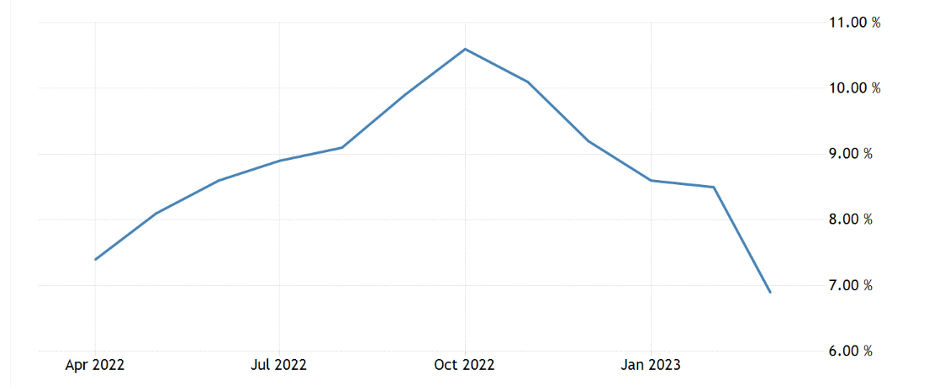
Graph of inflation in the month of March (Source; tradingeconomics)
Therefore, it seems likely that the European Central Bank (ECB) will continue to raise interest rates in the coming months. This is the opinion of the President of the Dutch Central Bank (DNB), Klaas Knot. "It's too early to talk about a break. For a pause, I would really need to see a convincing reversal in underlying inflation dynamics," it quotedFinancieele Dagblad the President of DNB. According to the president of DNB, core inflation must also fall before the ECB can stop raising interest rates.
The ECB's next interest rate decision is scheduled for May 4 and it seems very likely that rates will be raised again at that meeting. The extent of the interest rate hike is still a subject of debate. Although the previous rate hikes were substantial, the ECB could now also consider a smaller rate hike of 0.25 percent. New data on April inflation will be released on May 2, two days before the ECB's next interest rate decision. So these dates are likely to be decisive.
Since July 2022, interest rates have already been raised by 350 basis points. Never before has the ECB raised interest rates so quickly. Further increases are therefore not yet excluded, according to Klaas Knot's words. Should core inflation not fall in the coming months, interest rates could be raised further in the months June and July.
The ECB thus seems to be prioritising the fight against inflation, even if it comes with problems. Not only have banks been in the problems also fallen Housing prices and governments are struggling with higher levels ofBorrowing costs. The Italian Minister for the Economy and Finance, Giancarlo Giorgetti, Warned In March, the price of fighting inflation should not be so high that it is accompanied by a recession.
Some economists also argue that the current rise in prices is mainly driven by problems with the Supply-side, such as high energy prices following the outbreak of the war in Ukraine and high container prices following the post-coronavirus recovery. However, with the interest rate instrument, the ECB mainly influences the demand side of products and finds it difficult to solve supply-side problems. According to this reasoning, a further increase in interest rates is likely to have predominantly negative consequences.
On the other hand, it can be argued that the ECB has been pressing the accelerator for years and the central bank has been stimulating demand for products for so long. Also in podcasts from Holland Gold such a diagnosis has been made many times. The economy is first stimulated by the ECB's expansionary policy for a while, after which it has to kick the habit again by means of tighter monetary policy. The tight policy goes hand in hand with A recession and malaise. The current difficulties are therefore also a consequence of years of expansionary monetary policy.
Within the ECB, too, there is a conflict between so-called doves and hawks. Hawks want further interest rate hikes to curb inflation, while the doves are taking a step back and want to adopt a less hawkish monetary policy. Klaas Knot is known as a proponent of hawkish ECB policy, while Italy's Ignazio Visco often dovish policy.

Indication of the position of current ECB policymakers (Source; Bloomberg)
Inflation in the United Kingdom (UK) came in higher than expected. Inflation there in the month of March was10,1 percent, making the UK the only Western European country with double-digit inflation. Inflation did fall, but was still well above expectations. In February, inflation in the UK was still 10.4 percent. In February, the Bank of England for the month of March, an inflation rate of 9.2 percent. Inflation was therefore almost one percentage point higher than expected.

Inflation in the United Kingdom is well above that of other European countries (Source; Reuters)
The higher inflation rate in the United Kingdom is mainly due to the heavy dependence on relatively expensive gas and the acute shortage of labour. Energy prices in the UK are now 79 per cent higher than they were two years ago, it wrote Reuters. Nowhere in Europe have energy prices risen as fast as in the United Kingdom.
In addition, there is an acute shortage of workers. Not only are it estimated that due to Brexit,330.000 There is a lower labour force in the UK, students are also deciding to continue studying for longer, more people are taking early retirement and there is more long-term absenteeism. Fears of prolonged high inflation are therefore fuelled by the fact that workers are likely to demand higher wages. For example, doctors are already demanding a pay rise of 35 percent, as their wages have lagged behind inflation for years. Higher wage demands allow inflation to settle for a longer period of time, a so-called wage-price spiral.
So the period of higher inflation is certainly not over just yet. As a result, central banks are likely to be under pressure to raise interest rates for longer. The coming months will show whether further rate hikes will have an impact on markets.
 Have a look at us YouTube channel
On behalf of Holland Gold, Paul Buitink and Joris Beemsterboer interview various economists and experts in the field of macroeconomics. The aim of the podcast is to provide the viewer with a better picture and guidance in an increasingly rapidly changing macroeconomic and monetary landscape. Click here to subscribe.


