English
EN


The price of silver is determined by the interplay between the Fundamentals of silver and investment demand. That's according to market analyst Jeffrey Christian of CPM Group in a new update on the silver market. In this video he analyzes the most important developments and biggest misunderstandings in the silver market. Why are the premiums on silver coins so high? And what does the decline in silver stocks in London and New York mean for the silver price?
By fundamentals, the CPM Group analyst means the balance between the total supply of silver minus industrial demand. As an investor, you want to know whether there is scarcity in a particular commodity market or not, based on fundamental industrial demand. That is why it is important to separate investment demand from industrial demand, including in the silver market.
According to Christian, investors are not price takers of silver, but price setters. Manufacturers buy the silver that is left over and are price takers. The quantity that investors buy determines the Silver price, as this can make the difference between a shortage or surplus in the silver market. For example, between 1990 and 2005, investors were net sellers of silver, and the price fell. From 2005 onwards, investors started buying more silver again and the silver price also started to rise again. The graph below shows this well.
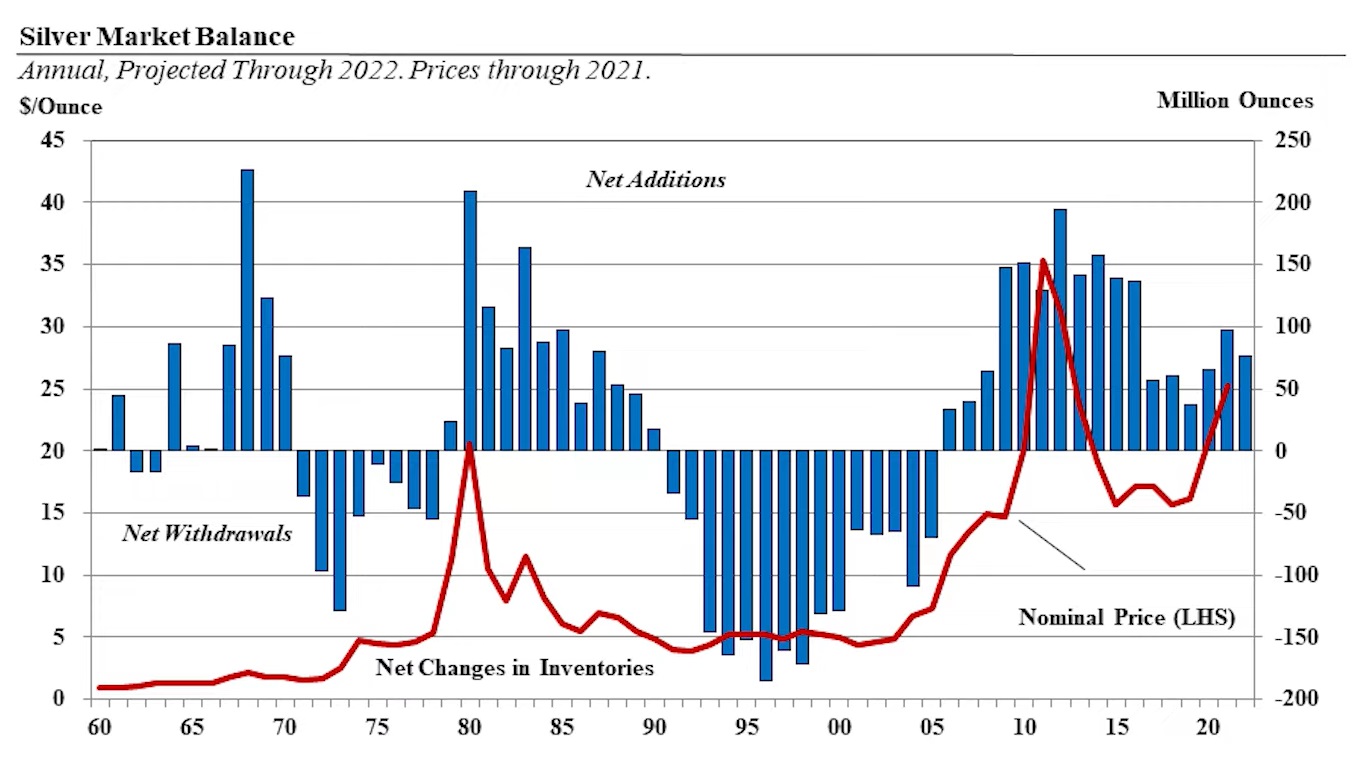
Balance in the silver market (Source: CPM Group)
The annual supply of silver has continued to increase in recent decades, but not anymore in recent years. This is due to a stagnation of silver mine production. The demand for silver also seems to have stabilised in recent years, although the composition of demand has fundamentally changed over the past few decades. Before the turn of the century, a significant amount of silver was still used for photography, but today it is almost non-existent. Over the years, more and more silver has been used for electronics.
In the last ten years, we have seen two new applications for silver grow in size, namely solar panels and cars. A lot of silver is used in solar panels and there is also more precious metal in cars because of all the electronics. On average, an electric car requires 1.5 to 2 times as much silver as a petrol car. The demand for silver for these applications is expected to continue to increase in the coming years.
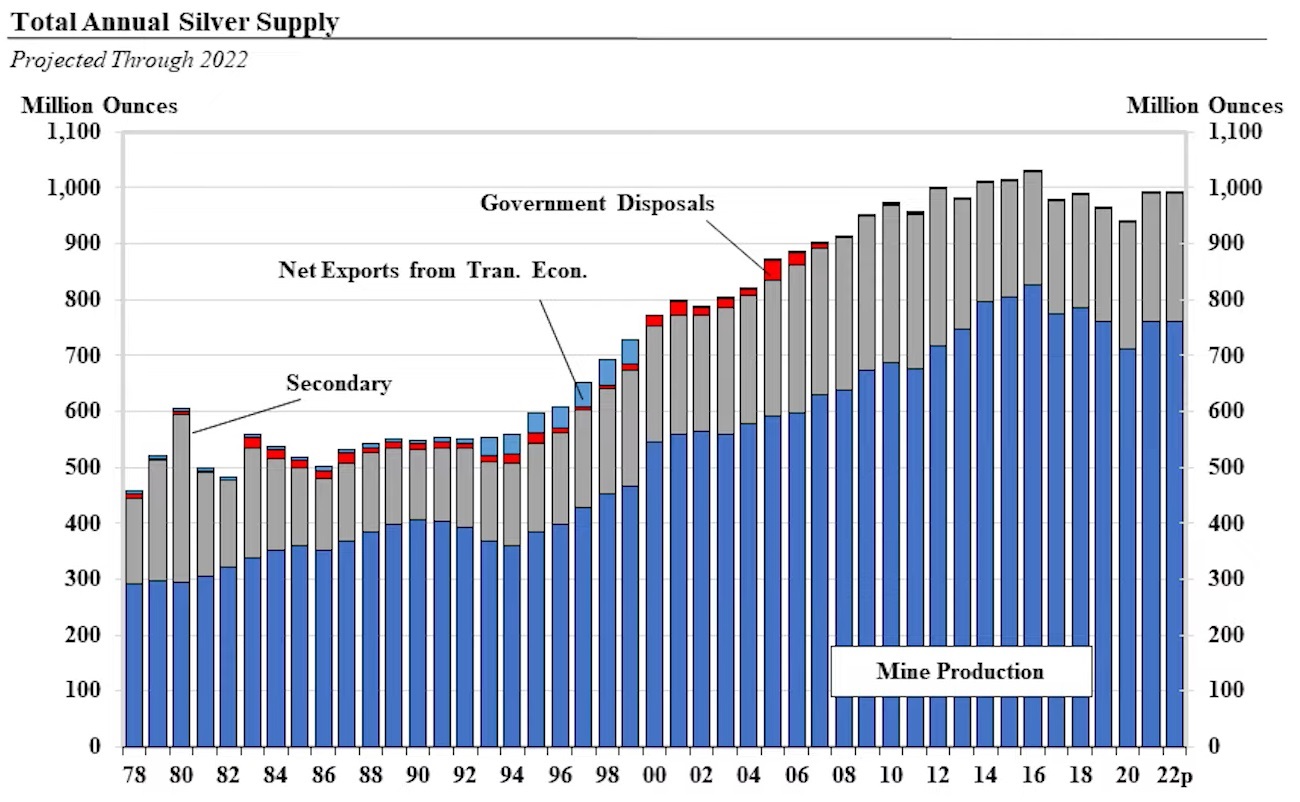
Supply of silver (Source: CPM Group)
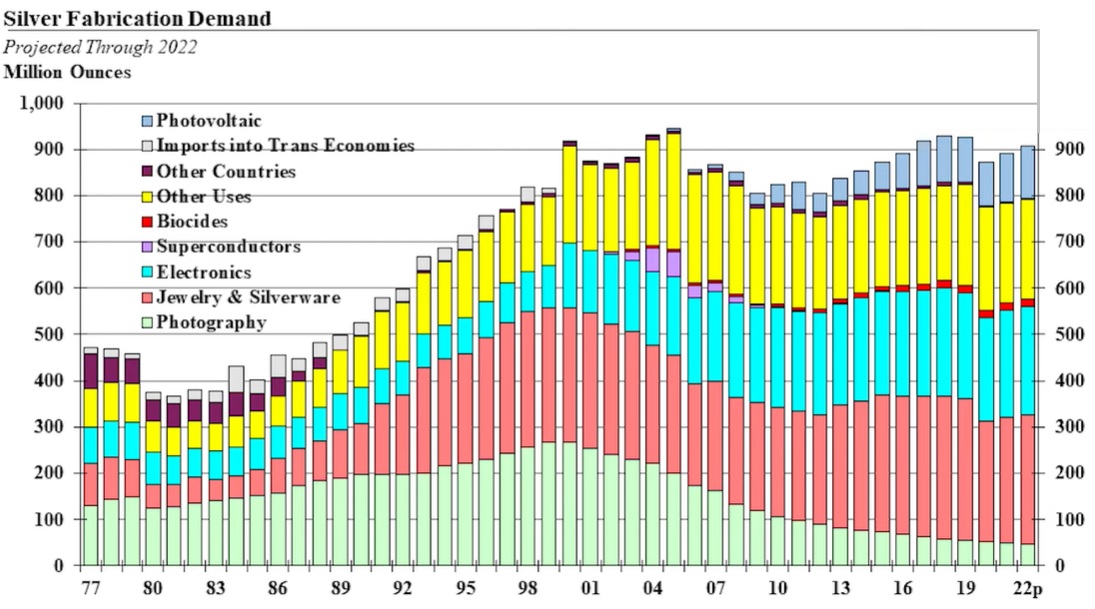
Industrial demand for silver (Source: CPM Group)
Investors have been selling silver in the form of ETFs in recent months, totaling around 100 million troy ounces since the beginning of this year. Other investors sell silver futures. On the COMEX, the position of speculators, the so-called Non-commercials, has turned from long to neutral in recent months. Commercial market players, on the other hand, show the opposite trend. They have been net short in recent years, but are now neutral again. That's because commercial parties sell silver on paper when investors want to go long.
According to Christian, this market dynamic has nothing to do with banks expecting the silver price to rise, let alone being able to manipulate the price. These two trends are mirrored to each other by the way commodity markets work. Commercial parties that hold physical stocks of precious metals typically have a short position on the futures market to hedge their positions. These market participants do not use futures contracts to speculate, but rather to hedge the price risk.
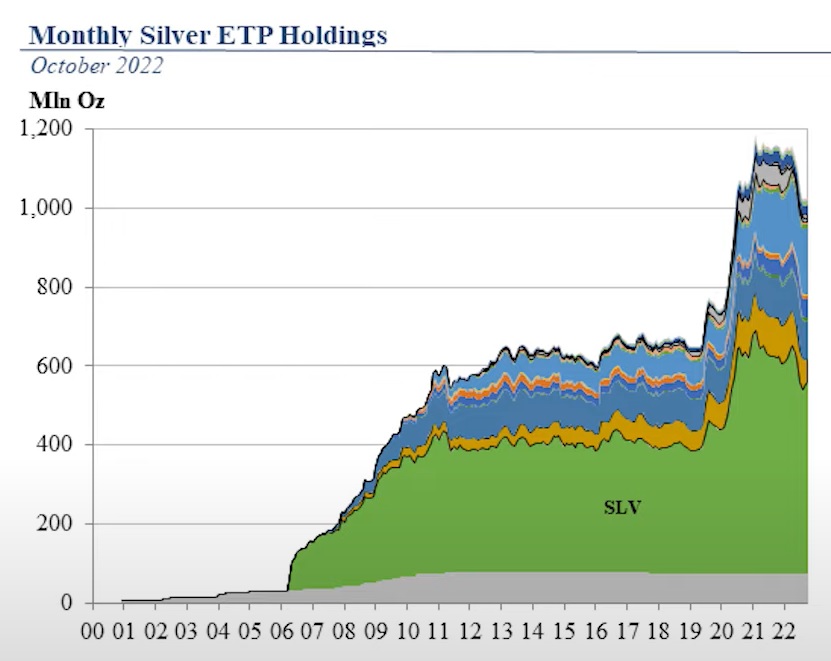
Silver stocks in ETFs (Source: CPM Group)
The premiums on Silver Coins have risen sharply in recent months, but that has more to do with a lack of production capacity of mints and logistical problems than with a shortage of silver. This is also evident from the fact that the premiums on larger silver bars of 100 troy ounces (a popular format in the United States) have risen much less rapidly. The fact that the premiums on these types of bars are now also approaching 20% shows that there is a lot of demand for physical investment silver and that the supply is becoming scarcer. However, there is no shortage yet.
The price of investment silver usually follows the price of silver contracts, plus a premium for production, transportation, and the like. At the current premiums, it will be more attractive for mints to increase their production. Investors can also take advantage of the high premium on coins by, for example, exchanging silver coins for relatively cheaper ones Silver bars.
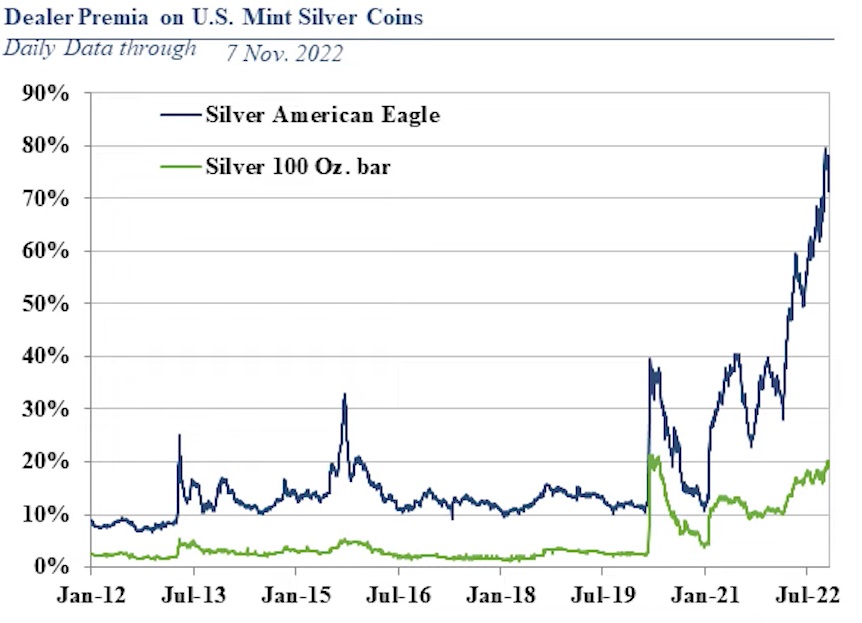
Premiums on silver coins and bars (Source: CPM Group)
Silver inventories in London have fallen from the peak of 1.15 billion troy ounces at the end of last year to 850 million troy ounces now. According to Christian, this is partly due to sales of ETFs and partly due to banks that have reduced silver stocks that they hold on behalf of customers. With regard to the silver stocks in the COMEX, he does not see any significant developments. While inventories have fallen significantly compared to the beginning of 2021, they have not reached extreme levels from a historical perspective. He also notes that historically, there has been no relationship whatsoever between the development of silver stocks and the price of silver. Sometimes they move in the same direction and sometimes they don't. Most of the time, there is no correlation at all.
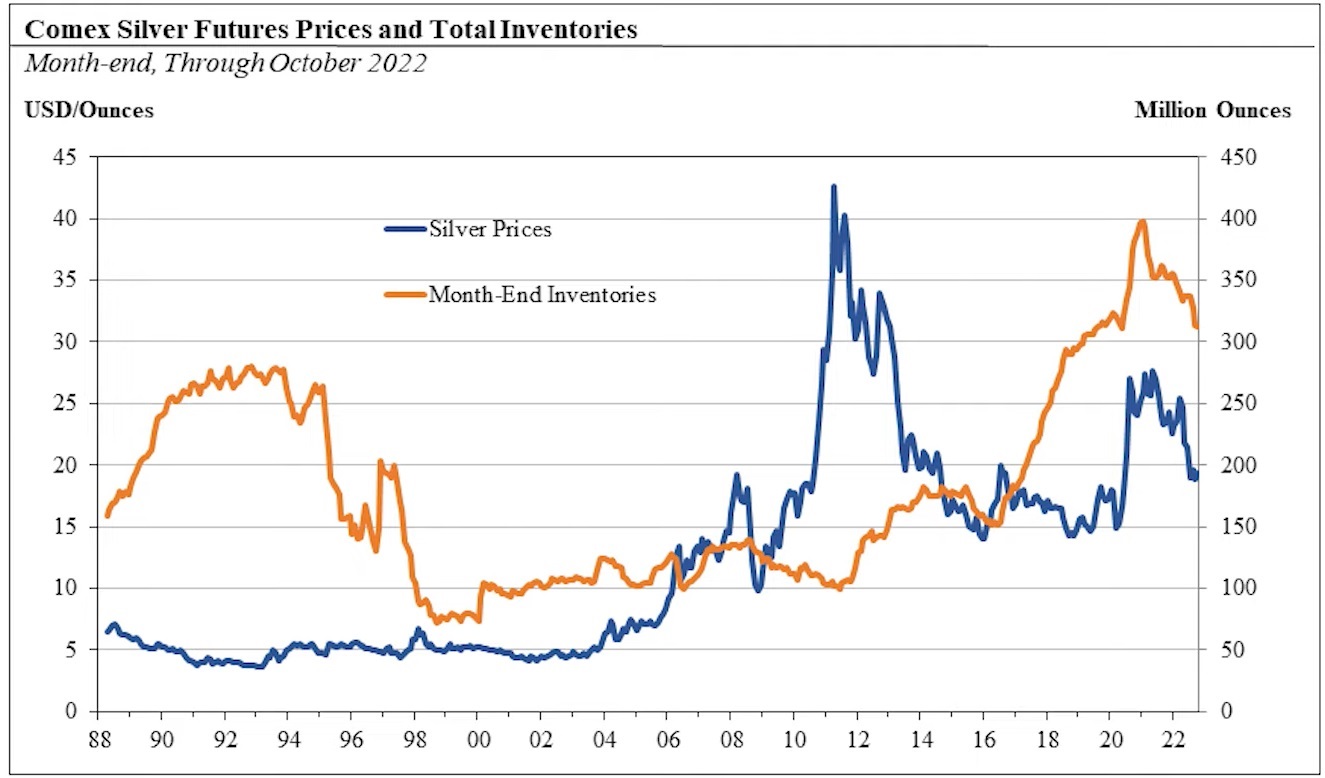
No relationship between silver stocks and silver price (Source: CPM Group)
Finally, Christian looks at the Lease Rates of silver, the interest that market participants are willing to pay to borrow silver for a period of 2 to 12 months. These rates have risen sharply since the beginning of this year, but according to Christian, that has little to do with a possible scarcity of silver. Average rates fluctuate in line with market interest rates, which have risen sharply since the beginning of this year.
Finally, the CPM Group analyst notes that there is no such thing as a single interest rate for borrowing or lending gold or silver. This is entirely dependent on the creditworthiness of the party that wants to borrow the precious metal. If the counterparty is a central bank, the risk and therefore the interest rate is much lower than when it comes to a jeweller or gold mine, for example. In addition to credit risk, market participants also take market risk into account.
 Have a look at us YouTube channel
On behalf of Holland Gold, Paul Buitink and Joris Beemsterboer interview various economists and experts in the field of macroeconomics. The aim of the podcast is to provide the viewer with a better picture and guidance in an increasingly rapidly changing macroeconomic and monetary landscape. Click here to subscribe.