English
EN


By: Frank Knopers
Global demand for gold rose to 1,234 tonnes in the first quarter of this year, the largest volume since the fourth quarter of 2018. Compared to a year ago, demand even increased by 34%. The main reasons for this are High inflation and the war in Ukraine, which is causing savers and investors to seek refuge in the precious metal. This is what the World Gold Council in its latest quarterly gold market report. Central banks also bought more gold.
The Gold price rose to more than $2,050 per troy ounce in the first quarter, approaching the previous record set in August 2020. In euros, the price of the precious metal even rose to a record high due to the further depreciation of the euro. This development was accompanied by a flight to investment gold, as total investment demand was twice as high as a year ago, with a total of 550.7 tonnes of gold.
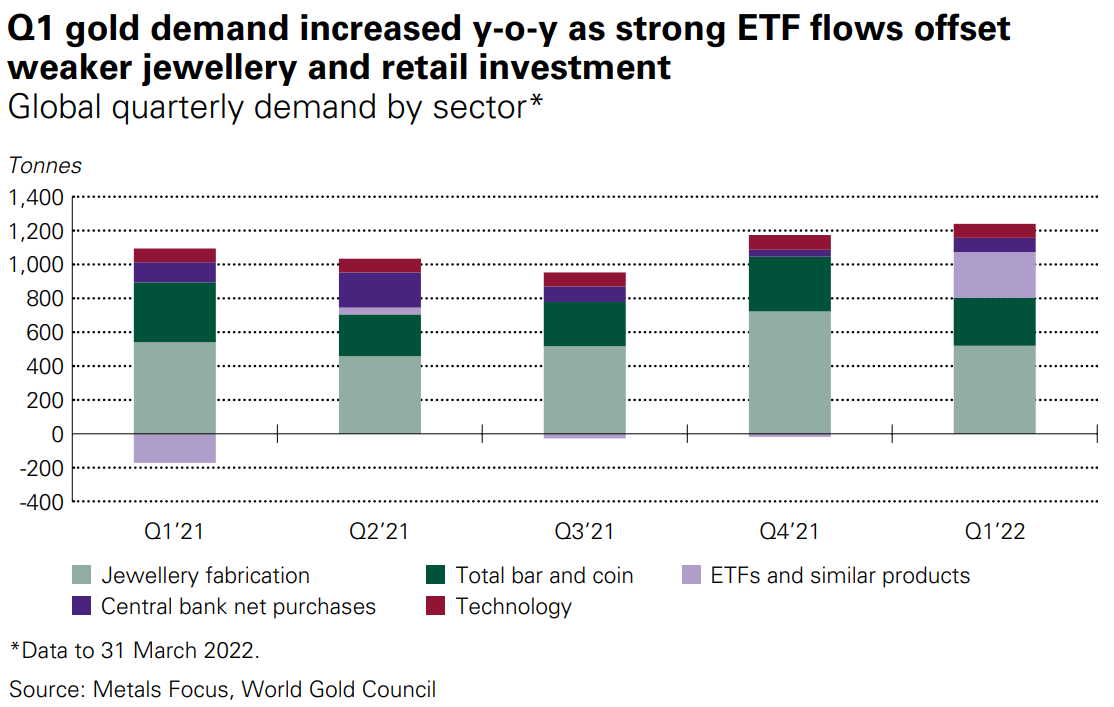
Total demand for gold increased in first quarter of 2022 (Source: World Gold Council)
According to figures from the World Gold Council, investors bought 268.8 tonnes of gold in the first quarter of this year through so-called Exchange Traded Funds (ETFs). These are shares of investment products that hold physical gold as collateral. Last year, investors sold these listed investments because interest rates started to rise. But with inflation skyrocketing and geopolitical turmoil mounting, investors are returning to the precious metal. The chart below shows how much gold investors buy or sell each quarter through ETFs.
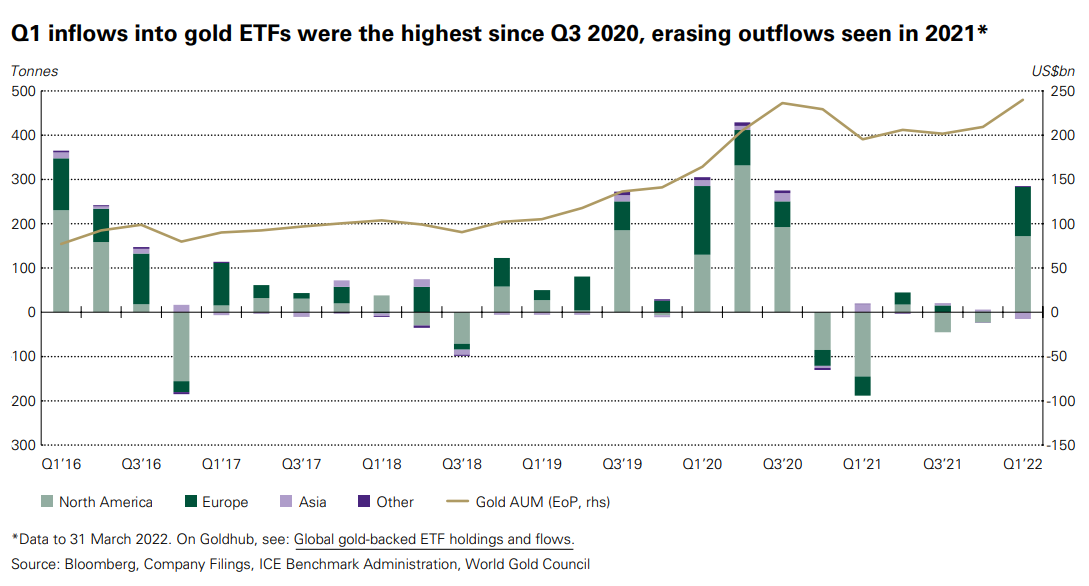
Investors added gold to their portfolios again en masse (Source: World Gold Council)
Immediately after the Russian invasion of Ukraine, we saw a run on physical gold, especially in Western countries. In Europe, demand for coins and bars rose to 78 tonnes, the highest level since the second quarter of 2013. Worldwide, however, fewer coins and bars were sold than one year previously. This is mainly due to a drop in demand in China, where price-conscious consumers are less likely to be able to cope with the price increase. Buy gold. Demand for coins and bars in that country fell by 43% last quarter compared to a year earlier, to 49 tonnes.
It was mainly Western economies where the demand for physical gold rose sharply in the first quarter of this year. This is also confirmed by figures from the American mint, the U.S. Mint. In the first quarter of this year, it sold a total of 518,000 troy ounces to Golden Eagle and Buffalo coins, which account for more than $1 billion in revenue. Only in the first quarter of 1999 did the mint sell more gold coins, but then the gold price was less than $300 per troy ounce. Expressed in currency, there are now much larger amounts of money in the gold market than more than twenty years ago.
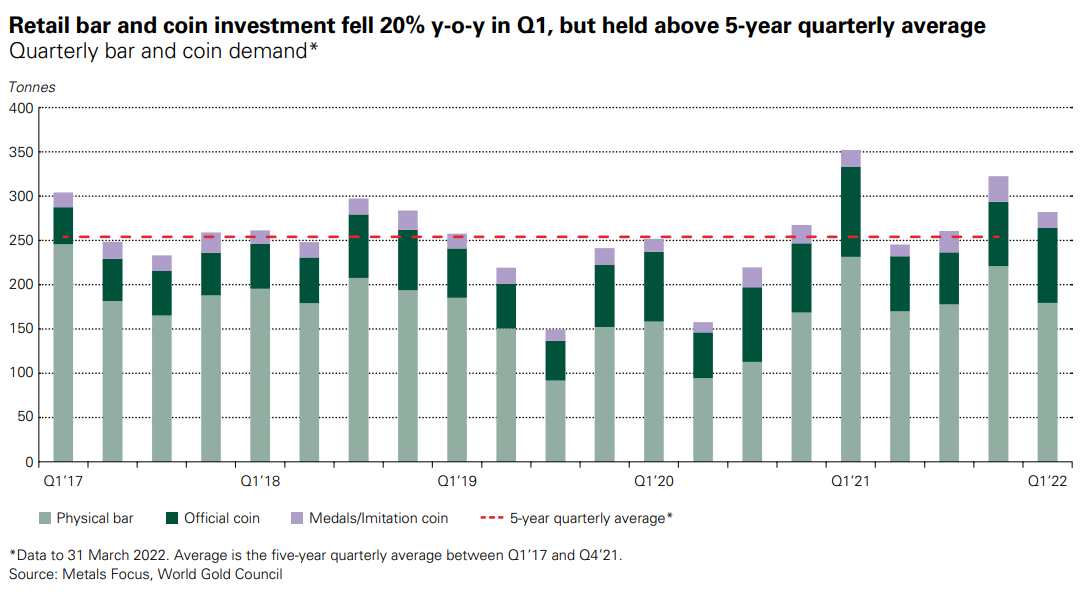
Demand for gold coins and bars is still significant (Source: World Gold Council)
In the first quarter, central banks bought twice as much gold as in the fourth quarter of last year, with 84 tonnes, but less than the average over recent years. While central banks worldwide bought gold structurally until the start of the corona crisis, we have seen a more erratic picture in the last two years. This is because some countries have stopped buying gold structurally, while other countries occasionally make very large purchases or sell some gold.
For example, in the first quarter of this year, Egypt bought 44 tonnes of gold at, increasing its gold holdings by 54%. Turkey bought 37 tonnes of gold, bringing its total gold reserves to 430 tonnes. These large purchases were offset by significant sales by Kazakhstan (34 tonnes) and Uzbekistan (25 tonnes). These countries have bought up part of the domestic production in recent years.
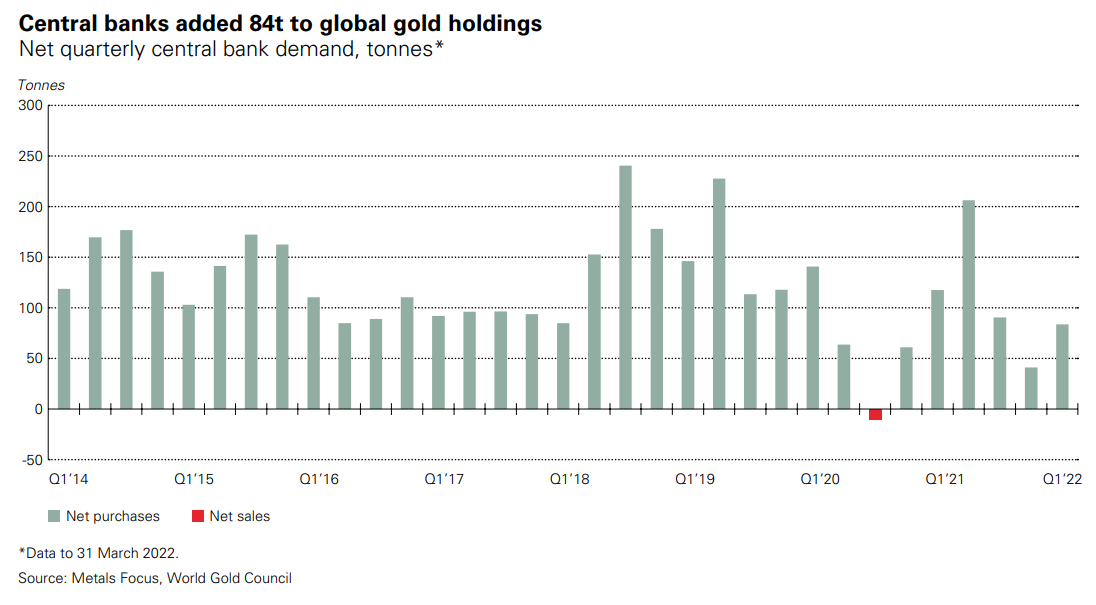
Central banks continue to buy gold, but at a slower pace (Source: World Gold Council)
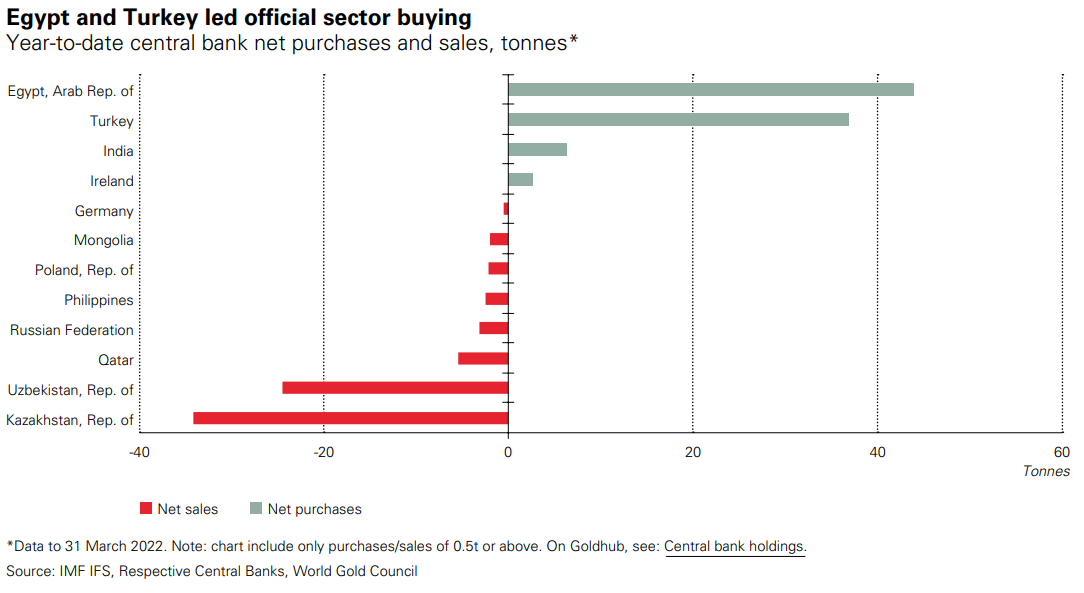
Egypt and Turkey in particular bought a lot of gold (Source: World Gold Council)
As volatile as the Gold Mine Stock Prices so stable is their production. In the first quarter of this year, global production rose by 3% to a new record. As the graph below shows, there has been little growth in global mine production in recent years. It is therefore difficult for gold mines to further increase production, despite the much higher gold price and therefore the potential yield.
Almost all gold mines can achieve a good profit margin at the current gold price, but it is not easy to further increase production and discover new gold veins. As a result, the sector has been talking about Peak Gold, the moment at which gold mine production can no longer increase further. That point has not yet been reached, but at the same time we can conclude that the supply of gold is not very elastic. A much higher gold price does not yet ensure that mines extract much more precious metal from the ground. As a result, the precious metal remains relatively scarce and valuable.
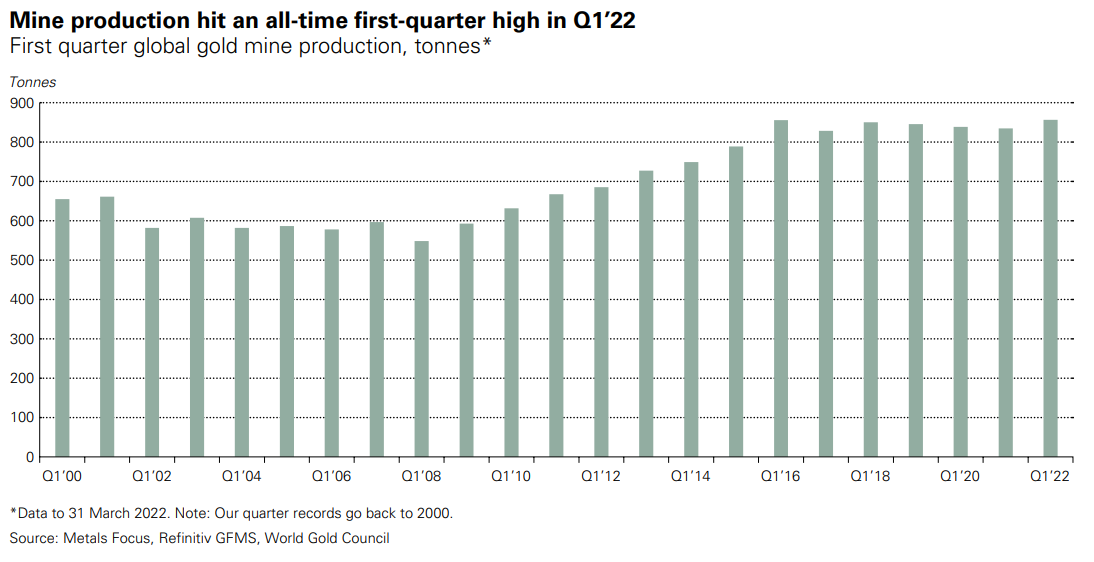
Gold mining sector production reaches new record, but increase levels off (Source: World Gold Council)
As the above-ground gold supply continues to increase relative to the annual mine production, an increasing share of the global supply of gold will also come from recycling. In the first quarter of this year, a total of 856.5 tonnes of newly mined gold came onto the market, while recycling already accounted for 310 tonnes of gold. The supply of scrap gold usually moves in line with the gold price. The graph below shows the development of recent years.
The attentive reader will discover that supply and demand are not exactly equal in these figures (see the table at the bottom of this article). That's because some of the demand is difficult to measure by the World Gold Council. In its own calculation method, this difference falls under the heading of OTC and other. These are, for example, direct transactions between parties (over the counter), stock changes of exchanges and producers and rounding differences.
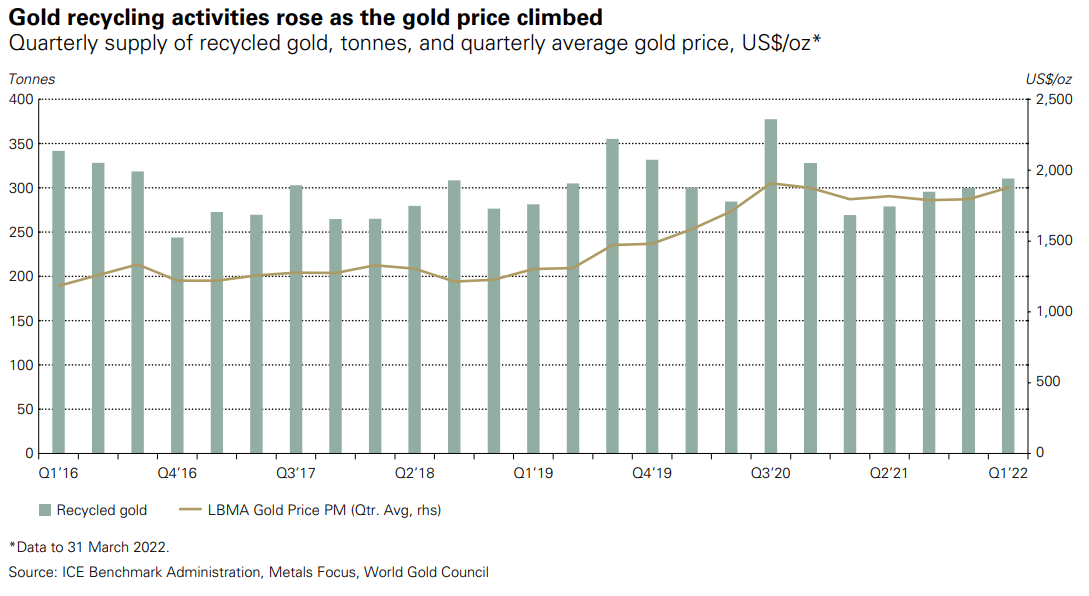
Supply of recycled gold remains fairly constant (Source: World Gold Council)
The new quarterly report of the World Gold Council confirms the trend that we are also observing in the industry. The demand for investment gold is increasing, especially in Europe. And there are plenty of reasons for that. Not only does skyrocketing inflation make it attractive to buy gold, but the depreciation of the euro and geopolitical turmoil are also causing a flight to safe havens.
In addition to gold coins and bars, gold ETFs were also in high demand in the first quarter, suggesting that asset managers and institutional investors are also buying gold more often. A wise choice, because gold has proven to be a good form of diversification in the investment portfolio. In addition, the precious metal has built a strong track record in uncertain times with high inflation and negative real interest rates.
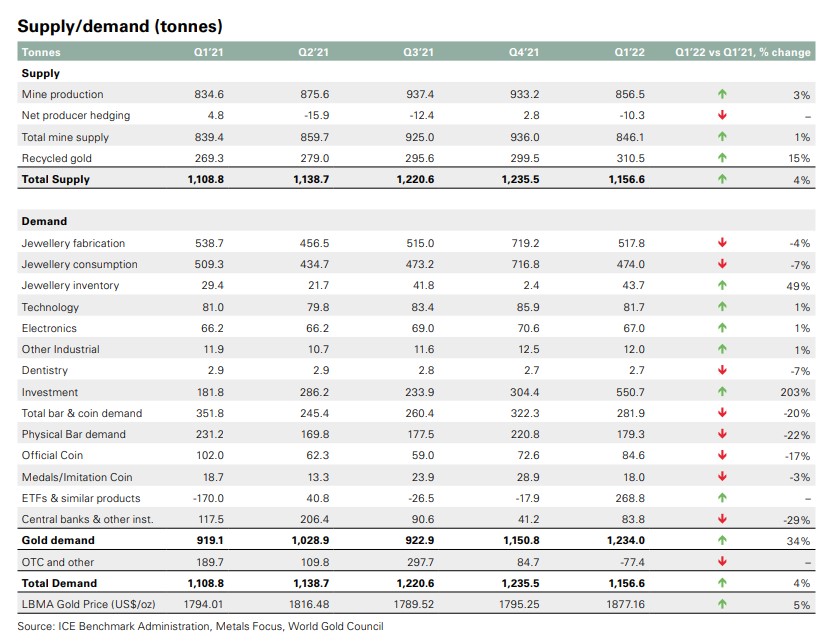
Balance of supply and demand in the gold market (Source: World Gold Council)
Do you want toBuy gold by means of Gold bars or Gold Coins? We are happy to help you with your order.