English
EN


We see that rising oil shortages are now leading to historically high prices. An economic shock, with slowing growth and rising inflation, appears unavoidable. According to the IMF, the global economy is once again facing a major test. What are the broader implications of this shock?
A rush among European and Asian refineries to secure oil cargoes, combined with uncertainty over the durability of the ceasefire, has pushed North Sea oil prices to a record high, reports the Financial Times. The price of oil produced off the British coast rose to nearly $147 per barrel. Forties Blend, a widely used benchmark for immediately deliverable North Sea oil, thereby broke above the previous record levels seen just before the financial crisis of 2008.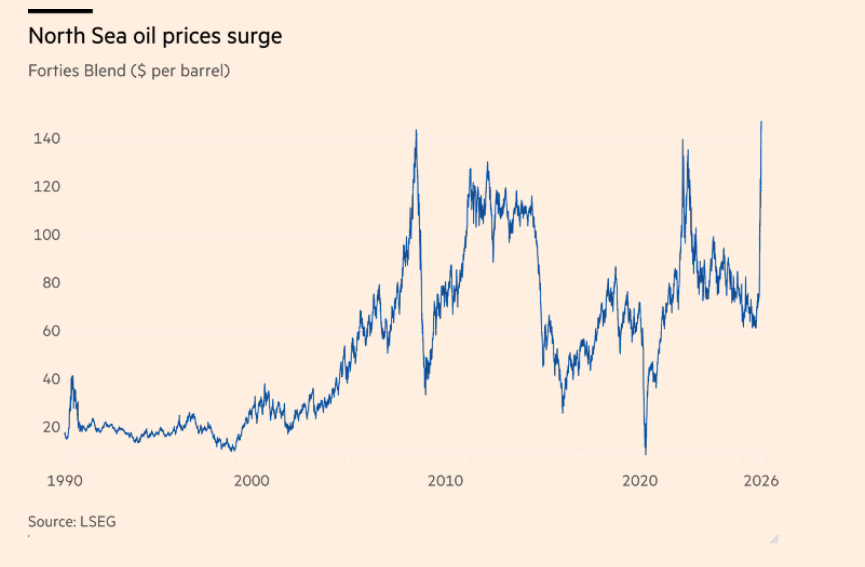
The price of North Sea oil rose to a record high (source: Financial Times)
Saudi Arabia announced on Thursday that a series of attacks on oil facilities this week are affecting production and exports. The attacks have taken more than 600,000 barrels per day of production capacity offline and reduced transport capacity on the East-West pipeline by 700,000 barrels per day. This pipeline can normally transport around 7 million barrels per day, of which 5 million were intended for export. Globally, there is now a daily shortage of more than 10 million barrels of oil.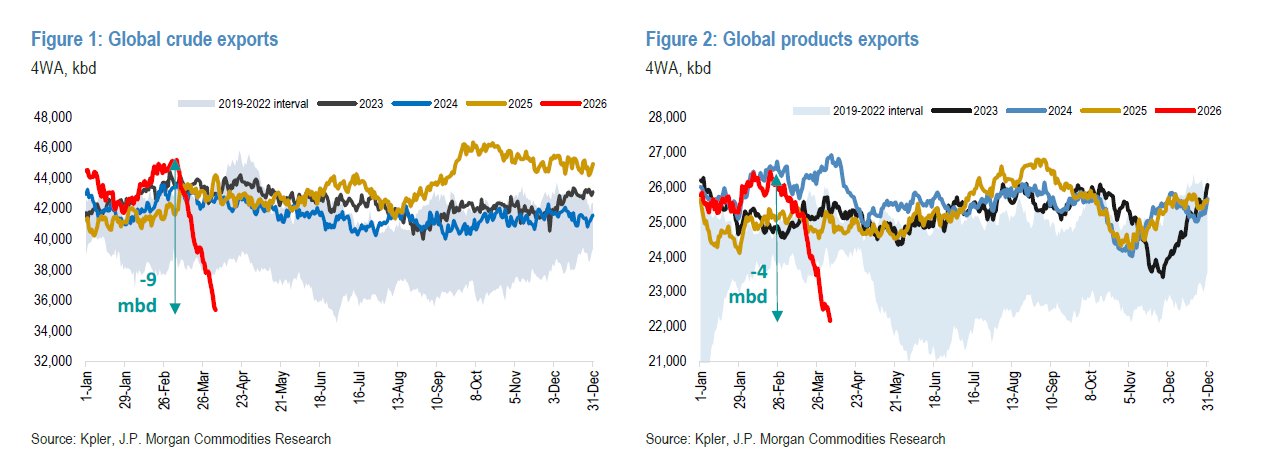
Global exports of crude oil and refined products significantly lower since the conflict (source: Kpler / J.P. Morgan)
One country appears to be benefiting from this. U.S. oil exports are heading toward a record of five million barrels per day. Based on current loading volumes, exports in April are already approaching around 4.9 million barrels per day, compared to approximately 3.97 million barrels per day in March. Analysts expect exports to increase further in May. Bloomberg notes, however, that constraints in shipping capacity and rising transport costs make it difficult for exports to rise significantly above 5.5 million barrels per day.
Dutch consumers are particularly affected by the oil crisis. According to Euronews, the Netherlands has the highest prices in Europe for petrol and diesel. The price for a liter of diesel in the Netherlands stands at €2.46 (as of March 30), more than double that of the cheapest country, Malta (€1.21). Taxes have a major impact on fuel prices.
Due to damage to energy infrastructure, even an immediate peace will not be able to prevent economic damage; energy markets have been permanently altered. We already discussed this in previous weekly selections and in this week’s podcast with Ewald Engelen. According to The Economist, a lasting risk premium is also likely to remain embedded in oil prices, reflecting the risk of renewed fighting. Iran could also begin charging tolls in the Strait of Hormuz.
According to the British publication, shortages of fertilizer, for which the Gulf region is a key supplier, have already disrupted the planting season in the Northern Hemisphere and parts of Africa. This will lead to lower food supply and rising global hunger. Supply chains for petrochemicals, helium, and aluminum are also under pressure. All of this will weigh on global growth and fuel inflation. In other words, stagflation. For investors, this means lower returns, as corporate profitability comes under pressure.
Kristalina Georgieva (source: IMF)
IMF Managing Director Kristalina Georgieva stated in a speech that the global economy is once again facing a major test. According to the IMF, the supply shock affects us through three channels: prices & supply, inflation expectations, and financial conditions.
The first we have already discussed, and regarding the second she says the following: if inflation expectations risk becoming unanchored and trigger a costly inflation spiral, central banks must act decisively with interest rate hikes. Fiscal support (for example to lower-income households) should remain targeted and temporary. Rate hikes will, of course, further slow growth.
If a strong tightening adds a negative demand shock to the supply shock, monetary policy returns to a 'delicate balancing act', while fiscal policy — provided there is fiscal space — shifts to carefully calibrated support for demand.
It is precisely this fiscal space that is the problem in many European countries, Ewald Engelen noted in our podcast. We are dealing with historically high budget deficits and government debt. According to him, governments may therefore look for additional resources, for example from pension funds.
The IMF has established a coordination group together with the World Bank and the International Energy Agency and will take the lead in the macroeconomic domain, including helping countries to better target their fiscal support. Georgieva further notes that most countries have so far stayed the right course in fiscal policy by refraining from broad-based tax cuts, energy subsidies, and price controls.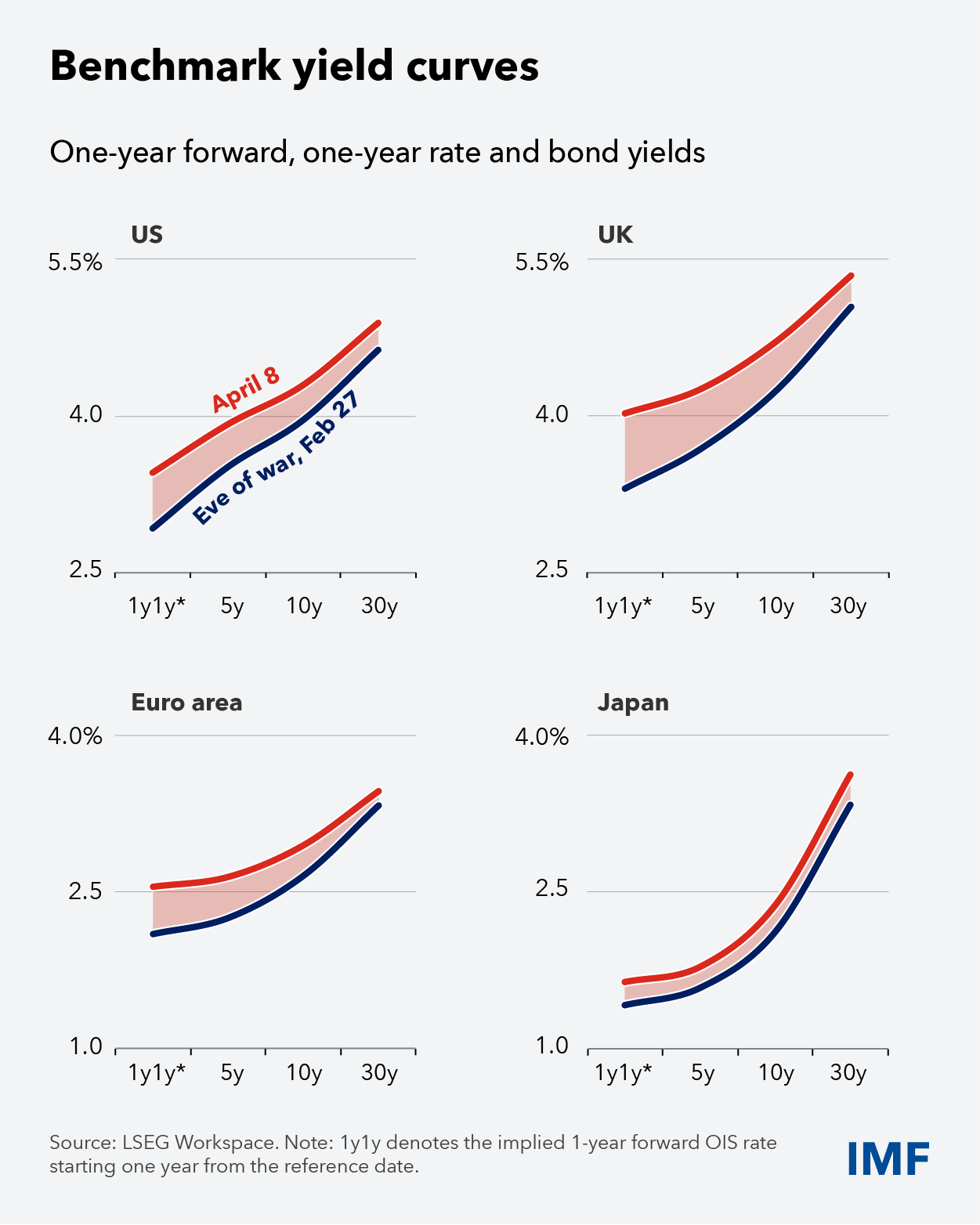
Rising interest rates since the war (source: IMF)
She also observes that fiscal space among governments is limited and that interest rates on government debt are already rising. Countries must therefore use their resources carefully and rebuild buffers after the shock. Whether that will happen remains uncertain. She expects demand for IMF support to increase by $20 to $50 billion in the short term. Jack Hoogland expects that faster-rising budget deficits and government debt will be positive for the gold price.
Simon White, macro strategist at Bloomberg, argues that the war may have caused lasting damage to the dollar system. For the first time in decades, gold reserves exceed the dollar reserves of central banks. According to him, the market is once again turning to gold as a reliable global form of collateral, at the expense of the dollar.
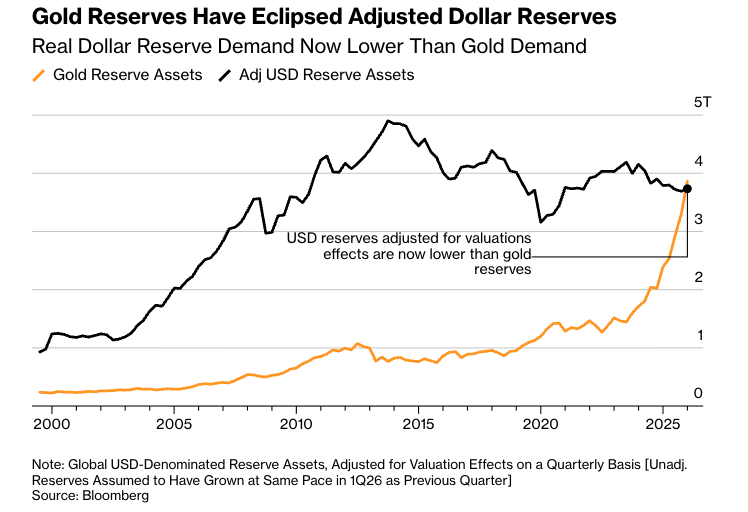
This is driven by growing distrust in the dollar system. Confidence had already declined after the freezing of Russian assets. The core of the global monetary system is now under pressure: the mechanism by which trade surpluses are recycled into dollar assets, allowing the U.S. to finance itself cheaply in exchange for security and stability. This process of de-dollarization is unfolding gradually. Read the full article here.
Also take a look at our YouTube channel
On behalf of Holland Gold, Paul Buitink and Yael Potjer interview various economists and experts in the field of macroeconomics. The aim of the podcast is to provide viewers with better insight and guidance in an increasingly fast-changing macroeconomic and monetary landscape. Click here to subscribe.