English
EN


Gold rose yesterday by 2% and silver by 5% following renewed hopes for an end to the conflict in Iran. Trump announced that talks with Iran will be resumed in Pakistan in the coming days. Precious metals are highly sensitive to developments in the oil price, but for now remain within a trading range. Banks such as HSBC and UBP, as well as the Chinese central bank, see this as a buying opportunity for gold.
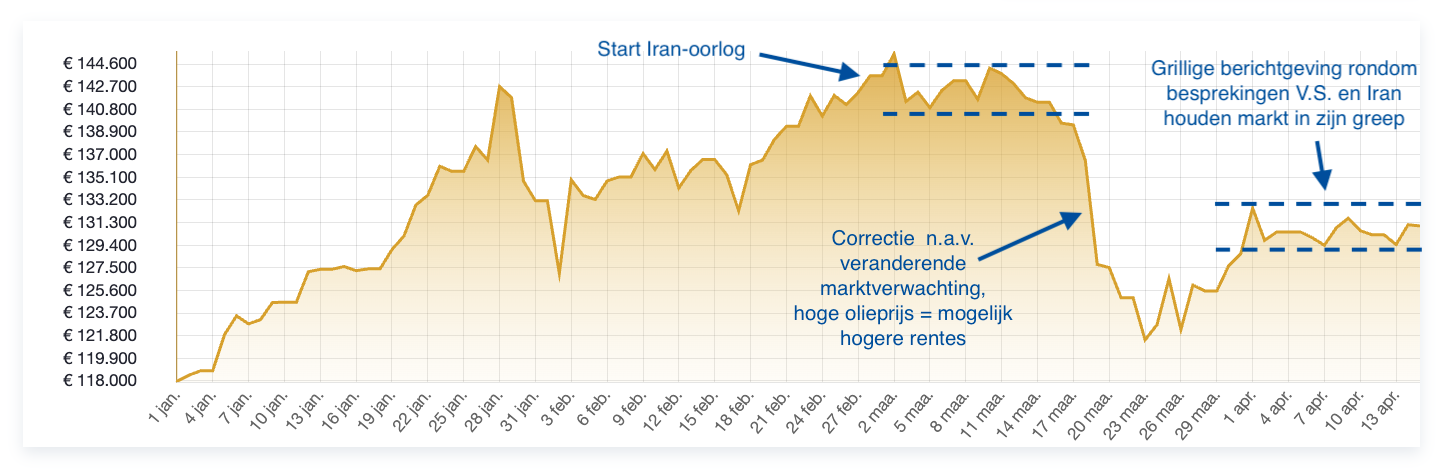 The gold price since the beginning of 2026.
In recent days, the outlook surrounding the Iran war has changed almost daily. News of a ceasefire lifted equities and precious metals. This was followed by reports that JD Vance returned from negotiations empty-handed, and continued attacks by Israel on Hezbollah in Lebanon further diminished hopes, causing markets to decline again. Last night, it was announced that negotiations will nevertheless resume. Gold and silver rose by 2% and 5% respectively, after having declined in the preceding days. According to the latest reports, Trump expects the war to be “nearly over”.
Although gains and losses are following each other rapidly, precious metals prices do not appear to be breaking out. “Markets are caught between expectations that the conflict will end soon on the one hand and unresolved inflation concerns on the other,” said Dilin Wu, market strategist at Pepperstone Group. Even in the event of a swift end to the war, energy markets will need time to recover from the damage. This also means that central banks may delay interest rate cuts until inflation driven by high energy prices has eased. This, in turn, implies that the gold price will continue to fluctuate around current levels. It is worth noting that daily moves of 2% were virtually unheard of a few years ago, whereas such volatility is now becoming more common.
A few weeks ago, we reported that many banks, despite the Iran war, maintain higher price targets for gold. Notably, they are also acting on this view. Swiss bank UBP (Union Bancaire Privée), a private bank with $233 billion in assets under management, is increasing its gold position again. It forecasts a gold price of $6,000 by the end of 2026 and expects long-term macro trends to outweigh short-term inflation risks for gold. The private banking division of HSBC is following a similar strategy, increasing gold positions as a hedge against the risks of high energy prices in emerging markets such as India. HSBC is doing so specifically because of the Iran war.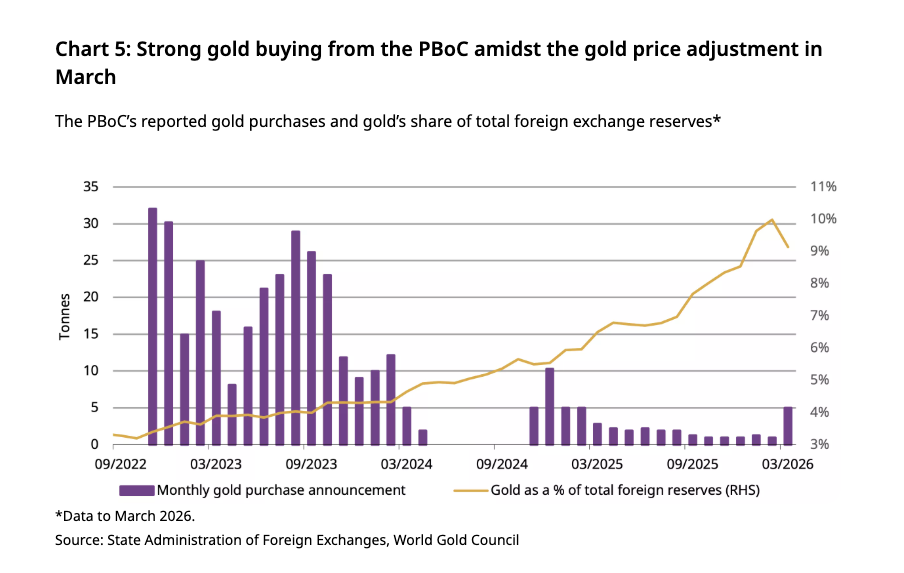
Gold purchases by the Chinese central bank increased again in March 2026, and gold is making up a growing share of total foreign reserves (such as dollars and dollar-denominated bonds). Source: World Gold Council.
The Chinese central bank has purchased gold for the 17th consecutive month in March and appears to have taken advantage of lower gold prices for new acquisitions. Over the years, gold has become an increasingly large share of foreign exchange reserves, partly due to the appreciation of the yellow metal and continued purchases. Chinese investors are also continuing to buy gold in large volumes. Even after price declines in March, gold positions in ETFs (paper gold contracts) are being expanded. In the first quarter of this year, $8.5 billion was invested in gold, equivalent to 50 tonnes of gold. 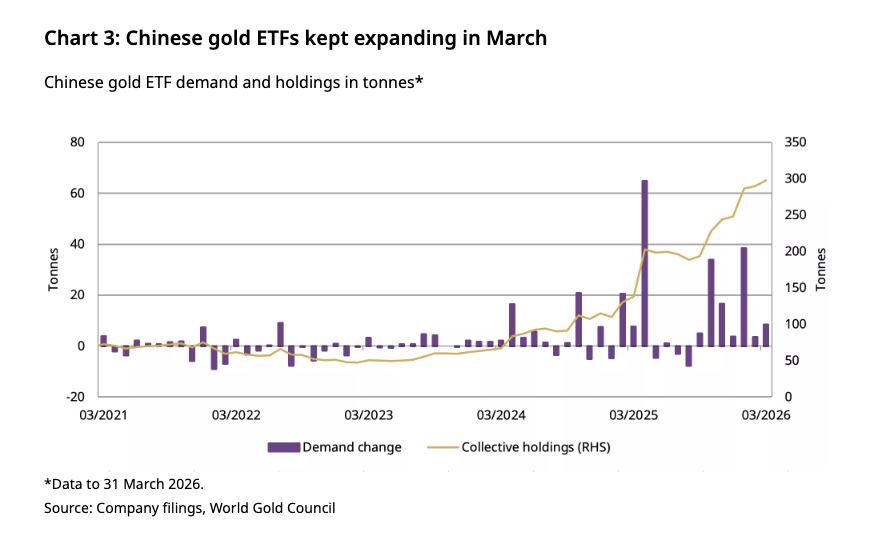
Chinese investors allocated $8.5 billion to gold ETFs in the first quarter of 2026, source: World Gold Council
Be sure to also check out our YouTube channel
On behalf of Holland Gold, Paul Buitink and Yael Potjer interview various economists and macroeconomic experts. The aim of the podcast is to provide viewers with better insight and guidance in an increasingly fast-changing macroeconomic and monetary landscape. Click here to subscribe.