English
EN


In the Previous piece we described how Roman emperors cheated with the money on a large scale. Again and again, the content of precious metal in coins was reduced. This deterioration of money contributed to the fall of the great empire. After that, the world fell into the Middle Ages, a period that reminds many people of decline. But is that justified? Did the world really stand still and did people still use money in the Middle Ages like the Greeks and Romans did?
After the fall of the Roman Empire, a time of great uncertainty began. Several peoples invaded European territories and people increasingly withdrew from the cities. Domains were often self-sufficient, the so-called Court system. Because people were in great uncertainty, coins were mainly saved. Thus the system of the Romans in which the use of coins was widespread disappeared.
Coins disappeared from everyday payments. In present-day England, the Romans did not set foot on land, but even here, after the fall of the Roman Empire, they fell back on a Primitive system that was more like bartering. For example, land was often leased by giving up a part of the harvest and many transactions did not involve any currency
There were still coins in use, but they still dated from the time of the Romans or were privately circulated. There was no longer a single monetary system. The price of a product was sometimes expressed in a mix of both coins and other products. The coins that were put into circulation at the time did not have a standardized value, but each contained its own content of precious metals.
In fact, it was not until the eighth century that Emperor Charlemagne began to set up a new monetary system. His father, Pepin the Short, started with a new silver coin. This coin was called the medal and was struck after the example of the ancient Roman Dinarius. In addition, units of account were also introduced, the Solidus and the pound. One pound was equal to twenty solidi and a Solidus was worth 12 pennies again. The Solidus And the pound were not currencies at the time, but were only used to express transactions. As a unit of account, therefore, an important function of money. Gold was still very scarce in the early Middle Ages and for that reason hardly any gold coins were minted.
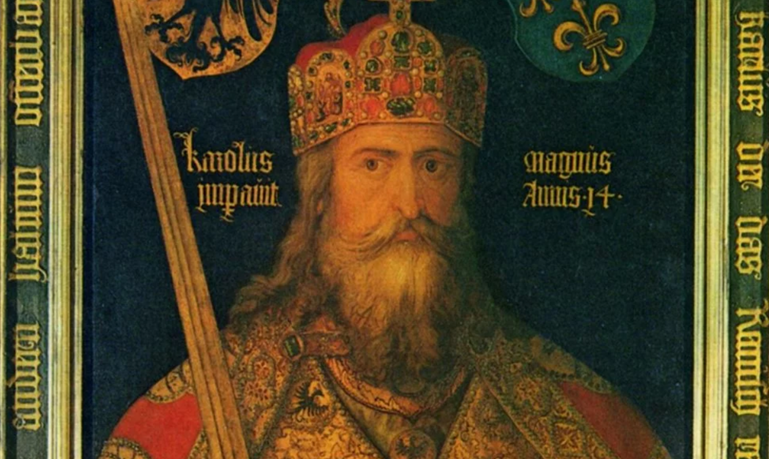
Emperor Charlemagne, painted in the fifteenth century (Source: History)
Under Charlemagne, the silver medal was used in a very large area. He also reduced the number of locations where coins could be minted and there were fixed regulations for what the coins should look like. Thus, for the first time since the Romans, a general coinage system with standardized coins was created.
In Charlemagne's empire there were estimated to be around the One hundred locations where coins were minted, many of which were very small. One of the locations where a lot of coins were minted was in Dorestad in the Netherlands. Between the 7th and early 9th centuries, this was an important trading place, located at the junction of the Rhine and Lek rivers. These two rivers could be used to transport goods in different directions. There was a large port, so a lot of silver came into the empire here. Dorestad was a very important city in the Middle Ages and A lot of trade. Some products that came from Dorestad were later found all the way back in Sri Lanka. The city fell into disrepair in the course of the 9th century. It is located on the spot where Wijk bij Duurstede is now located.
Because this monetary system was spread over such a large area, different names for the same unit also emerged. What is a given region Pound was, for the French, a Livre and for the Italians another lira. Also, a medal was a penny for the English and became a Solidus Another shilling mentioned in England. Charlemagne's empire did not last long, but it did set the tone for coinage.

The vast territory that Charlemagne managed to conquer (Source: Wikipedia)
In the High Middle Ages, trade was able to flourish after centuries of economic decline following the fall of the Roman Empire. A functioning money system was restored and monarchs owned larger and larger territories. In addition, new inventions were made. For example, a new type of plough was developed, which increased the production of food. In the late Middle Ages, trade cooperation was also added, such as the Hanse which was closed between German cities.
Trade between Europe and the Middle East was Huge boost through the Crusades. The Europeans bought carpets, jewelry, and other products on a large scale from the areas where the soldiers were shipped to. Of course, the troops and supplies needed for the Crusades had to be paid for. Also, a lot of coins from all kinds of different regions had to be exchanged to trade with other peoples.
The fact that the economy flourished also led to the rise of bankers. The demand for intermediaries increased as an ever-increasing number of coins came into circulation. The monarch was the Mint Lord of his territory and put into circulation his own coin which was minted in the local Mint. From the thirteenth century onwards, gold coins came into circulation again, because gold had become less scarce. One of the most well-known gold coins, the Florin, originated in Florence and was accepted in many areas. Later, the Florin was imitated all over Europe and so the first gold guilder was minted in the Netherlands in 1325.
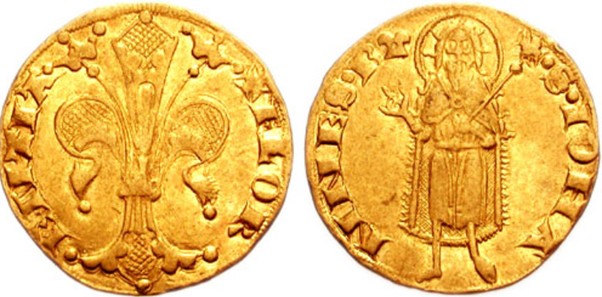
Gold florin minted in Italy in 1347 (Source: Wikipedia)
Transporting money for transactions was no easy feat and very dangerous at the time. Services were also offered for this. As early as the thirteenth century, bankers had set up a network that made transactions easy and fast. For example, a cash transport to Ghent from Champagne took only four days confiscated, whereas previously weeks were set aside for this. Later, cheques were also used for this type of transaction, which made transport much safer.
For example, intermediaries had emerged that provided for the exchange and transport of money. Religiously, Christians were not allowed to levy interest. Because in Judaism there are Only options were available, Jewish bankers became major providers of wealth. Many of these loans also required collateral. A building where loans could be taken out was also popularly called 'de Lommerd'. The word originates from 'Lombardy', the region in the north of Italy where banking reigned supreme in the Middle Ages.
The kings of both England and France were also in great demand for credit. These were very risky loans, because they were often borrowed to finance wars. As a result, the loans sometimes had interest rates of up to sixty percent. The French and English kings even exiled Jewish bankers when they were at their wits' end and loans could not be repaid.
In England, bankers emerged after the Middle Ages because gold was deposited with goldsmiths, but in the Middle Ages, bankers were created for other reasons. This is reminiscent of the ancient Greeks, because here too bankers started as a kind of exchange bureau in the commercial centres.
It is very interesting to see how in the Middle Ages the thread was slowly picked up again and later a flourishing trade arose. The image that dismisses the Middle Ages as a boring period is therefore partly unjustified. The foundation for the renaissance had been laid, a period in which the Netherlands would become a global player.