English
EN


In the Previous Part The series on monetary history described how the Greeks used coinage, but also how the Athenians' money deteriorated in quality and how this went hand in hand with the decline of the power of the Athenians. The Romans also had an extensive coinage system. Unfortunately, the quality of these coins also deteriorated as time went on. What did the coins of the Romans look like and how did the Roman Empire fall?
Different coins in circulation
The Romans had several coins, varying in both the material from which the coin was made and the value that the coin represented. In the early days of the Roman Empire, bronze coins were popular. At that time, the Romans did not have silver mines at their disposal and had to rely on the supplies of other European territories that were conquered. Even when silver became available, the Romans held on to bronze for a while. For a long time, bronze coins were the only legal tender in Rome, even though silver was available.
In this respect, the Romans are somewhat similar to the Spartans in Greece, who are said to have used low-grade iron bars in ancient Greece. One of the reasons that bronze was retained may be that the Romans wanted to reduce the influence of foreign countries, as can be read in The Lost Science of Money. Whatever happened to the conquered territories, this would have no effect on the coinage used in Rome.
Although bronze coins were preferred for a while and silver coins did not circulate in Rome at that time, silver coins were used to make payments to soldiers to be met. In areas outside the Roman Empire, silver coins were mainly used. As a result, troops residing in border areas preferred silver money. Later, silver coins were put into circulation and silver was also used in Rome, for example with the Dinarius. The bronzes Dupondius and the brass Sestertius were used for day-to-day payments.
For the Roman upper class, gold was a way to sell their wealth to the world to show. Gold decorations and jewellery were expensive and therefore a prerogative for the wealthy. It was not until fairly late that gold was minted and gold could also be used in the Roman Empire. Thus the golden became the Aureus only under Julius Caesar, who reigned from 48 BCE, Frequently minted. These pure gold coins kept a very stable value for a long time and even rose rapidly in value when inflation increased, about which more later.
Propaganda
For a long time, people were depicted on the coinsPictured who had played an important role in the development of the Roman Empire. It wasn't until Julius Caesar called the shots that Roman Emperors Themselves on the coins. The coins were therefore an important Communication and propaganda channel. Especially in remote areas, the coins told the population who actually ran their empire. Research into ancient Roman coins also gives us information about the state of affairs in Rome. For example, it turned out that a emperor which was thought not to have really existed, to have reigned for a time.
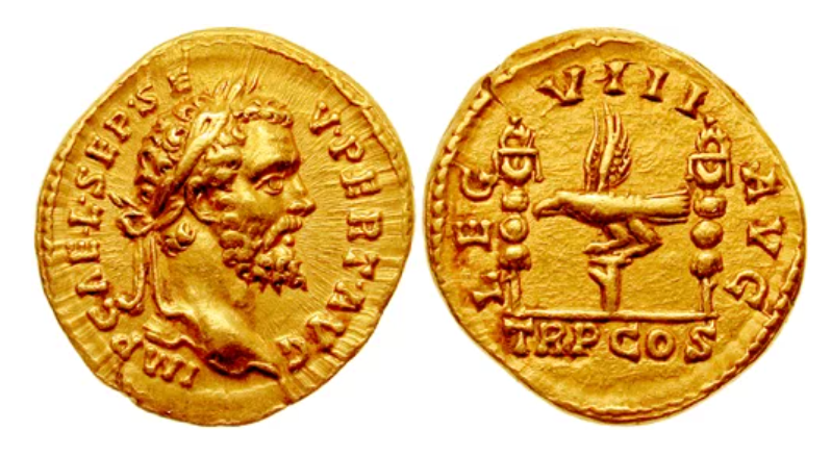
The coins of the Romans are now worth thousands of euros (source; History)
Tampering with coins
The Roman Empire expanded rapidly. The cost of maintaining the vast empire increased, but this did not cause any problems as long as revenues also increased due to an increasing number of taxpayers. When the pace of expansion slowed down and was finally halted, higher and higher taxes had to be levied. Later, the Roman emperors began to mix coins with low-grade metals, which allowed the gap in the budget to be filled. After all, more coins can then be minted without the need for more precious metal. However, this decision would prove to be catastrophic for the value of the coins and thus the stability of the price level.
It has happened several times that the money of the Romans was used toCheated. Several emperors saw the way to make extra expenditures by reducing the quality of money. Emperor Nero introduced a new coin that contained less silver to rebuild burnt-down Rome. The precious metal content in coins was further reduced by wage increases for soldiers.
Emperor Caracalla introduced the double Dinarius, a coin that had twice the value of a normal one.Dinarius, but nevertheless contained the same amount of silver. When Emperor Aurelion came to power in 270 AD, he reduced the percentage of silver in a coin to a paltry 5 percent. Again and again, wars and large construction projects were financed by reducing the precious metal content in coins.
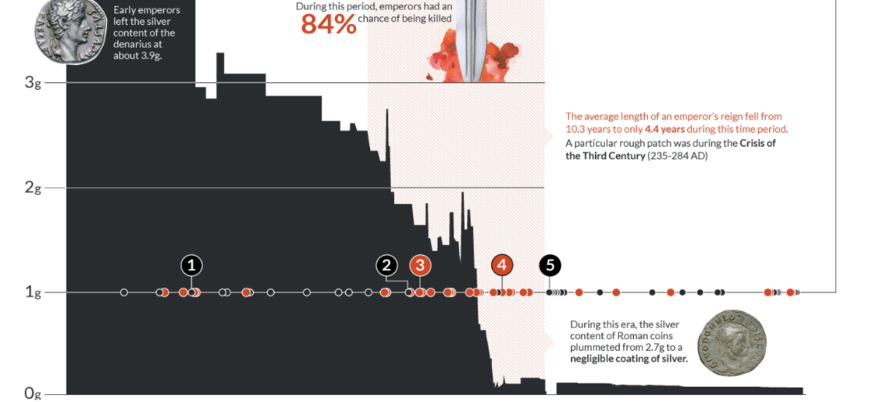
Especially in turbulent times, the quality of the coins deteriorated. Monetary deterioration goes hand in hand with the number of emperors who have been killed. (Source; Money.visualcapitalists)
Even when Diocletian later made some attempts reforming the system, prices continued to rise. The emperor did mint new coins of higher quality, but so many bad coins had been minted by now that prices continued to rise. To stifle the unprecedented rise in prices, Diocletian issued a great edict in the year 301 A.D. in which all prices were fixed.
This edict did not result in the desired remedy, but in a series of bankruptcies. Sellers who could no longer raise their prices, but were facing inflation, chose to stop. Since wages were also set by the edict, more and more people started looking for jobs that were not included in the edict. This led to a new rule of Diocletian in which everyone was obliged to practice his father's profession.
Yet Diocletian can also be attributed with some positive things. For example, he did come up with the world's first budget for government, which allowed certain regions to be compared to see where costs could be cut. He also levied uniform taxes throughout the empire and introduced a reorganization of the army. Yet he completely missed the point with the edict. In 305, he was the only Roman emperor to voluntarily abdicate and spent the rest of his life spending most of his timegardening.
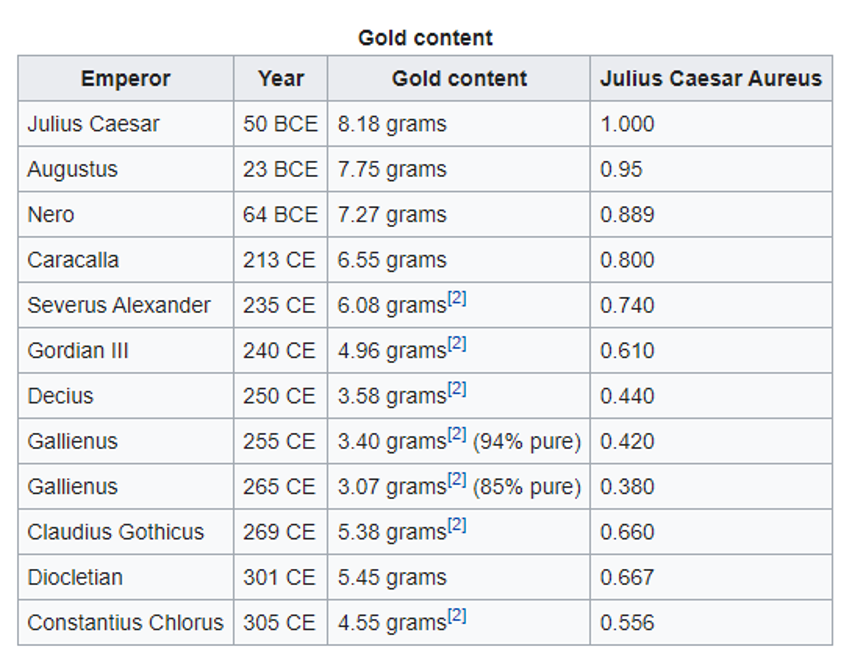
The gold content of the golden Aureus also gradually decreased. (Source; Wikipedia)
The Fall of Rome
The fall of Rome is not only due to the tampering with the coins. Attacks by various tribes also caused the Roman Empire to collapse. The fact that territory was lost from the third century AD onwards, whereas previously it was mainly territory conquered, also sparked a internal power struggles. This didn't do much good for internal stability either. The fall of the Roman Empire is therefore rather a long process and a combination of circumstances.
The fact is that the quality of money can be a good indicator of the state of a country. The way in which the quality of Greek currencies deteriorated was analogous to the decline of Greek power. The Roman Empire tampered with coins in order to maintain the empire, which only led to deteriorating situations. Price controls, such as Diocletian's, have also been seen more often in the course of history as a reaction to currency depreciation. The question is whether the deterioration of money is a cause or a symptom of the decline of an empire. The two phenomena often go hand in hand. Thus, at last, the opulence of the Greeks and Romans came to an end, and the world passed into a new era; the Middle Ages.
 Have a look at us YouTube channel
On behalf of Holland Gold, Paul Buitink and Joris Beemsterboer interview various economists and experts in the field of macroeconomics. The aim of the podcast is to provide the viewer with a better picture and guidance in an increasingly rapidly changing macroeconomic and monetary landscape. Click here to subscribe.