English
EN


Switzerland's largest bank, UBS, provided insight into the mindset of the mega-rich in a recent report. The result? AI remains the primary theme, but a majority wants to move away from dollar investments and plans to expand their gold allocation by 50% in 2026. After another month of conflicting reports and a sideways price movement for gold, the publication from the World Gold Council gives investors reason to reconsider the risks of an interest rate hike for gold.
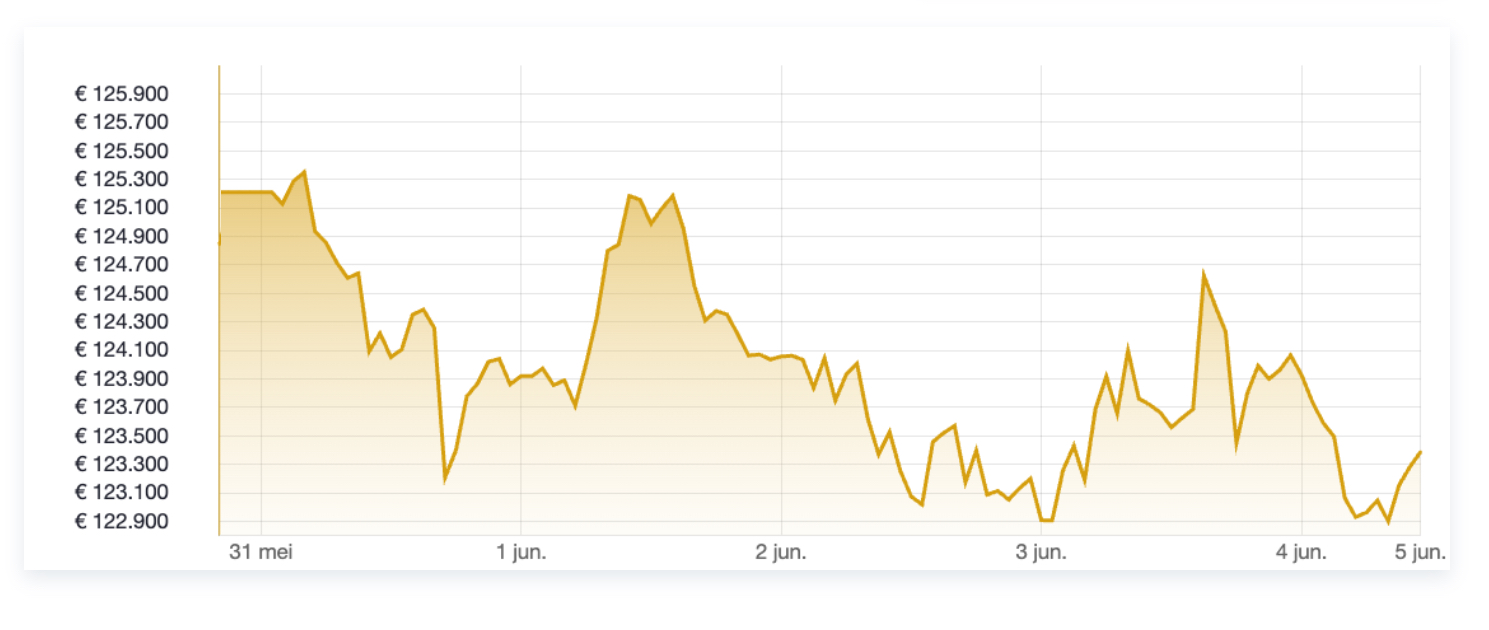
(Image caption: The gold price continues to move sideways this week)
Before we dive into all the reports, a brief overview of the major developments from the past week:
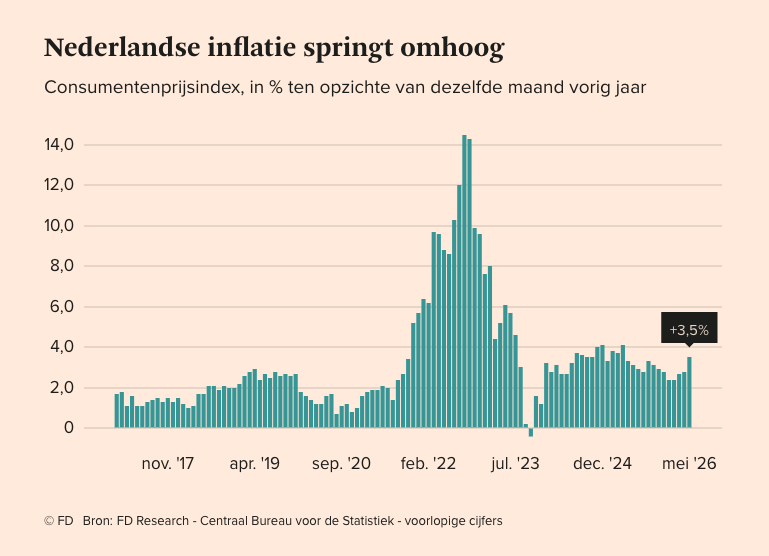
(Image caption: Dutch inflation jumps higher. Consumer price index, in % compared to the same month last year. Inflation rises fastest in May since October last year. Source: FD).
Yes, according to UBS, high-net-worth individuals invested 2% of their total wealth in gold in 2025 and want to expand this to 3% in 2026. Although this seems like a small amount at first glance relative to total wealth, it does mean they want to own 50% more gold in 2026 than the year before. This is a clear validation of the trend that private investors are increasingly investing in gold.
Switzerland's largest bank, UBS, recently released this data in their Global Family Office Report 2026. For this report, they surveyed 307 family offices across 30 different markets. A family office is a management firm and private office for the total wealth of one or more very wealthy families. They handle not only banking and investments, but also tax and legal matters, as well as future planning. Of the family offices surveyed by UBS, each family holds an average of $2.7 billion in wealth, collectively accounting for $627.4 billion.
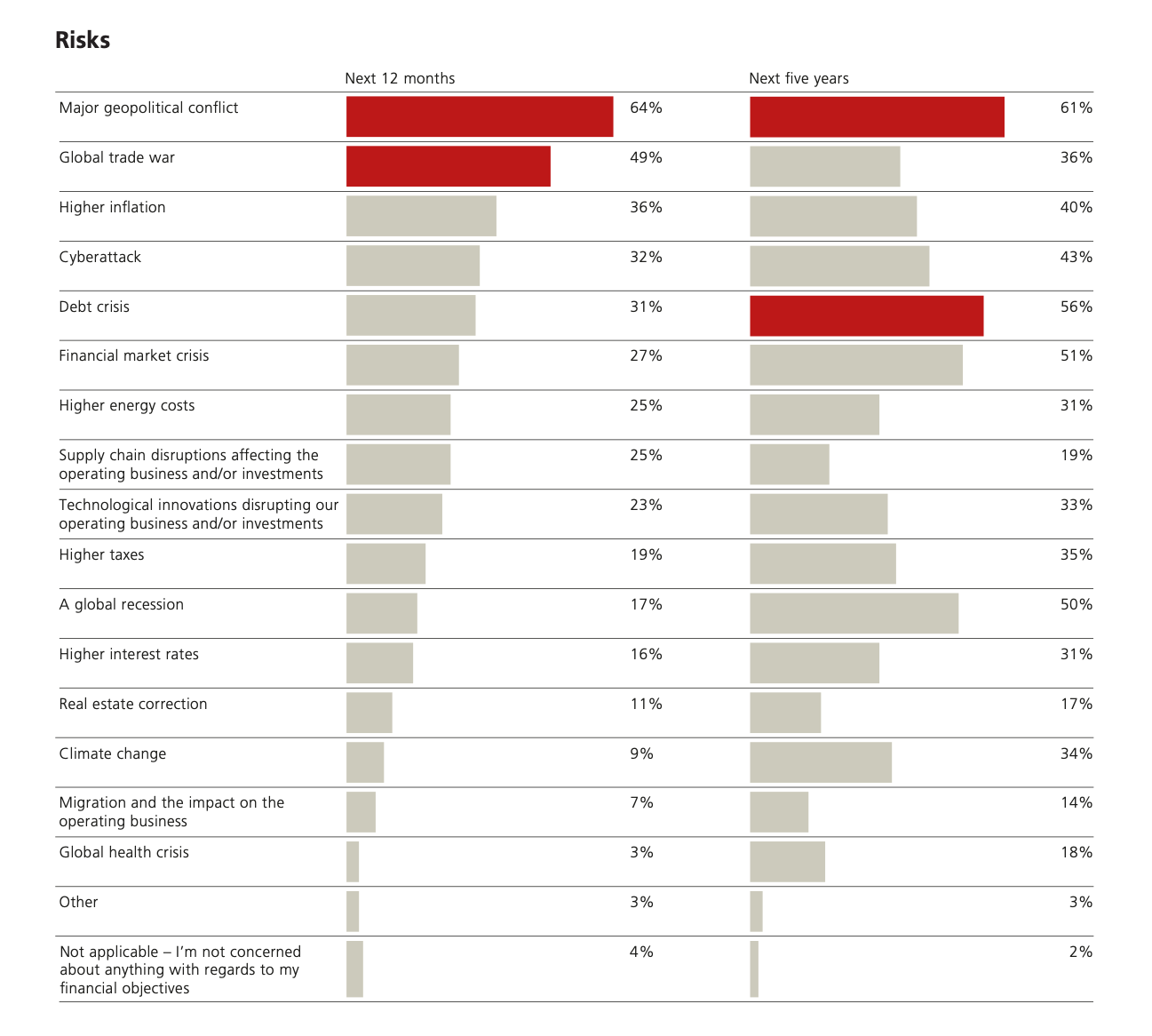
(Image caption: Which risks do family offices and their clients see over the next 12 months and 5 years? This table provides an overview. In the short term, geopolitical tensions and the trade war are seen as the biggest risks; in the long term, a debt crisis is also a major concern. Source: UBS).
An important question is: why do these wealthy families invest in gold? Most family offices that invest in gold use it as a long-term investment and as a hedge against geopolitical risks. Looking at the risks family offices see for the future, a more complex picture emerges. In the short term, 64% primarily see geopolitical conflicts and 49% see a trade war as major risks. Extending the outlook, 56% expect a debt crisis in the next five years, 40% expect higher inflation, and 50% expect a financial crisis and recession. Looking at what is on the minds of wealthy families, they are anticipating precisely the kind of crisis against which gold provides a vital hedge.
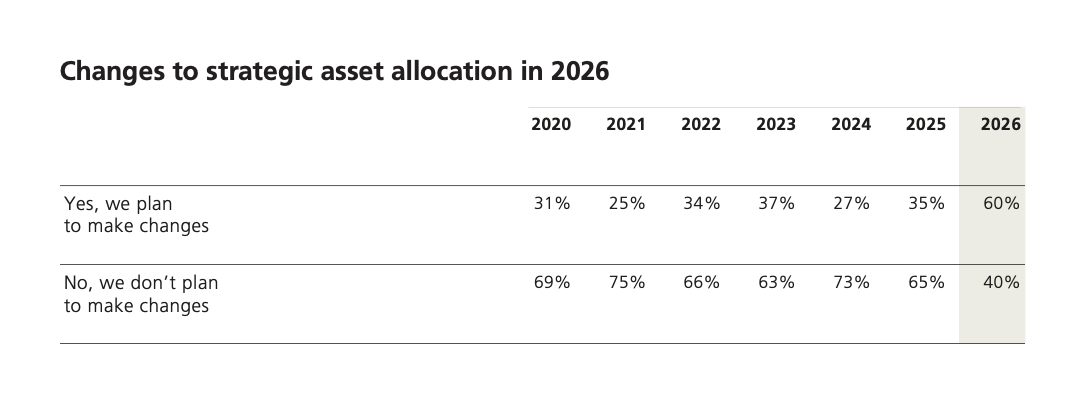
(Image caption: Changes to strategic asset allocation in 2026. Do family offices expect changes in the strategic distribution of the investment portfolio? From 2021 to 2025, only 25% to 35% considered this; in 2026, that figure is 60%. Source: UBS).
It is not just that sentiment is negative; action is being taken. At least 60% of family offices expect to adjust the strategic allocation of their investment portfolio in 2026, compared to 35% in 2025. Something is definitely happening.
Another striking element from the study is that, even though AI stocks and investments in established equity markets remain the focus, people want to move away from dollars. A staggering 65% of respondents expect the dollar's status to weaken further over the coming year. Many parties feel overexposed to the dollar and are actively seeking diversification in alternatives such as the Swiss franc, the euro, and gold.
"Gold plays an important role in our portfolio diversification and in our efforts to reduce exposure to the US dollar," says one of the clients in the study.
It is generally assumed that an interest rate hike by central banks is bad for the gold price, because gold yields no interest, and other safe havens, like government bonds, yield higher returns when rates rise. However, this is not the whole story, says an analyst from the World Gold Council. Gold could surprise us positively during an upcoming Fed rate hike. Historical data shows that the gold price rose in more than 50% of cases in the 21 days following a rate hike. The chart below provides an overview of the gold price's reaction to interest rate hikes since 1997, from 21 days prior to a hike to 21 days after.
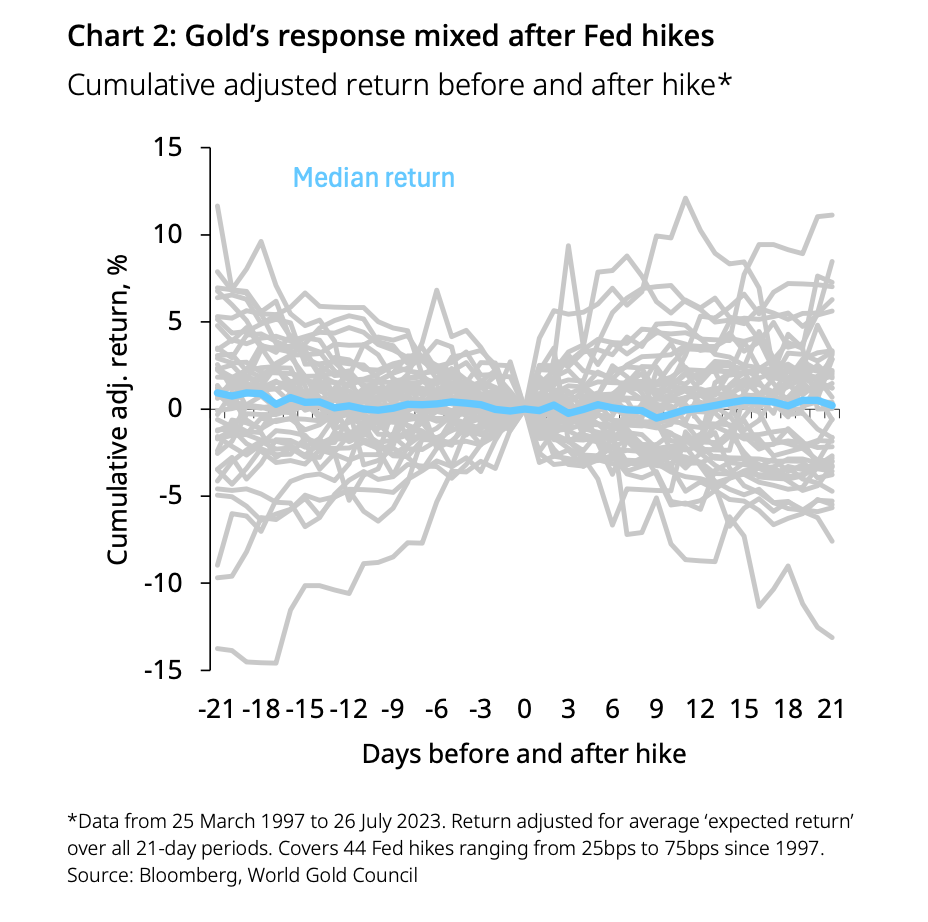
(Image caption: The price reaction (cumulative return) of gold can be read on the vertical axis. On the horizontal axis, we see the number of days before and after the moment of a Fed rate hike (day 0). Source: World Gold Council).
Whether the gold price falls in response to a rate hike depends entirely on the reasons behind the Fed's decision. Interest rates are often cut to stimulate the economy when there are signs of a financial crisis or recession. Therefore, rate hikes can be interpreted as a return to more stable and safer times.
However, in the current geopolitical and economic climate, a rate hike is actually a sign of uncertainty. On one hand, the rate hike will be intended to combat inflation, which is being fueled by rising oil prices. On the other hand, a Fed rate decision is currently politically charged, questions regarding fiscal pressure are at play, and the views of Fed members are beginning to diverge more. Additionally, it is noted—just as in the UBS report—that there is a global movement away from dollar investments.
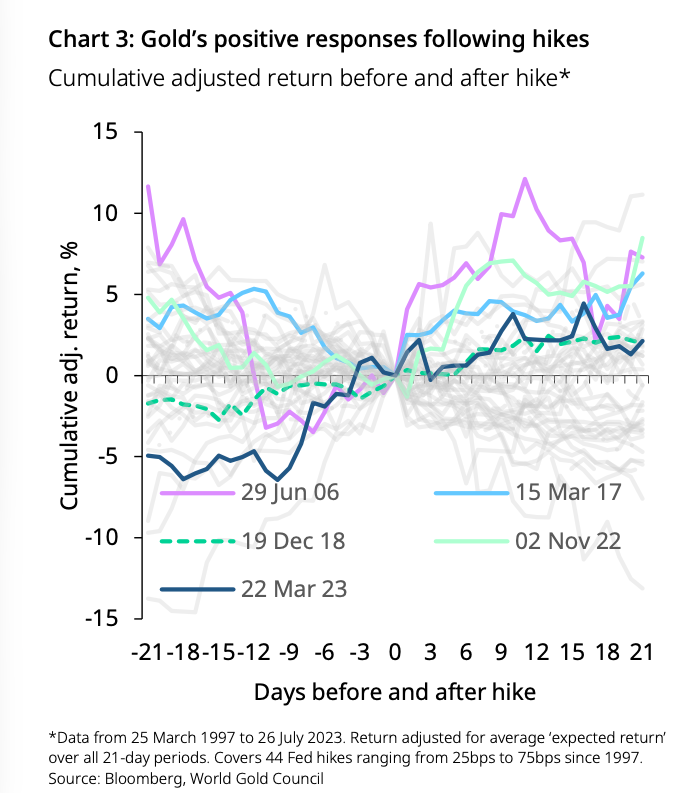
(Image caption: The same graph as above, but now highlighting various years in which an interest rate hike was followed by rising gold prices in the 21 days that followed. Source: World Gold Council).
Whether an interest rate hike will depress the gold price will primarily depend on its effect on the dollar. If a hike causes investors to lose confidence in the dollar because it signals instability and economic weakness, it could just as easily be positive for the gold price. The report does not offer a concrete prediction of what will happen in the coming months. However, it demonstrates very clearly that an interest rate hike does not by definition mean the gold price will fall. It is more of a 50/50 toss-up.