English
EN


By: Frank Knopers:
Since the beginning of the Russian invasion of Ukraine, Western countries have imposed several sanctions. The most recent measure was the decision of all G7 countries to suspend imports of Russian gold curb the need to. Earlier, European countries decided to import less oil and gas from Russia. This economic warfare is supposed to weaken Russia, but it hits Western countries just as hard. What do we notice about sanctions against Russia?
On 28 February, the EU and the US decided to freeze all foreign exchange reserves of the Russian central bank in euros and dollars. As a result, the country is unable to use more than half of its reserves. At the time, the Dutch Central Bank (DNB) wrote in a explanation that it would be much more difficult for Russia to stabilize the value of the ruble. After all, the Russian central bank can no longer sell dollars and euros to support the value of its own currency. DNB predicted that a weaker rouble would lead to a decline in purchasing power for the Russian population.
But has this measure had the desired effect? On April 1, Russian President Vladimir Putin announced that natural gas must be paid for in rubles from now on. Since this measure, the ruble has increased in value. At that time, they still received 85 rubles for every US dollar, at the time of writing it is only 53 rubles. That sanction measure therefore did not have the desired effect. In fact, a number of European countries, including the Netherlands, have already been cut off from Russian gas, because they do not want to pay in rubles. As a result, energy security in several European countries has been Deteriorated.
An additional disadvantage of the sanctions policy is that Russia has dropped the euro as a trading currency. Until recently, the country wanted to use the euro more often as an alternative to the US dollar. As a result of these sanctions, the euro's reputation as an international currency has been severely damaged. And that puts pressure on the value of the euro, while the aim was to hit the ruble. The graph below shows the development of the value of the ruble over the past twelve months. The currency is stronger now than it was before the war.
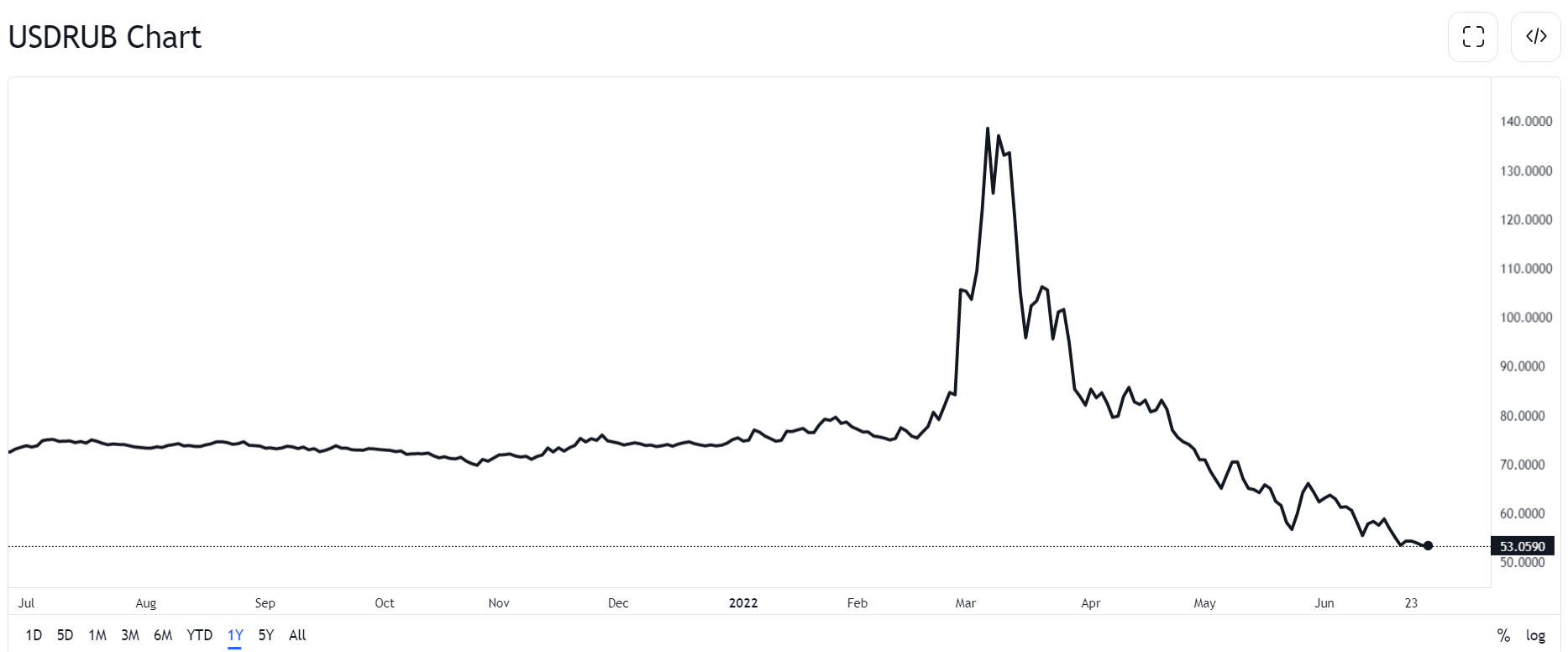
The ruble has actually strengthened against the dollar (Source: Tradingview)
Another much-discussed sanction measure was the exclusion of Russian banks from the SWIFT payment system. This makes it more difficult for banks to make payments. But even this measure is only partially effective. Russian banks have alternatives to still make payments, for example via Gazprombank. In 2014, the central bank of Russia also developed its own payment system, called System for Transfer of Financial Messages (SPFS). So, Russian banks can already use this system.
India and China also want to support this system, which means that there will be more support for an alternative to the Western SWIFT payment system. As more non-Western countries embrace this system, it could erode SWIFT's dominance. The finance ministers of the BRICS countries recently announced that they would not be able to finance the want to collaborate more. The sanctions will therefore further accelerate the transition to a multipolar world. Iran joined the BRICS this week and also Argentina would be planning to do so. These countries are joining forces to create a Alternative Economic Bloc which is less dependent on the West. Western sanctions have made that urgency even greater.
At the beginning of June, the EU reached a agreement on an import ban on Russian oil and oil products. Within six months, countries in the EU must completely stop importing Russian oil and oil products, with the exception of countries that can only import oil via pipelines. European countries are also planning to reduce imports of coal and gas from Russia.
The consequences of these sanctions are felt directly by consumers and businesses, as energy prices have risen sharply and remain high. Not only have oil and gas become much more expensive, but also coal. The Price of coal on the European market, for example, has already more than tripled this year to EUR 363 per tonne. Asia's main benchmark for coal rose last Friday for the first time in history to $400 per ton. Many European countries are even restarting their coal-fired power plants to become less dependent on gas or to reduce energy prices. Despite climate targets that were previously a reason to burn less coal.
The price of liquefied natural gas has also risen sharply worldwide, as rich European countries are also bidding for the scarce supply of liquefied gas. They want to buy more liquefied gas to become less dependent on Russia, thus competing with countries that are completely dependent on liquefied gas. And as a result, poorer countries are increasingly Shortest end of the stick. Pakistan recently failed to buy liquefied gas on the world market. The country's oil minister, Musadik Malik, foresees major problems: "European countries buy gas everywhere where it is still available. As a result, liquefied gas, which cost $4 2.5 years ago, is now not available even for $40."
Uncertainty surrounding the war in Ukraine and Western sanctions have severely disrupted the global energy market. This leads to high fuel prices and rising energy bills for consumers and businesses. Not only in Europe, but also elsewhere in the world. For relatively affluent consumers in Western countries, this already means a significant decline in purchasing power, but for emerging economies the consequences are much more dire. Consumers there spend a much larger share of their income on fuel and food than we do in the rich West. The Western sanctions therefore affect not only the Russian economy, but also Europe and the rest of the world.
Russia sees its income increase due to high energy prices. Financially, the country seems to be coming out stronger. However, Russia is also affected by the sanctions, such as Western companies that can no longer supply parts or software that are vital to Russian industry. It is also becoming more difficult for Russia to obtain fast computer chips, now that several countries have imposed sanctions. From an economic point of view, therefore, the sanctions mainly have losers.
This contribution comes from Geotrendlines
 Have a look at us YouTube channel
On behalf of Holland Gold, Paul Buitink and Joris Beemsterboer interview various economists and experts in the field of macroeconomics. The aim of the podcast is to provide the viewer with a better picture and guidance in an increasingly rapidly changing macroeconomic and monetary landscape. Click here to subscribe.