English
EN


Rising interest rates, geopolitical turmoil and fears of a new recession have caused investors worldwide to flee to the US dollar. In the past twelve months, the dollar index has already risen more than 22%, while other international currencies such as the euro, the British pound and the Japanese yen have fallen sharply. Why is the dollar rising so fast? And what does this mean for gold, that other safe haven?
Last summer, the dollar reached its first time in 20 years parity with the euro, which means that the exchange rate between these currencies had become the same. The same threatened to happen at the beginning of this week with the British pound, which plummeted in value after announcing an unprecedented support program. The pound fell to an exchange rate of $1.03, after which the central bank intervened by buying government bonds. Parity between these two currencies would mark a historic milestone, as the British pound has always been worth more than the US dollar.
The value of the dollar has not been as high against other currencies as it is today since the 1980s. That's because, as uncertainty in financial markets increases, investors are pulling capital out of the riskier emerging economies and seeking safety in the United States. U.S. Treasuries are also the most liquid collateral, which means that in times of stress, investors sell their risky bonds and exchange them for U.S. Treasuries.
This flight to safety sounds paradoxical, given that the U.S. national debt has passed $30 trillion, equivalent to 126% of the gross domestic product of the United States. By way of comparison, that comes pretty close to a public debt of more than 150% of GDP for a country like Italy. Yet, for several reasons, these two examples are not comparable, reasons that explain why the dollar is so popular right now.
The first reason is that the US dollar is still the most important currency in the world. The euro can now almost equal the dollar in global payments, but the dollar remains king when it comes to lending and currency reserves. Precisely because so many loans have been made in dollars worldwide, companies and governments that have taken out these loans are constantly in need of dollars.
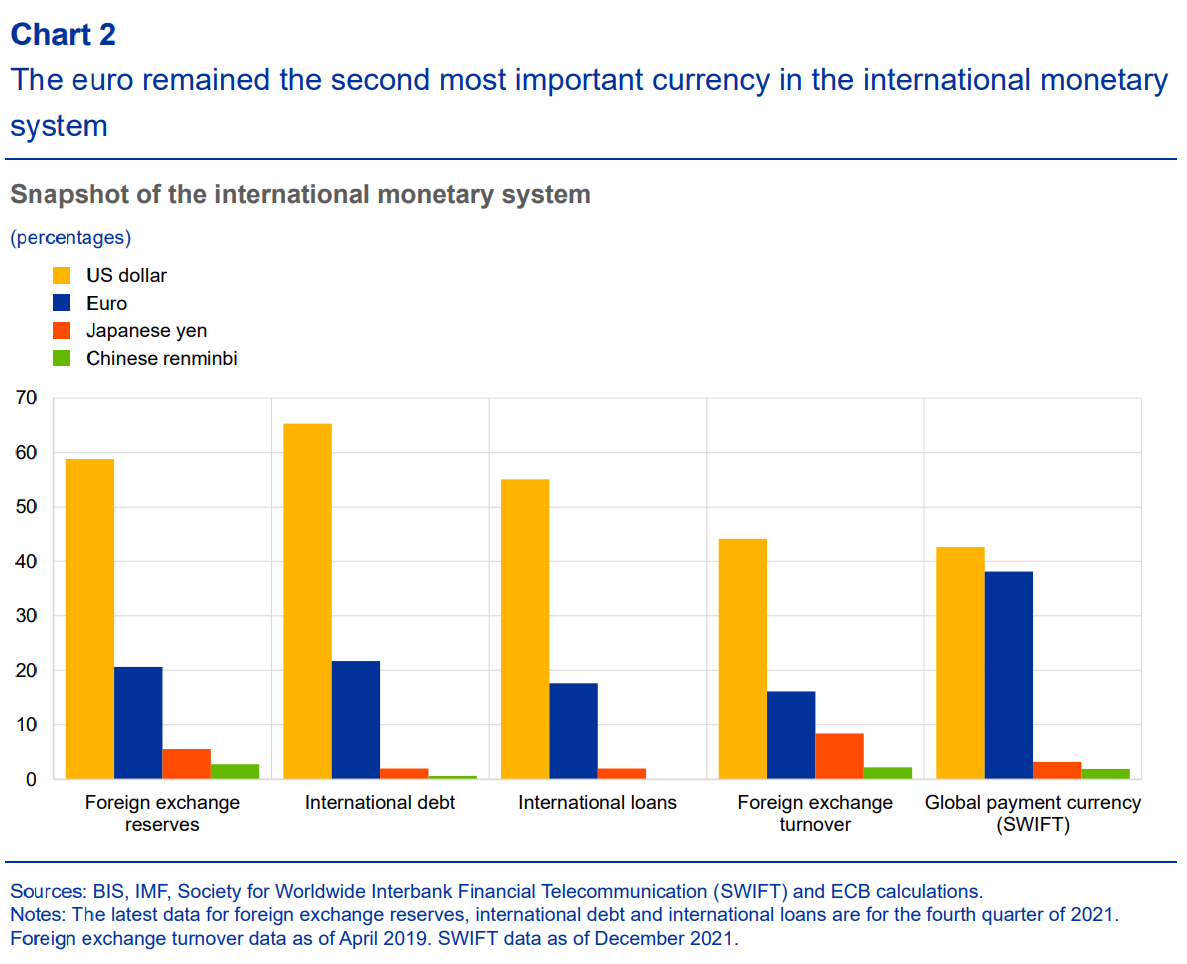
U.S. dollar is still the most important international currency (Source: ECB)
Now that interest rates on dollar loans are rising and financing conditions are deteriorating, parties that have borrowed in this currency want to repay these loans more quickly. At the same time, the demand for new dollar loans is falling, which reduces the demand for dollars and increases the supply. As a result, the U.S. dollar is appreciating against almost all other currencies in the world. The chart below shows this movement in the foreign exchange market at a glance.
A notable exception is the Russian ruble, which was the only one to appreciate against the dollar. The ruble has risen in value as more countries need this currency to buy Russian gas. So there has been more demand for rubles since then.
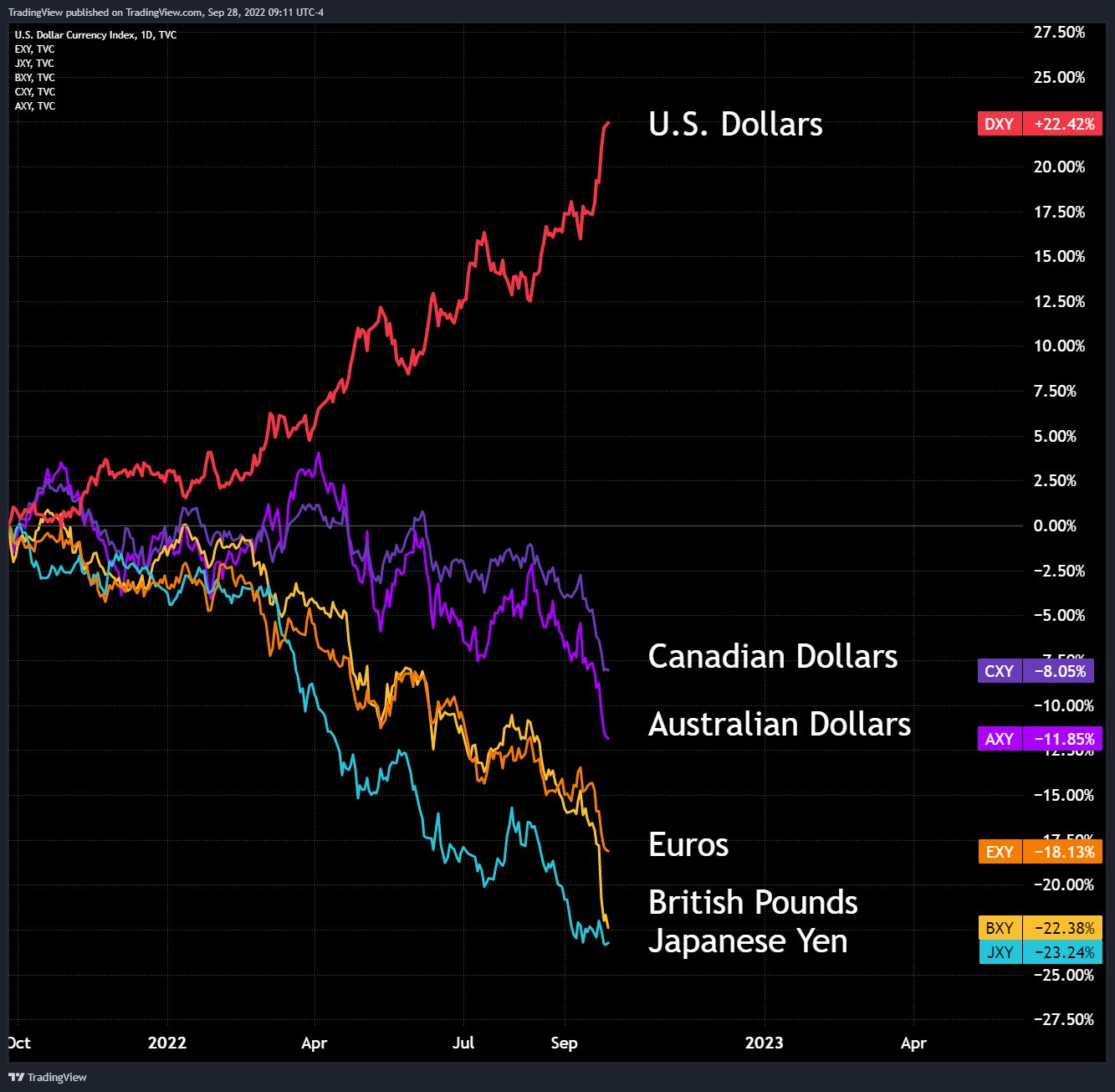
Almost all currencies are depreciating against the dollar (Source: Tradingview)
A second reason why the dollar is rising in value is the Federal Reserve's change of course. The U.S. central bank started raising interest rates much earlier than other central banks, making it more attractive to hold assets in U.S. dollars. The European Central Bank did not act until much later, which means that there is still a large interest rate differential between the two currency areas. For example, the Fed currently has a policy rate of 3.25%, while the ECB is at a much lower rate of 0.75%.
The U.S. central bank plans to raise interest rates further, making it harder for other central banks to catch up. And then there is also the fact that the ECB is limited in its ability to raise interest rates. After all, every interest rate hike increases the pressure on southern countries such as Italy, which increases the risk of fragmentation in the European bond market. Investors Speculating against the central bank by shorting Italian government bonds. Italy must not be dropped from the pack if the ECB shifts gears.
And then there are countries that have an even more questionable monetary policy. Take, for example, the Bank of England, which is now raising interest rates and buying government bonds at the same time. This week, the central bank had to intervene to lower the yield on British government bonds, because the market no longer wanted to buy them. Investors have low level of trust public finances following the announcement of a major support programme. This reflects on the value of the British pound.
Meanwhile, the Bank of Japan is keeping any kind of interest rate hike at bay, to prevent interest rates on the skyrocketing national debt from rising. Last week, Japan's central bank had to deal with the first time in 1998 intervene to support the value of the yen. As a result, interest rate differentials are diverging to such an extent that it is becoming less and less attractive to hold the yen.
Finally, the euro is also suffering from deteriorating market conditions. In particular, geopolitical turmoil with high energy prices and their impact on the earning capacity of European economies is making investors nervous. The exchange rate between the euro and the dollar even briefly fell below $0.96 this week.
The result of all this is a flight to the dollar. Not because the U.S. economy is in such good shape, but because the situation in the rest of the world is much worse. The strong dollar makes imports cheaper for the United States, while its competitive position for exports deteriorates. A strong dollar is therefore not necessarily a blessing for the US economy either.
For emerging economies, the strong dollar is disastrous, because all the dollar debt they have is becoming more and more expensive. The IMF expects that 60% of poor countries will be in trouble because of the strong dollar, compared to 20% a decade ago. A flight to dollars puts pressure on the currencies of the poorest countries.
Rising interest rates are making the US dollar more attractive against gold. Historically, the precious metal has a negative correlation with the dollar. But with the current inflation and all the geopolitical turmoil, the world precious metals remain a valuable addition to the investment portfolio as a safe haven outside the financial system.
What also speaks in favor of gold is that it offers a hedge against currency risk. Savers can protect themselves against a depreciation of the currency by converting part of their assets into gold. Central banks cannot print gold. In a deflationary scenario, the Gold price down, but much less than other investments such as stocks and real estate.
 Have a look at us YouTube channel
On behalf of Holland Gold, Paul Buitink and Joris Beemsterboer interview various economists and experts in the field of macroeconomics. The aim of the podcast is to provide the viewer with a better picture and guidance in an increasingly rapidly changing macroeconomic and monetary landscape. Click here to subscribe.