English
EN


Throughout history, money has taken many different forms, but not every form has managed to retain its value. Money loses its value when it can be easily created or manipulated. Gold forms a notable exception in this regard. Due to its natural scarcity and the energy required to produce it, it has played a central role in monetary systems for centuries. What makes gold so suitable as money, and why did other systems fail?
Scarcity as a foundation
Money functions as a means of exchanging value, but can only fulfill this role when it cannot be easily created. When money can be produced without effort, it loses its credibility as a medium of exchange.
An example of this is the island of Yap, where large stone discs in the shape of a donut, the so-called rai, were used as money. These stones varied in size from a few centimeters to several meters and were quarried on the island of Palau, more than 400 kilometers away. Obtaining these stones required significant effort: inhabitants had to perform labor in exchange for the right to carve the stones, after which they were transported over long distances by canoe.
It was precisely this combination of scarcity and labor that made the rai suitable as money. For generations, this system functioned effectively, until in 1871 the Irish trader David O'Keefe arrived on the island. In exchange for copra, he transported large rai stones by ship. By using modern vessels, he was able to greatly increase the supply of stones. As a result, the number of rai on the island grew rapidly, and the scarcity that determined their value disappeared.
Where a large stone had previously been extremely rare and a sign of wealth, the increase to 13,281 stones ultimately led to hyperinflation and worthless money.
Decentralized and resistant to manipulation
Money that is issued centrally can be manipulated, putting trust in the currency under pressure. A clear example of this is the denarius, the silver coin of the Roman Empire. This coin served as a reliable means of payment for a long time, but as the empire expanded, government expenditures also increased.
To finance these expenses, more and more coins were minted. Because it became increasingly difficult to obtain additional silver due to scarcity, emperors chose to gradually reduce the silver content of the denarius and replace it with less valuable metals such as bronze. As a result, the underlying value of the coin declined, leading to monetary debasement and rising prices.
At the same time, an effect known as Gresham’s law emerged: people hoarded the older, more valuable coins and spent the newer, less valuable ones. As a result, higher-quality coins disappeared from circulation, and the monetary system deteriorated more rapidly.
The crisis of the third century accelerated this process. Due to rising military expenditures, the silver content was further reduced, until by the end of 260 the denarius contained only about 2.5% silver and consisted largely of copper. This debasement led to hyperinflation in the third century.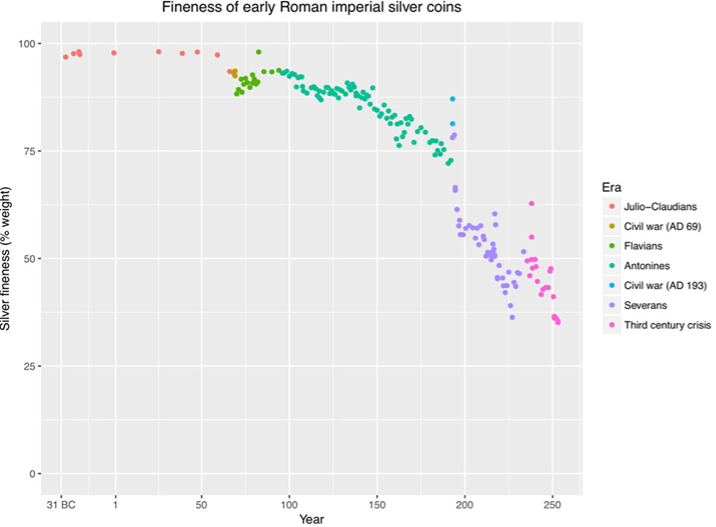
Silver content in Roman coins. (Source: The Collector)
Scarcity and decentralization form the foundation of trust in money. This explains why gold has preserved its value better than many other forms of money throughout history. The total amount of gold is limited: all the gold in the world fits into a cube of approximately 22 meters. New supply can only be added through an intensive mining process that requires significant energy and labor. This combination of scarcity and production costs makes gold suitable as a medium of exchange and a store of value.
In addition, gold is not dependent on a central authority. Unlike coins whose precious metal content can be reduced, a kilogram of gold always remains a kilogram of gold. This prevents its value from being easily eroded. When currencies are linked to gold, as under the gold standard, the money supply is constrained by the available gold reserves. This imposes discipline on governments and makes it more difficult to create large amounts of new money, thereby limiting monetary debasement and preserving purchasing power.
Whether money is a successful medium of exchange depends on essential characteristics. Money must be scarce and not easily manipulated in order to maintain trust and value. Gold meets these conditions because the total supply is limited and new supply can only be added through an intensive production process.
Furthermore, gold is not dependent on a central authority, making it difficult to alter or debase. These characteristics make it harder to manipulate and impose discipline on governments. This explains why gold represents the fundamental principle of sound money. A principle that is more relevant than ever today, in an era of unlimited money creation.
Also take a look at our YouTube channel
On behalf of Holland Gold, Paul Buitink and Yael Potjer interview various economists and macroeconomic experts. The goal of the podcast is to provide viewers with better insight and guidance in an increasingly fast-changing macroeconomic and monetary landscape. Click here to subscribe.