English
EN


Silver is once again attracting attention as demand for the precious metal rises from both investors and industry. Applications in solar panels, electrification and semiconductors are driving industrial demand, while supply has barely increased for years. Could silver therefore be one of the most interesting opportunities in precious metals in the coming years?
Silver occupies a special position in the financial world. While gold is mainly seen as a monetary metal and store of value, silver sits at the crossroads of money and industry. The metal played an important role in monetary systems for centuries and is today also indispensable in modern technology. According to JPMorgan Chase, silver prices could rise further in 2026 due to persistent deficits and strong industrial demand.
Silver plays an important role in modern technologies thanks to its applications in solar panels, electrification and semiconductors. Strong growth in these sectors could further increase demand for silver. In combination with supply that is growing only modestly, this could increase future upside potential. At the same time, sharply rising prices could put industrial demand under pressure over the longer term, as companies increase their focus on recycling and substitution. Where do the opportunities for silver lie, and what risks does this unique position entail?
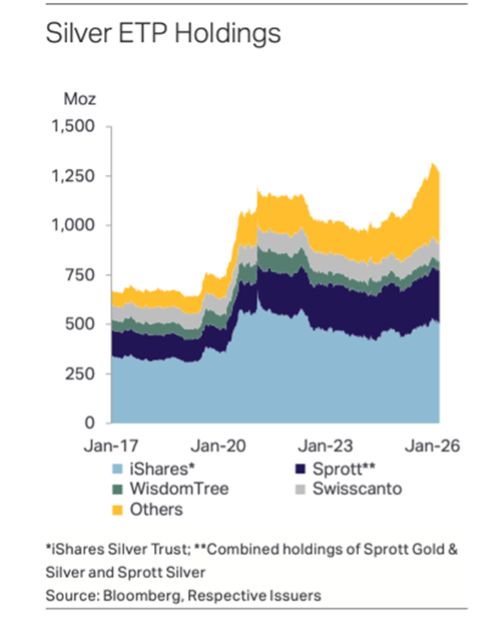
Number of millions of ounces of silver in ETPs (source: Metals Focus)
Goods derive their value from the intended benefit of the product: there is demand for food because it nourishes. With money, this is different. People usually do not want money in order to use or consume it directly, but to exchange it later for other goods and services. The value of money lies in its ability to buy other goods or services. Economist Ludwig von Mises wrote that money derives its value from yesterday’s purchasing power. But if you go back far enough, the question arises: why did people originally accept it as a medium of exchange?
According to Mises, money always began as a commodity with its own value. Silver, for example, was already used for jewellery and utensils before it served as money. Because people already considered it valuable, it had a market price and could be exchanged for other goods. In a barter economy, direct trade was often impractical. That is why people increasingly began to use silver indirectly in transactions, because they knew others would also accept it. Silver therefore first had value as an ordinary product, then as an indirect medium of exchange, and eventually developed into money. At the moment a commodity becomes money, it already has existing purchasing power or a market price relative to other goods. It is precisely that existing value that causes people to accept it as money.
Demand for investment silver such as silver coins and bars has increased strongly in recent years. In 2025, this demand rose by 14%, and an increase of 18% is expected in 2026. Demand for silver as a store of value and investment object remains just as relevant today.
Silver is extremely conductive, minimises energy loss, conducts heat exceptionally well, is highly reliable and has high reflectivity. This makes it a crucial precious metal for industry. In 2024, industrial demand for silver reached a new record of 680.5 million ounces, mainly driven by solar panels and applications of artificial intelligence. In addition, new industries such as data centres and electric cars are creating additional demand. If these markets continue to grow, additional demand for silver can also be expected.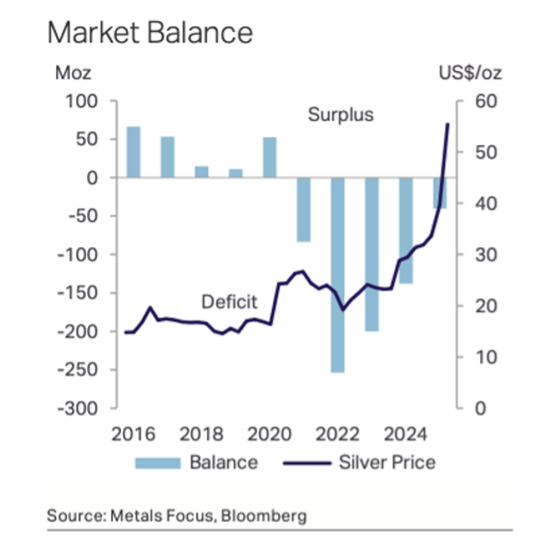
Annual silver deficits (source: World Silver Survey)
On the other hand, silver supply is just as important. What stands out is that supply has barely grown since 2016. Silver is mainly extracted from other metal mines because underground it easily mixes with other common metals. As a result, only 30% of silver is mined from pure silver mines: it is primarily a valuable by-product. Rising demand and lagging supply lead to deficits. For the sixth year in a row, the silver market is in deficit, meaning demand exceeds supply, which over time can contribute to a rising silver price.
A rising silver price also brings disadvantages. JPMorgan reports that the biggest long-term threat to silver is material substitution. A high silver price that leads to rising costs may encourage companies to look for alternatives to silver. Demand for silver in solar panels has declined over the past year. The higher silver price increases the incentive to replace silver and weighs on demand for silverware and jewellery. As this demand declines at high prices, volatility may increase.
Silver distinguishes itself from gold because it sits at the crossroads between an industrial and a monetary metal. Historically, silver has an extensive monetary history in which it has proved capable of preserving purchasing power in times of inflation and crisis. Demand for silver is increasing thanks to greater interest in silver coins and bars and rising demand from new technologies. Combined with lagging supply, this leads to deficits that create greater upside potential. For investors looking to benefit from both the monetary and industrial properties of precious metals, silver offers a unique position in a portfolio.
Be sure to take a look at our YouTube channel
On behalf of Holland Gold, Paul Buitink and Yael Potjer interview various economists and experts in the field of macroeconomics. The aim of the podcast is to provide viewers with a better understanding and guidance in an increasingly fast-changing macroeconomic and monetary landscape. Click here to subscribe.