9.2
8.899 reviews

English
EN


Investors bought 11% more investment gold in the first half of this year than in the same period last year. This is what the World Gold Council in its latest quarterly report released this week. In China and India in particular, considerably more gold coins and gold bars were sold than a year ago, but the gold market in Turkey also experienced a strong rebound this year.
China's gold market benefits from strict capital controls, limiting investors' ability to invest overseas. Also, some Chinese investors are concerned about a possible real estate bubble, which is why they currently prefer to invest their money in gold rather than in stones.
In India, the demand for gold increased because certain festivals fell at a favorable time, resulting in more sales than in other years. The central bank also managed to make up for the shortage of cash, a shortage that arose when the two largest banknotes in India suddenly had to be handed in at the end of last year. Because there is more money in the hands of the population, the economy gets going again and Indians have money to buy gold again.
The increased demand for gold in Turkey was driven by the growth of the economy and high inflation, according to the World Gold Council. At the end of last year, Turkish President Erdogan called for foreign currency to be exchanged for gold. This may also have given a boost to the Turkish gold market.
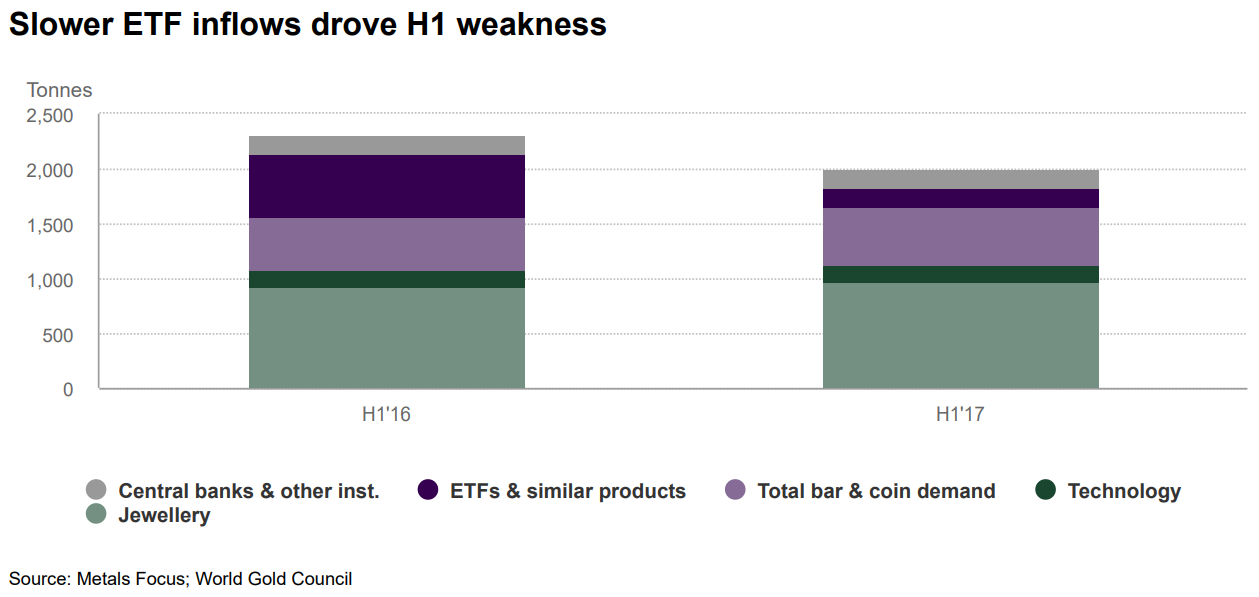
Less gold to ETFs, but more demand for investment gold (Source: World Gold Council)
Globally, gold ETFs were less popular in the first half of this year than in the same period last year. Nevertheless, a total of 167.9 tonnes of gold has already been added to reserves this year, most of it in European gold ETFs. Figures from the World Gold Council show that they added 128 tonnes of gold to their holdings in the first half of this year, accounting for 76% of global gold inflows into ETFs.
The extremely low interest rates and the political uncertainty of elections in the Netherlands and France gave a strong boost to the European gold market in the first half of this year . Gold ETFs, which issue shares based on physical gold stored in a vault, benefited in particular. The total gold holdings of these ETFs grew to a record level of 977.7 tonnes in the second quarter of this year, up from the previous peak of 960 tonnes at the end of 2012.
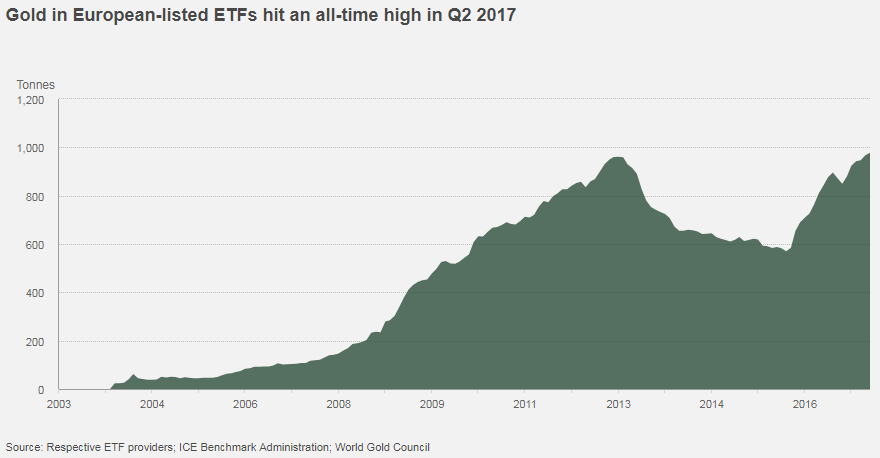
Stocks of gold ETFs in Europe to new all-time high (Source: World Gold Council)
Since the outbreak of the financial crisis, central banks have become net buyers of gold. In the first half of this year, they added a net 176.7 tonnes to their reserves, a few percent less than the purchases in the same period last year. The biggest buyer was again Russia, which added 35.7 tonnes of the yellow metal to its reserves in the second quarter of this year. Kazakhstan has been continuously buying more gold for years and bought 11.3 tonnes in the second quarter.
Turkey's central bank has restarted this year for the first time in a long time Buy gold and added 21 tonnes to its reserves in the second quarter. Their total gold reserves thus reached a total of 137 tons. The only country that sold a substantial amount of gold was Germany. They tapped 3.8 tonnes in the second quarter Gold bars from her vault to mint coins.


