English
EN


At the request of one of our readers, Jack Hoogland has taken another close look at the copper market. While investors remain focused on the war in Iran, the energy crisis, and the AI boom, one of the most compelling investment stories of this decade is quietly unfolding in the background. The combination of rapidly rising demand and a structural shortage of new supply could drive copper prices significantly higher in the years ahead.
Amid all the headlines surrounding the conflict in Iran, the energy crisis, and the AI frenzy, the copper market has received remarkably little attention from the financial media. In our view, that lack of attention is actually a very bullish sign.
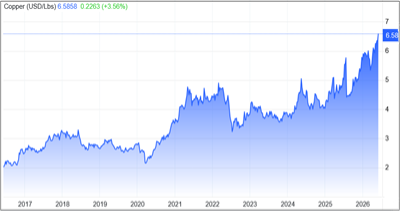
As the chart below illustrates, copper prices remain firmly entrenched in a strong uptrend. Following last month's correction, copper mining stocks have also resumed their upward trajectory.
In addition to accelerating demand growth, the copper market is facing a serious and immediate supply challenge. As shown in the tweet below, both Citi and Goldman Sachs raised their copper price forecasts this week.
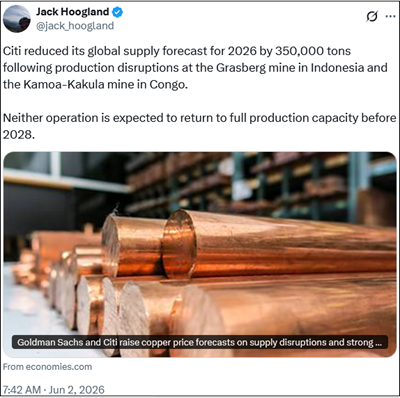
The banks point to ongoing disruptions at two major copper mines that were impacted by mudslides and earthquakes last year. Together, these disruptions are expected to reduce global copper supply by approximately 350,000 tonnes, resulting in a larger deficit than previously anticipated.
Meanwhile, Chile, the world's largest copper-producing nation, reported a 14% decline in copper production in April, as highlighted in the tweet below.
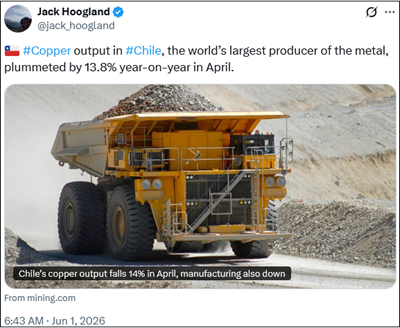
Part of the decline is being attributed to falling ore grades. At the same time, state-owned mining giant Codelco has struggled with operational challenges for years, resulting in disappointing production performance.
As a result, copper supply is already under considerable pressure, while demand continues to rise steadily due to massive global investments in renewable energy, electric vehicles, defense spending, AI data centers, and electricity grid expansion.
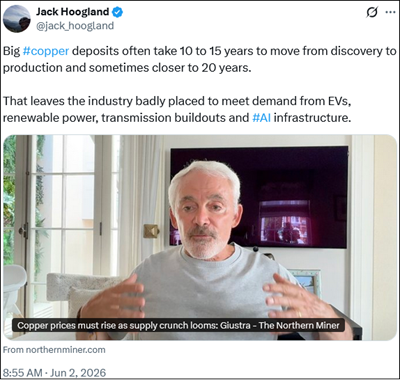
Looking further ahead, renowned resource investor Frank Giustra has warned of a major supply crunch in the copper market.
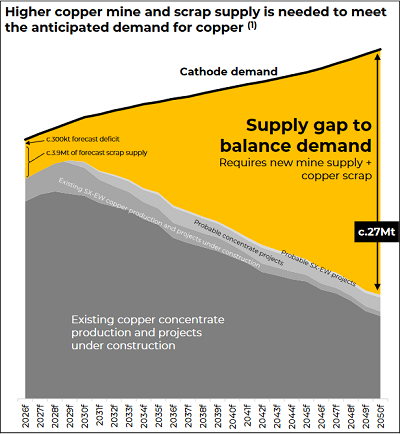
According to Giustra, only four truly large-scale copper mines are currently under development worldwide. To meet projected demand growth through 2050, however, approximately six major new copper mines would need to enter production every year.
Developing a copper mine typically takes between 10 and 20 years, making a rapidly expanding supply deficit increasingly difficult to avoid.
The chart below illustrates just how dramatically the supply gap is expected to widen over the coming years. The world is heading toward what could become a historically significant copper shortage.
If these projections prove accurate, copper prices are likely to continue rising sharply in the years ahead. Copper mining stocks, which typically offer leveraged exposure to the underlying metal price, could potentially deliver even stronger returns.
Disclaimer: This article reflects the personal opinions of Jack Hoogland only and does not constitute investment advice or a recommendation to buy or sell any financial instrument. Investing involves risk. Always conduct your own research before making investment decisions.