English
EN


This week we saw a remarkable movement in the gold market. On Tuesday, the gold price on the New York stock exchange was $70 per troy ounce higher than in London, the Largest price difference in forty years. These prices often diverge, but under normal circumstances, traders step into the market to eliminate this difference. That didn't happen this time, resulting in two different gold prices and a shortage in the gold market in New York. How could this have happened?
To answer this question, we first need to gain a better understanding of how the gold market works. The gold price in New York is determined on the basis of trading in gold contracts, which can be physically delivered in the form of gold bars of 1 kilo and 100 troy ounces. Gold is also traded on the gold market in London, but in the form of gold bars of 400 troy ounces (12.5 kilos). This is the standard format in which central banks and so-called Bullion banks trading the precious metal.
Under normal circumstances, traders enter the market to eliminate the price difference between New York and London. They then buy gold where the price is lowest and make it available to the market where the price is higher. In the case of the gold market, it means that traders have gold bars melted down and taken to the market where the price is higher. This arbitrage is lucrative under normal circumstances if the price difference is greater than $1.50 per troy ounce.
This week, that didn't happen, with the result that the price difference rose to $70 per troy ounce. At one point, the price for a kilo of gold in New York was more than €2,000 higher than in London. This exceptional situation caused great confusion in the gold market. Traders and investors saw two different prices on the boards, making them unaware of the price at which they could trade physical gold. As a result, suppliers and gold dealers decided to temporarily stop accepting new orders, effectively freezing the gold market. As a result, we were also forced to temporarily stop accepting new orders.
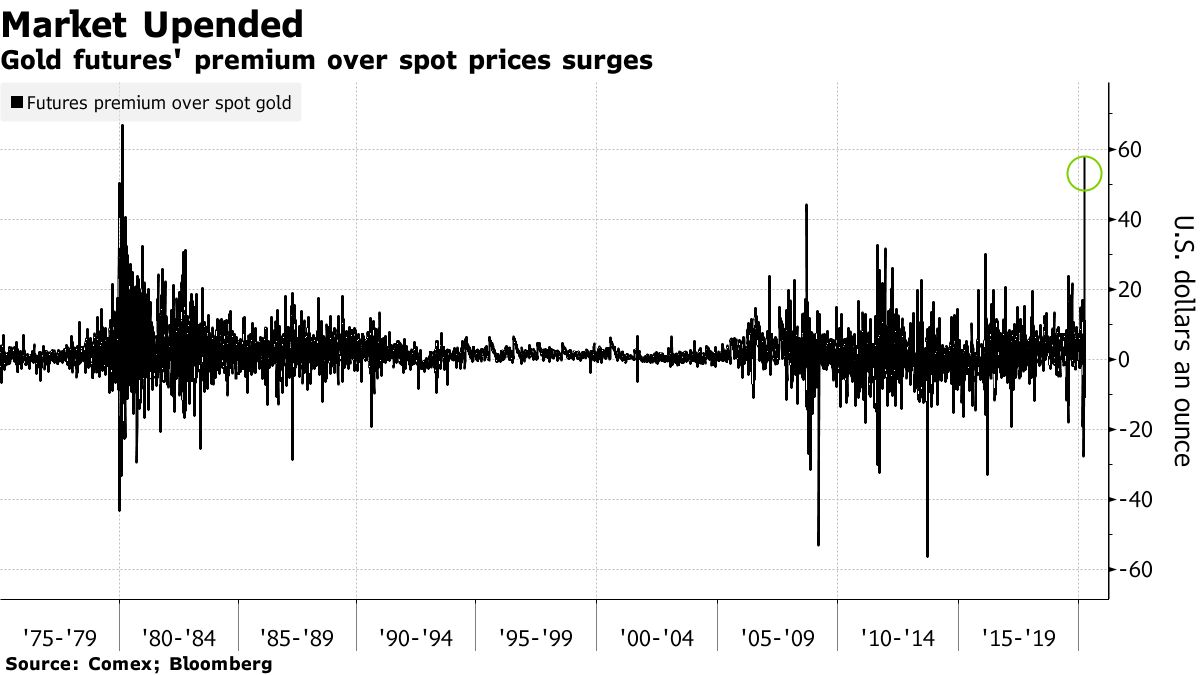
Run on gold drove the gold price in New York further higher (Source: Bloomberg)
This week, several major smelters in Switzerland have increased their production due to the coronavirus Temporarily discontinued. This results in longer delivery times in the market, while the demand for investment gold is very high right now. As a result, there is currently less capacity to melt gold bars of 400 troy ounces into smaller gold bars of 1 kilo and 100 troy ounces. Those are the bars that traders in New York need to be able to physically deliver gold contracts.
There is also currently a lack of transport capacity, because there are far fewer passenger flights between Europe and the US due to the coronavirus. Normally, gold is transported in passenger planes, but that capacity is now much more limited. Because of these two factors, the gold is less likely to get into the desired shape at the desired location. This is causing stress in the gold market, with investors in New York fearing that gold contracts could not be delivered.
But a bigger problem, speaking to the trade, is that the near-shuttering of the airline industry has made shipping #gold in all forms really hard.
As a colleague in Asia put it today: "There are enough kilobars around: the issue is how to get it where its wanted. pic.twitter.com/rr1LLDUNya — John Reade (@JReade_WGC) March 24, 2020
To alleviate the pressure on the gold market in New York, the Chicago Mercantile Exchange (CME) came up with New gold contracts with more flexible delivery terms. These contracts also allow for delivery in the form of 400 troy ounces of gold bars. These are still readily available worldwide and can therefore be used to settle gold contracts. As a result of this measure, the price difference between New York and London disappeared.
The London Bullion Market Association (LBMA) highlighted in a statement on Thursday press release that there is still more than enough capacity to melt gold. Although a number of smelters in Switzerland are now temporarily closed, smelters elsewhere in the world still have enough capacity to meet demand, the LBMA writes. She emphasizes that there is still more than enough gold in London, namely 8,263 tons. What she doesn't mention is that most of the gold has already been allocated to customers and is therefore not available to support the market.
Looks like a potential solution to the dislocation between OTC #gold and Comex gold futures. pic.twitter.com/6QSHpFDTDo
— John Reade (@JReade_WGC) March 24, 2020
LBMA concludes that there is good global refining capacity: read the latest update here - https://t.co/7HKIRQVgNV #gold pic.twitter.com/hE4YXJDvqr
— LBMA (@lbmaexecutive) March 27, 2020
This contribution comes from Geotrendlines