English
EN


The geopolitical escalation in the Middle East is causing unrest in financial markets. Oil prices rose rapidly to $100 per barrel, and fears of a recession are increasing. But when do high oil prices become a real economic problem, and how large could the damage be?
Mark Zandi, chief economist at Moody’s, expresses his concerns about the rising risk of a recession: historically, high oil prices are often followed by economic downturns. Oil plays a crucial role as the foundation of the modern economy. This commodity is embedded in almost every production process: transport, industry, chemicals, and agriculture. The economy can be visualized as a long chain of production processes. When costs rise at the beginning of that chain, they flow through to the final product. Oil sits at the start of nearly every chain.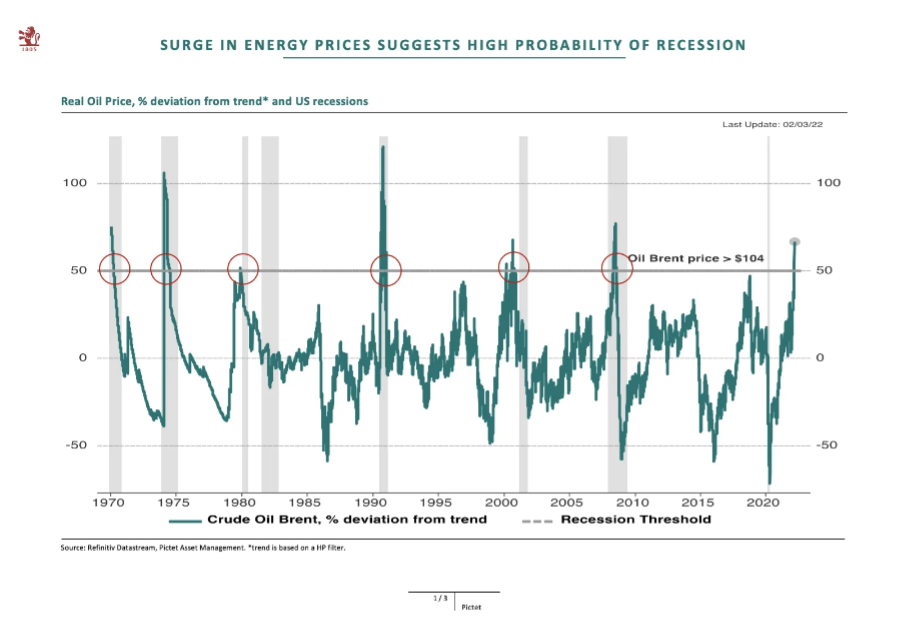
Oil prices during recessions (Source: Bloomberg)
In addition, oil is difficult to replace with alternatives. Most trucks are designed to run on diesel, and industrial machinery is powered by oil. As a result, companies cannot easily switch to cheaper alternatives to reduce costs. This dependency makes the economy vulnerable to oil price shocks.
Rising oil prices quickly feed through into the cost of goods and services. Because companies cannot always fully pass on these higher costs, profit margins come under pressure. Profit margins are a key driver of investment. When they shrink, companies invest less.
Another option is to pass on the increased costs to consumers through higher prices. This pushes up CPI inflation, prompting central banks to raise interest rates in an attempt to contain it. Higher interest rates, in turn, slow economic growth.
Consumers also feel the impact directly. NOS reports that diesel prices at the pump have reached a new record high. Higher spending on fuel and energy reduces disposable income, leading consumers to spend and save less. This further weighs on economic growth.
Finally, the Netherlands is one of the world’s largest trading nations. The Dutch economy relies heavily on exports and imports and depends on stable trade routes and the supply of oil and gas. Due to unrest in the Middle East, these routes are being disrupted, according to De Nederlandsche Bank.
The economic impact of rising oil prices depends on the duration and intensity of the conflict. Initially, rising costs are absorbed by companies, and countries tap into strategic oil reserves to dampen price increases. The Dutch government, under the coordination of the International Energy Agency, has released strategic reserves due to tensions in the Middle East.
If prices continue to rise, companies will have to pass on costs to consumers. In addition, oil reserves will eventually be depleted. If the situation escalates further and persists, the economic impact becomes increasingly significant. De Nederlandsche Bank has outlined several scenarios.
Scenario 1 — Favorable: In a scenario where tensions ease and energy prices decline later this year, the damage remains limited. Higher costs are partially reflected in prices, leading to a modest increase in inflation, while the overall economic impact remains contained.
Scenario 2 — Unfavorable: In a less favorable scenario, prices rise further and remain elevated in the second and third quarters. Economic growth slows, business investment declines, consumption falls, and inflation increases further.
Scenario 3 — Severe: In the most severe scenario, energy prices remain extremely high for two years. These high prices are fully reflected in the cost of goods and services. Inflation rises significantly while economic growth weakens; this phenomenon is known as stagflation. This creates difficult policy choices for central banks: higher interest rates can reduce inflation but further slow the economy. This leads to higher unemployment, while household purchasing power and business investment decline.
What does this mean for investors? Geopolitical conflicts bring structural uncertainty. There is no crystal ball to predict the outcome or the reaction of financial markets. The only certainty in periods like these is volatility. Larger price swings than usual are therefore to be expected. Investors may consider investing periodically and keeping part of their capital liquid to respond to market movements. DCA — dollar-cost averaging — offers a prudent approach to navigating volatility without taking unnecessary concentration risk. We have previously written an article on this topic.
High oil prices can have a significant impact on the economy, as oil is embedded in nearly all production and transportation processes. Higher energy costs quickly lead to inflation or declining profit margins, putting pressure on economic growth. The ultimate impact depends on the duration and intensity of the conflict. As long as uncertainty persists, heightened volatility in financial markets is to be expected. DCA enables investors to enter the market gradually and reduce concentration risk.
Also take a look at our YouTube channel
On behalf of Holland Gold, Paul Buitink and Yael Potjer interview various economists and macroeconomic experts. The aim of the podcast is to provide viewers with better insight and guidance in an increasingly fast-changing macroeconomic and monetary landscape. Click here to subscribe.