English
EN


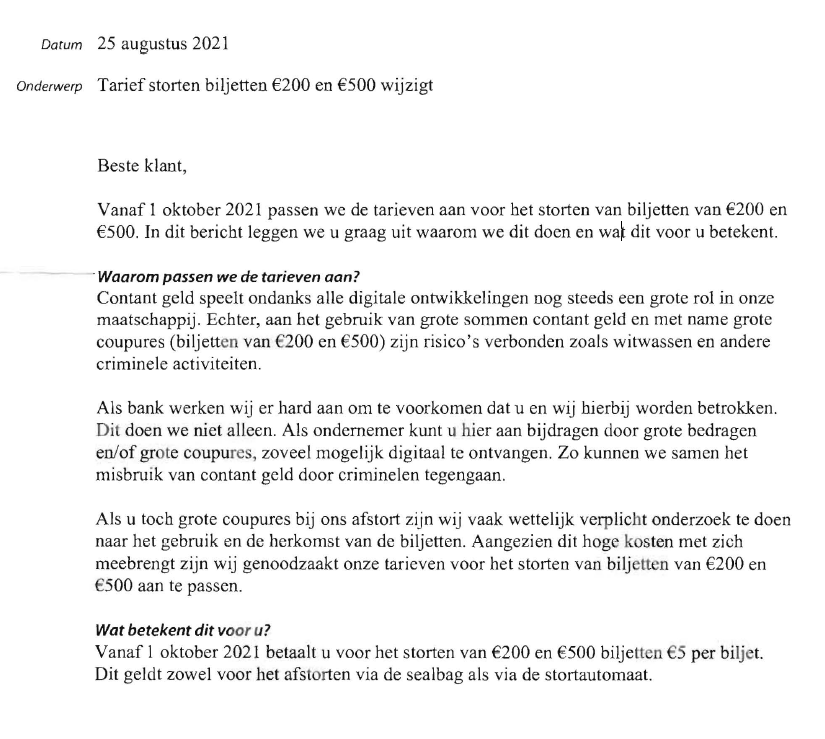
As of 1 October, Rabobank will increase the costs for depositing large banknotes. Business customers will pay €5 per note for depositing €500 and €200 notes. The bank says it incurs high costs for investigating the origin of these notes, because they are often required by law to do so.
The bank writes in a cover letter that there are risks associated with large banknotes, such as money laundering and other criminal activities. By increasing the fees for depositing these notes, the bank is trying to encourage its customers to make large payments digitally from now on. From the letter:
"Despite all the digital developments, cash still plays a major role in our society. However, the use of large sums of cash and especially large denominations (€200 and €500 notes) involves risks such as money laundering and other criminal activities.
As a bank, we work hard to prevent you and us from being involved. We don't do this alone. As an entrepreneur, you can contribute to this by receiving large amounts and/or large denominations digitally as much as possible. In this way, together we can combat the misuse of cash by criminals."
Business customers of the Rabobank, The pay these higher costs not only when depositing via sealbags, but also via the landfill machine. And that can be quite expensive. For cash payments without identification, a limit of €10,000 applies. If customers pay in €200 notes, that's a total of fifty notes. This means that an entrepreneur has to pay €250 in costs when depositing such an amount.
Rabobank is not the only bank that further discourages the use of cash. Earlier this year, ABN Amro also entered the Controversy, when she announced her plans to charge fees for withdrawing funds. Customers who withdraw more than ten thousand euros in cash in a year will have to pay five euros plus 0.5% of the amount withdrawn in fees for each subsequent cash withdrawal.
The Dutch Central Bank (DNB) was not charmed by this action. At the beginning of July, the central bank announced that it wants to sit down with banks to discuss make appointments. DNB's position is that cash must remain accessible and usable. The central bank proposed to make agreements with banks for the next five years to arrange this.
According to the central bank, it is understandable that banks want to pass on payment costs to customers, but in doing so they should not harm the users of cash. DNB also stated that banks' efforts to detect money laundering and fraud should not impede the legitimate use of cash and reduce the accessibility of cash infrastructure.
Rabobank's plan to increase the costs of depositing large denominations seems to be contrary to DNB's starting point. €200 and €500 banknotes can also be legitimately obtained and used legitimately. We are therefore curious to see whether the central bank will address this. Or do different rules apply to large banknotes?
Rabobank increases fees for depositing €200 and €500 banknotes
This contribution comes from Geotrendlines