English
EN


By: Frank Knopers
The U.S. government is considering price caps for gasoline and diesel, as Congress will vote next week on a new bill to curb "excessive prices." Fuel prices have been rising in the United States for three weeks in a row now. As a result, Americans are now paying Record prices at the pump. A gallon of gasoline (about 3.78 liters) now costs an average of $4.56, while the price for diesel is currently at $5.57. Can fuel price caps help consumers?
The price of oil has risen by about 20% since the war in Ukraine, but the prices of fuels have risen much faster. This is mainly due to a lack of refining capacity, because too little has been invested in the energy sector. Refineries had scaled back their production due to the corona crisis, but due to the rapid recovery of the economy, they are now unable to keep up with the demand for fuels. As a result, prices are rising and there is a threat of Shortage of diesel.
In the United States, fuel prices have been rising almost continuously for three weeks now. In addition, the price of diesel has risen to record highs. And this is not only noticeable by farmers and transport companies, but also by consumers. The high fuel prices are working direct prices of food and building materials, for example. This situation is annoying for consumers, but beneficial for energy companies. Profit margins for refining crude oil are at record highs due to the scarcity of fuels Increased. They are now three to four times higher than a year ago.
That is precisely what the US government is trying to curb with a new bill. The bill entitled 'Consumer Fuel Price Gouging Prevention Act' gives the U.S. president the authority to declare an emergency. In concrete terms, this means that energy companies are not allowed to increase the prices of oil products such as petrol, diesel and kerosene during this period. In other words, it is a form of price control designed to protect consumers.
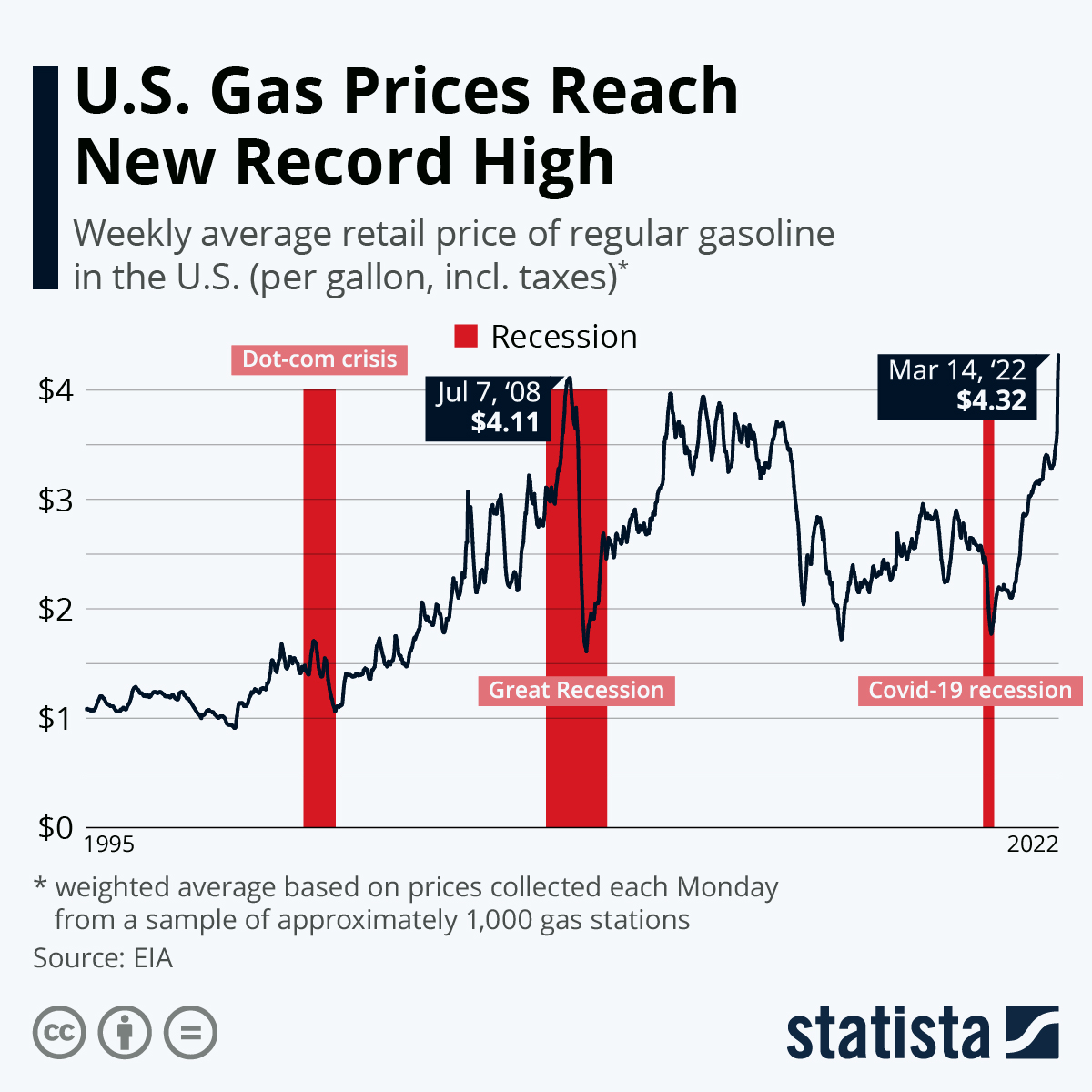
Gasoline prices have also risen to record highs in the U.S. (Source: Statista)
These kinds of price controls have been tried many times throughout history by politicians who don't understand economics. Despite all the good intentions, these kinds of interventions always backfire, because they distort the underlying dynamics of the market. The law of supply and demand teaches that enforcing a lower price than the market price has consequences for the available supply. Previously Warns also Neil Bradley, vice president of the U.S. Chamber of Commerce. This lobby group in the US represents the interests of more than three million companies and organizations.
He foresees long queues at the petrol stations, because the supply of fuel will be further reduced by possible price caps. Just like during the oil crisis in the 1970s, people will have to stand in line for a long time for fuel. It is possible that fuel will be rationed. By limiting the profit margins of refineries through this bill, it will become less attractive for the energy sector to invest in additional refining capacity. If the profit margin becomes too small, the supply of fuels may even decrease in the long term. And that while the demand is actually increasing towards the summer.
Bradley foresees long queues at the pump if Congress passes this bill. According to him, the U.S. government should send a signal to the energy sector that it is supporting domestic production for the long term. This will create new investments that are needed to meet demand. If the government really wants to support the economy, it is much more effective to reduce the tax on fuels. This immediately leads to more purchasing power and lower inflation rates.
The bill to prevent consumers from paying even more for fuel sounds noble, but it will have a very detrimental effect. It therefore seems more like a measure for the stage. If the law is not passed, the Democrats can say that the Republicans do not want to help consumers and are on the side of the oil sector. But that doesn't bring us any closer to a solution to this energy crisis.
This contribution comes from Geotrendlines
 Have a look at us YouTube channel
On behalf of Holland Gold, Paul Buitink and Joris Beemsterboer interview various economists and experts in the field of macroeconomics. The aim of the podcast is to provide the viewer with a better picture and guidance in an increasingly rapidly changing macroeconomic and monetary landscape. Click here to subscribe.