English
EN


In Gold We Trust (IGWT), part of asset manager Incrementum, publishes an annual report on the state of affairs with regard to precious metals. End of March Wrote we already wrote a piece about the preview of the report that was released. Today it's Seventeenth Report Appeared. The new report does not detract from the positive outlook that the preview chartbook promised us in March. The report has more than 400 pages. What's in it?
According to IGWT, there is currently a 'Showdown', which they define as a moment when important things can fundamentally change. Such aShowdown is now there on the monetary and geopolitical fronts. These two important factors also allow the Gold price on an important point. There could be a glorious period ahead for the precious metal.
In previous reports, IGWT predicted that the long period of low interest rates would eventually have consequences. For years, policy rates were very low and even negative interest rates were levied on bank deposits. The report has therefore long expressed the expectation that inflation would increase and calls the statement by central bankers in 2021 that inflation would be temporary legendary. Inflation turned out to be more long-lasting and persistent, forcing central banks to radically adjust their course. IGWT therefore says it is not surprising that people have had less and less confidence in the central bank for a long time. It should be noted, however, that such statements about inflation were made before the war in Ukraine broke out. The war caused energy prices to skyrocket, which led to sharply higher inflation.
However, there is now a trilemma, in which the central bank cannot ensure price stability, market stability and economic growth at the same time. When central banks raise interest rates, it does have a dampening effect on inflation, but it also causes major turmoil in the banking sector. Recently, we have seen three of the four largest bank failures in the United States after several parties had already collapsed in the crypto world. The economy is also suffering from these rapid interest rate hikes. Last month, for example, it was revealed that the Dutch economy was in the first quarter of the year.shrunk. We are also seeing a major decline in lending, both in Europe and in the US, and central banks therefore seem to have to choose between price stability and stability in the financial markets, in the economy and in the banking sector.
 IGWT follows the Austrian school and therefore points out the fluctuations in the Business Cycles by central bank policies. The cycle begins with the central bank stimulating the economy with low interest rates, creating financial bubbles and making wrong investments. If interest rates then go up again due to higher inflation, these bubbles burst, zombie companies emerge and the economy ends up in a recession. The past few decades have already shown many of these cycles. While these cycles create periods of rapid growth, they also create periods of deep financial crises. According to the Austrian school, it would be better to minimize these cycles.

IGWT is also concerned about the development of the monetary aggregate M2, the money supply in the broad sense. This indicator includes not only the basic money and the scriptural money of households, but also short-term savings deposits. In recent decades, the size of the money supply has grown according to this definition. This year, however, M2 seems to be declining and that is worrying, according to IGWT. Since the Second World War, M2 has not shrunk on an annual basis. Previous phases in which M2 fell were followed by banking crises, deflation and economic malaise. Although times have changed a lot, this is not a good sign, according to the report.
 The FED, the US central bank, has already had to soften its monetary tightening policy when some medium-sized banks in America collapsed. According to IGWT, this immediately indicates the weakness of our financial system. If parties such as the Silicon Valley Bank Collapse as a result of tighter monetary policy, the central bank is left with only one option; provide even more liquidity to parties that have run into difficulties. In recent years, several attempts to reduce the balance sheet have failed. And if inflation has fallen in a while, IGWT expects central banks to stimulate harder and to fuel inflation even more. The graph below shows that attempts to reduce the balance sheet in many cases end with a further expansion of the balance sheet through new asset purchase programmes.

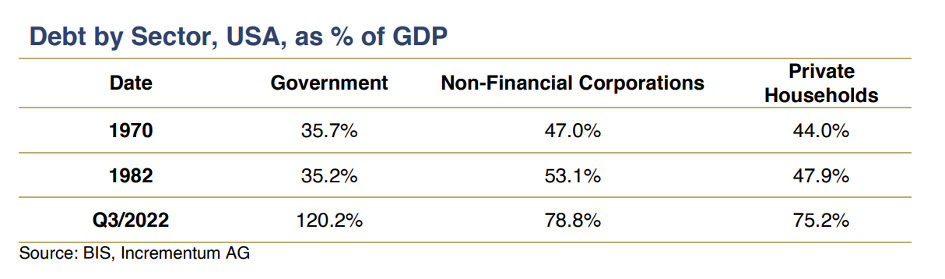
IGWT is also uneasy about the amount of debt that has currently been contracted. Compared to 1970, the amount of debt has increased enormously. This applies not only to the amount of public debt, but also to the debt of the private sector. This also ensures that the Fed cannot raise interest rates as quickly as it did in the 1970s, when there was also high inflation. It was the then chairman Paul Volcker who raised interest rates sharply, resulting in a severe recession, the Volckershock. Although inflation is also very high today, the comparison with the Volckershock is not correct, according to IGWT. For example, with today's high debts, interest rate sensitivity is much higher than it was in the 1970s. The central bank therefore has a harder time curbing inflation with its interest rate policy.
There is also a lot of turmoil on the geopolitical front. According to the report, two power blocs are emerging; on the one hand, the established order, led by the United States. On the other side are Russia and China, which are increasingly finding other emerging economies on their side. It is interesting to see that it is precisely China, Russia and emerging economies have added a lot of gold to their reserves in recent months. We have also discussed this on Holland Gold report.
By buying gold, these countries hope to reduce their dependence on the dollar. China seems to be succeeding quite well, as the country now uses its own renminbi more often than the dollar in transactions with foreign countries. In 2010, the Chinese currency was hardly used for such transactions. Countries want an alternative to the dollar, especially after the harsh sanctions against Russia after the outbreak of the war. Gold remains one of the few apolitical currencies in the world and is therefore attractive to hold, according to IGWT.
IGWT also sees a scenario in which world trade decreases, as several companies that strategically produce raw materials are nationalized. For example, Chile nationalized two large companies that produce Lithium and Indonesia restricted exports of nickel and tin so as not to hinder domestic production. Logistics chains have been getting shorter since the corona crisis, which is another sign that global trade looks different after the corona crisis and geopolitical turmoil than it did before.
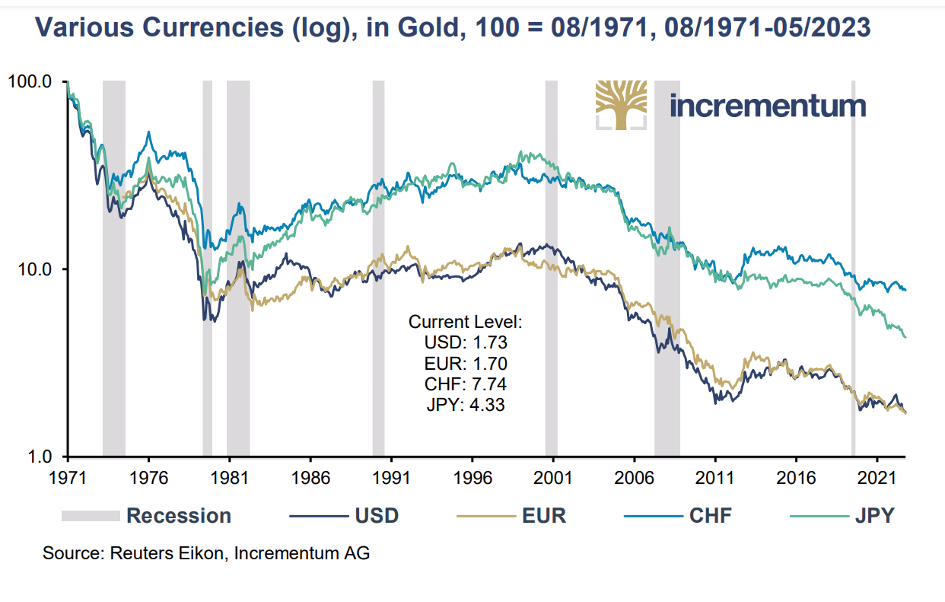
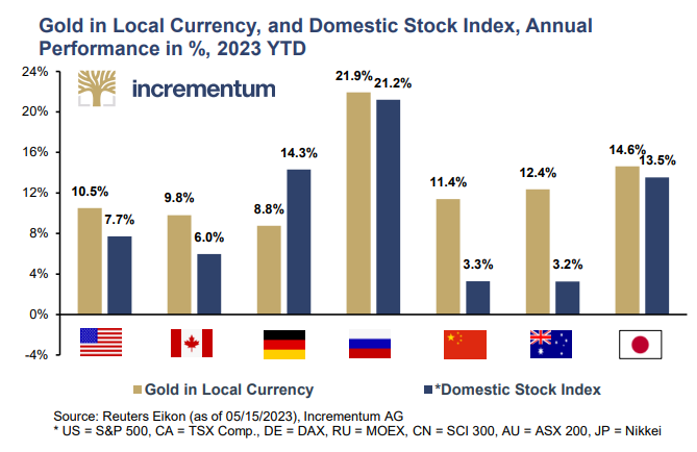
Traditionally, gold has always been a stable commodity. It's not that the value of gold increases every year, but gold is fairly stable in value over the long term. The precious metal is therefore a very good weapon against inflation. The purchasing power of a banknote, on the other hand, decreases every year. It is therefore not so much that the price of gold does very well every year, but rather that fiat money loses purchasing power every year. In April, the annual inflation rate was 5.2 percent, but even in normal years, money loses 2 percent of its value every year. The charts below show how different currencies and stock markets have performed against gold in recent years.
Partly due to the aforementioned monetary and geopolitical factors, gold is at an interesting point, according to IGWT. Since 2009, central banks have been adding gold to their reserves. This trend accelerated tremendously after the war in Ukraine and the associated sanctions. For example, gold purchases increased by 152 percent in 2022 compared to 2021. This made 2022 a Record year as far as gold purchases are concerned. On the other hand, central banks hold less foreign exchange. Turkey was the largest buyer of gold, buying 148 tons of gold. China was in second place, followed by Egypt. It is interesting to see that major oil exporters such as Iraq and Qatar are also adding a lot of gold to their reserves.

IGWT therefore expects a so-called bull-market for gold, which has been fuelled in part by high demand from central banks. In addition, investors will also want to protect themselves against high inflation and uncertainty. Although the demand for gold from investors is still limited, IGWT expects a turning point soon, which could cause the price of gold to rise explosively. The month of March saw another influx to gold ETFs due to the turmoil in the banking sector. That indicates that investors are quick to seek refuge in precious metals in the event that turmoil arises. A new event, such as the failure to raise the US debt ceiling in time, together with the enormous demand from central banks, could cause the gold price to rise, according to IGWT, according to the report.
According to IGWT, there is therefore reason enough to be optimistic about precious metals. The current geopolitical turmoil is likely to continue for some time and inflation has not been reduced to two percent overnight. The coming period will show whether IGWT is right.
 Have a look at us YouTube channel
On behalf of Holland Gold, Paul Buitink and Joris Beemsterboer interview various economists and experts in the field of macroeconomics. The aim of the podcast is to provide the viewer with a better picture and guidance in an increasingly rapidly changing macroeconomic and monetary landscape. Click here to subscribe.