English
EN


Precious metals are digesting the sharp price increases of recent months, a process accompanied by significant volatility. Unsurprisingly, the largest price swings tend to occur on trading days with below-average liquidity. Gold and especially silver took another hit on Presidents’ Day, when markets in the United States and Canada were closed.
At the same time, Chinese and several other Asian markets remain closed throughout the week due to the Chinese New Year. Asia was the driving force behind the price rally, and without participation from the East, upward price momentum has temporarily stalled.
Volatility is being further fueled by geopolitical developments. In particular, a potential US attack on Iran could trigger substantial price swings across financial markets and therefore also in gold.
After six weeks in 2026, gold is trading 15% higher in US dollars and nearly 14% higher in euros. Silver has seen most of its year-to-date gains evaporate since late January, retaining an 8% increase in dollars and 7% in euros. The gold-silver ratio has shown sharp fluctuations, moving from 60 at the start of the year to 45 at the end of January and currently standing at 64.
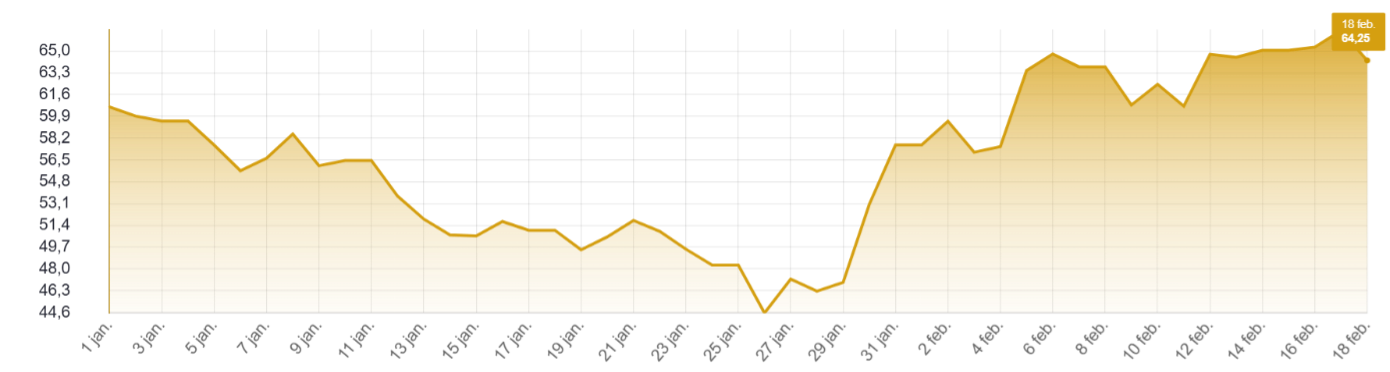 Chart: gold/silver ratio since 1/1/26 (Source: HollandGold)
Amid all the volatility, one factor has remained remarkably constant: the persistently weak dollar. The dollar index (DXY) has not been this low in nearly four years. This cheaper dollar has provided additional fuel for price increases in physical assets such as gold and silver. There are numerous reasons to hold a negative view on the US currency. Beyond structural factors such as severely deteriorating government finances, there is also the unpredictable economic policy of the US administration and political pressure to lower the (short-term) policy rate.
However, much of this is already priced in. A Bank of America survey of various fund managers shows that negative sentiment toward the dollar has not been this strong since 2012. This is reflected in speculative positioning in futures markets. The combined short position across eight currency pairs against the dollar totaled USD 20 billion at the end of last week, the highest level since June. Conversely, the long euro position has not been this elevated since May 2023.
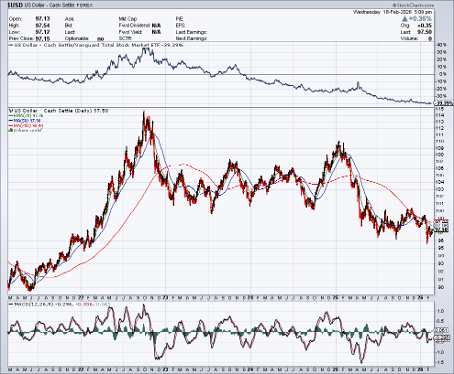 Chart: $-index over 5 years (Source: StockCharts.com)
One-sided positioning in futures markets increases the likelihood of short covering, which does not necessarily require a specific trigger, as profit-taking alone may suffice. The correlation between the dollar and gold has been highly unstable for some time. If the US currency were to appreciate without negatively impacting gold prices, this could be a positive development for gold in euro terms.
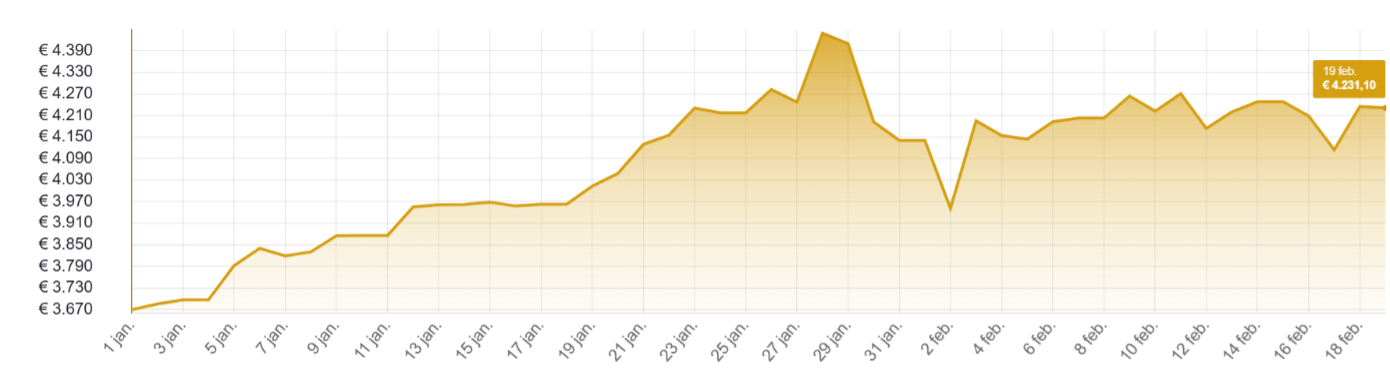 Chart: gold price since 1/1/26, in EUR (Source: HollandGold)
Meanwhile, markets remain largely in the dark regarding Federal Reserve monetary policy. The minutes of the most recent monetary policy meeting indicate disagreement among members of the Monetary Policy Committee over the future interest rate path.
The camp advocating additional near-term rate cuts faced pushback following the January inflation report, which showed the Consumer Price Index (CPI) declining to 2.4% compared with 2.7% a year earlier. For the upcoming monetary policy meeting on March 18, 94% expect rates to remain unchanged, according to the CME FedWatch Tool. Last week, expectations for the first rate cut shifted from June to July, but in recent days a slight majority has once again begun to anticipate a June cut.
The Silver Institute expects 2026 to mark the sixth consecutive year of a supply deficit in the global silver market. The organization forecasts a deficit of 67 million troy ounces compared with 95 million troy ounces in 2025. Supply is expected to increase, but not sufficiently to meet demand. Investors compete with industrial users in both futures and physical markets, putting upward pressure on prices. Alternatives to silver exist for certain industrial applications, but production processes take time to adjust. Moreover, prices of these alternatives, such as copper and aluminum, have also risen recently.
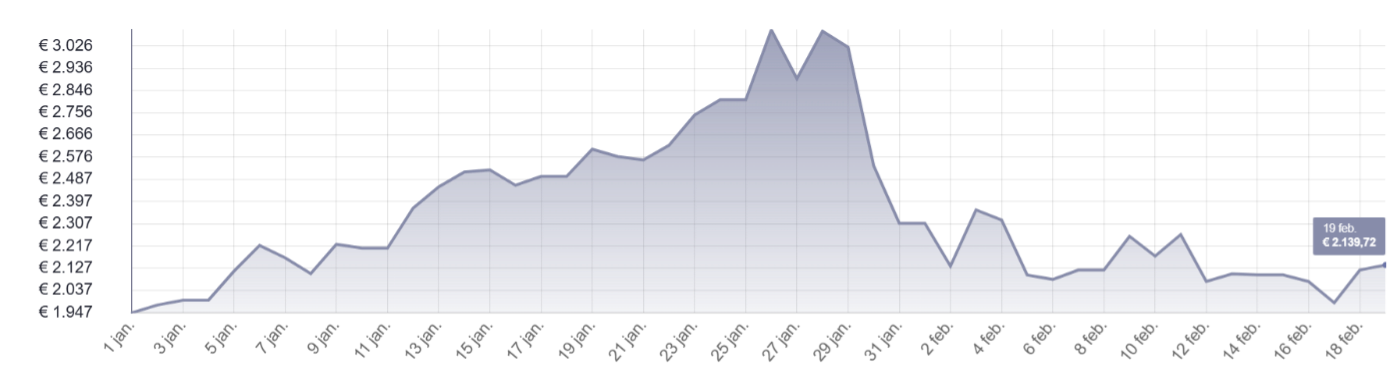 Chart: silver price since the start of this year per kg, in EUR (Source: HollandGold)
There is also ongoing speculation about the impact of potential physical scarcity on futures exchanges. Registered Comex inventories are under pressure, which could pose challenges if an unusually large number of futures holders were to opt for physical settlement simultaneously. This concern is not new and tends to resurface when open interest, or the number of outstanding contracts, is elevated, as is currently the case. Typically, open interest declines sharply as contracts approach expiration.
Most market participants, however, are not interested in physical delivery and instead close their positions or roll them forward to the next contract month. In addition, Comex inventories are not static. The parent company of Comex is the CME Group, whose major shareholders include large financial institutions such as JP Morgan, State Street, BlackRock and Morgan Stanley, all of which hold positions in the silver market.
Moreover, Comex applies strict position limits and retains the authority to impose a unilateral cash settlement should exchange operations be threatened. In such a case, the cash equivalent of the position is paid out without physical metal being delivered. Therefore, while a theoretical possibility of insufficient silver supply exists, in practice the likelihood remains relatively low.