English
EN


By: Frank Knopers
In the Netherlands, wages will rise by an average of 3.8% this year and in the United Kingdom by as much as 4.7%. In recent decades, wages have not been so hard Increased as it is now, but that is nothing compared to the skyrocketing inflation. In fact, the average purchasing power of most people is falling by several percent this year, as the cost of living rises much faster. In the United Kingdom, real incomes - i.e. after adjusting for inflation - have not even risen since 2001 dropped so hard like this year. What does this mean for our economy and for our prosperity?
The causes of high inflation are now well known, namely rising energy prices and therefore increasingly higher food prices. In the United Kingdom, inflation reached its highest level in forty years in June at 9.4%, but is expected to rise further to 13% in October. In fact, the situation in the United Kingdom is so dire that a supermarket chain has recently interest-free loans up to £100 to customers who can no longer afford groceries. In the Netherlands, we see similar inflation figures, because we are dealing with the same price increases for fuel, energy and groceries.
In July, inflation in the Netherlands rose by 11.6% year-on-year, which means that anyone who sees their wages rise less than that percentage is in fact going to suffer. That means that most people will effectively get less purchasing power for the same work this year. The call for additional wage increases is therefore stronger, also because the labour market is still very tight and corporate profits are increasing. Many companies have been able to raise the prices of their products and services in the past year, but employees do not fully benefit from this.
More wage increases will have the effect of keeping inflation high for a long time and of making high prices structural. It is the dreaded wage-price spiral, in which wage increases and inflation reinforce each other. There is a good chance that inflation will rise even further in the short term. The prices of important energy sources such as gas and coal are still rising. Households that now have to renew their fixed energy contract will soon be able to renew their fixed energy contracts on an annual basis pay a few thousand euros more, assuming a consumption of 3,500 KWh and 1,500 cubic meters of natural gas. This is a direct attack on the disposable income of many households.
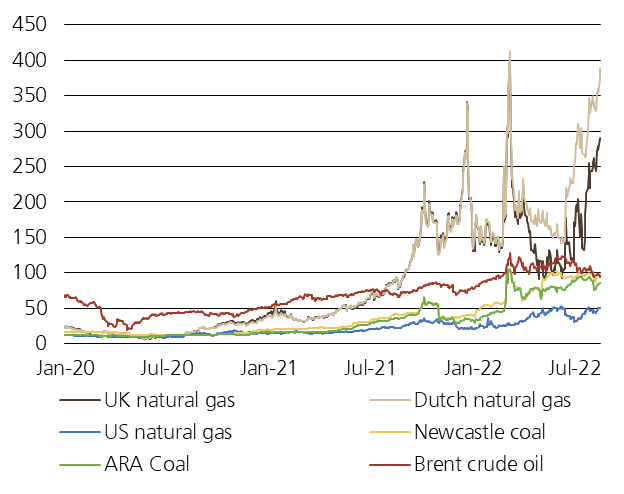
Energy prices are rising, especially in Europe
In addition, according to figures from GfK, groceries have become 18.5% more expensive in the last eleven months. In practice, this means that, on an annual basis, €1,500 more on groceries than a year ago. If we add all the other fixed costs to that, the question is whether a few percent more wages is enough to compensate for the loss of purchasing power. According to Nibud, one in three households Already having problems keeping the housekeeping book in balance. This means that in addition to the lowest incomes, more and more middle-income earners are at risk of getting into trouble. And that does not bode well for our economy.
Without further wage growth, it is inevitable that our purchasing power will decrease. And that means more people have to cut back on luxury goods and services. And then, in the long run, high inflation can automatically turn into deflation, where certain products and services can become cheaper. With additional wage increases, we can further postpone this decline in purchasing power, but not prevent it. Eventually, everyone will have to deal with skyrocketing energy prices, which will cause part of our purchasing power to disappear abroad.
There is a good chance that the energy crisis in Europe will cause a recession or possibly even a depression, as discussed earlier in this video of Holland Gold explains and in This interview with Eric Mecking. Due to high energy prices, more purchasing power is flowing away from Europe to energy-producing countries such as Russia and Saudi Arabia. This effect is also reflected in the trade balance of the Eurozone. Since the beginning of the war in Ukraine, it has turned from a surplus to a lack. High energy prices will therefore reduce prosperity in Europe. Higher wages will not structurally change this outcome.
 Have a look at us YouTube channel
On behalf of Holland Gold, Paul Buitink and Joris Beemsterboer interview various economists and experts in the field of macroeconomics. The aim of the podcast is to provide the viewer with a better picture and guidance in an increasingly rapidly changing macroeconomic and monetary landscape. Click here to subscribe.