English
EN


The war in Ukraine has brought about a major shift in the financial landscape. More and more countries want to reduce their dependence on the United States. As a result, the hegemony of the dollar is coming under increasing pressure. The BRICS countries, a group of emerging economies, have been looking for alternatives to the Greenbacks. Recently, a possible new currency of the BRICS, which may be backed by gold, has been in the news many times. How likely is it that this coin will be created?
The end of the dollar's hegemony has already been highlighted by credit analyst Zoltan Pozsar, but also by politicians Jelena Postuma In a podcast by Holland Gold. Recently appeared on Kitco an interview with strategic advisor Simon Hunt. According to Hunt, the importance of BRICS will grow in the coming years. There are many countries that want to join the partnership. Last year, China indicated that it wanted to admit new members. There are now reportedly 20 countries that want to join the BRICS alliance, including Saudi Arabia, Argentina, Egypt, Iran, Turkey, United Arab Emirates, Thailand and Venezuela. BRICS will become BRICS+.
Since America blocked foreign exchange from Russia following the invasion of Ukraine, several countries have been looking for ways to circumvent the dollar. Initially, the idea of introducing a currency backed by a basket of commodities was floated, based on the idea of Zoltan Pozsars Bretton Woods 3. According to Hunt, this idea has been replaced by the idea of a gold-backed coin. Recently, we have already seen that central banks bought a record amount of gold. In doing so, they capitalized on the geopolitical turmoil and relied on the security of gold. Some economists therefore expect gold to become increasingly important in the financial system.
According to Hunt, gold is already playing a bigger role in the trade of Russia. The country has a surplus on its balance of payments and places the dollars in which it is paid in an account with the Chinese central bank. There it can then be exchanged for gold. According to Hunt, such a construction can be set up between many more countries. In addition, it is logical that countries are looking for alternatives to the dollar as a reserve. It is quite possible that energy contracts will be concluded in different currencies in the coming years. The strategic adviser therefore wonders why countries would want to hold on to so many dollars in the future.
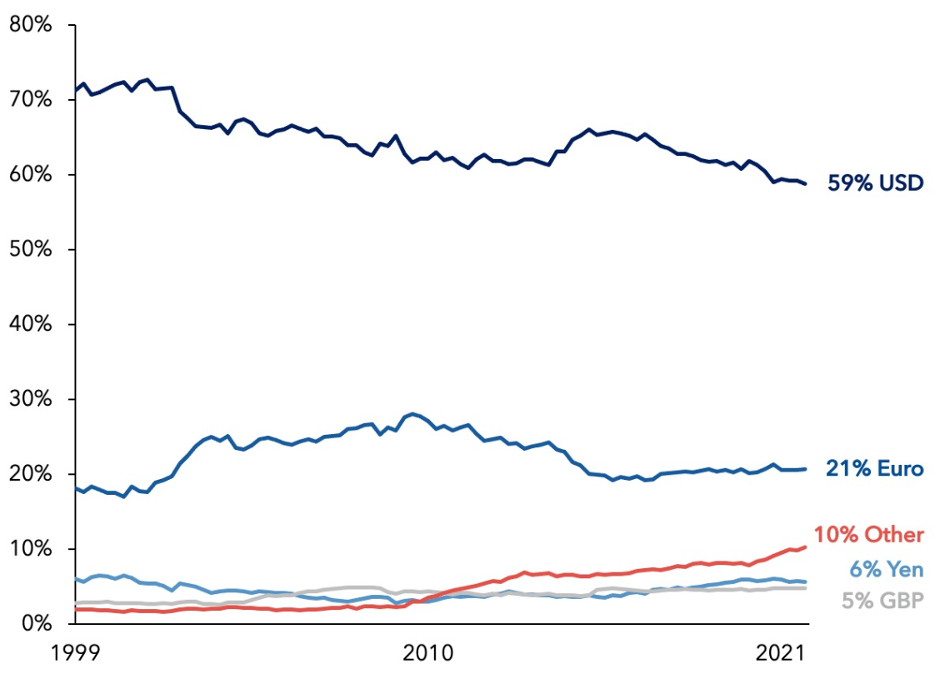
The share of dollars in foreign exchange reserves has been declining for years. (Source: IMF)
Hunt expects a coin that can be exchanged for gold to appear in a few years; 'The development of the new currency is taking place in stages. At the end of this process, say at the end of the twenties of this century, I expect that there will be a new currency that can be exchanged for gold. That seems like an optimistic expectation. Even at the time of the Gold Standard from 1871 to 1914, the standard was a gold core standard rather than a strict gold standard. Even then, money was not fully backed by gold. The precious metal was stored in the vaults of the central bank and the transactions were fulfilled with fiat money, as can be read in the book De Nederlandsche Bank by Wim Vanthoor.
There is also a problem with a pure gold standard. Such a standard means that the money supply can no longer grow with the economy, but depends on the amount of gold in the country. If the quantity of gold falls, it must be accompanied by a fall in the money supply. This makes it more difficult to implement stimulative policies in a crisis. One must also watch out for deflationary developments if a strict gold standard is introduced. Central banks have traditionally been very afraid of deflation. So the return to a gold standard seems like a risky move in that regard.
But if the BRICS countries were to introduce a fiat currency, the question would arise as to whether a BRICS currency would be wise for economies that are very different from each other. This is very reminiscent of the introduction of the euro in the years around the turn of the century. If such different economies introduce a currency, the exchange rate will never be perfectly aligned with the economies of participating countries. Ideally, therefore, a political union should be established first, but that does not seem likely either. A new currency will therefore almost have to have a link with commodities or gold, as tweeted Paul Buitink recently.
Leslie Maasdorp, Vice President of the New Development Bank (NDB), Excludes that a BRICS coin will be introduced in the near future. The NDB was created as an alternative to the International Monetary Fund (IMF) and the World Bank, both of which are dominated by America. The NDB helps emerging economies and, for example, finances infrastructure projects. The bank has an initial capital of 50 billion, but it is expected that the capital will increase, as more countries will join the new bank. Bangladesh and the United Arab Emirates have already joined, Uruguay is likely to follow this year.
According to the NDB, there is no question of a new BRICS currency yet. 'Although BRICS countries are pushing for more use of local currencies, we are not yet ready to challenge the power of the dollar,' Maasdorp said. 'The intention of a new currency is really a long-term goal. There is no intention to come up with a new currency now.'
The question now is what happens next. There is a good chance that the dollar's dominance will wane. The absolute dominance of the American currency seems to have come to an end now that more and more contracts are no longer concluded in dollars, but also in other currencies. On the other hand, the dollar will continue to be an important currency in the future, especially since the big companies such as Apple and Facebook still come from America.
The analysis of Zoltan Pozsar therefore certainly seems to make sense. According to the credit analyst, multiple power blocs are emerging and we are moving towards a multipolar world. In some areas, the dollar will be replaced by the renminbi, but in other areas, the dollar will not lose much. In the long run, it is therefore possible that the BRICS countries will introduce a new currency, but this does not seem to be happening in the short term. Time will tell exactly how the BRICS+ will develop.
 Have a look at us YouTube channel
On behalf of Holland Gold, Paul Buitink and Joris Beemsterboer interview various economists and experts in the field of macroeconomics. The aim of the podcast is to provide the viewer with a better picture and guidance in an increasingly rapidly changing macroeconomic and monetary landscape. Click here to subscribe.