9.2
8.875 reviews

English
EN


In recent months, there has been a lot of speculation about the prospects of the economy. There were economists who already expected a recession in 2023, but a deep recession has not yet occurred. In 2024, there are again economists who expect that a hard landing cannot be avoided. What exactly is the difference between a hard and a soft landing and what can we expect for 2024?
By an economic soft landing, economists mean a slowdown in economic growth, without this being accompanied by a major recession. Economists want to avoid a hard landing, a situation in which a deep recession does occur, with harmful effects such as rising unemployment. In recent months, this hard landing has not occurred. Although the Dutch economy was technically in recession with two quarters of economic contraction, these quarters were not accompanied by a sharp rise in unemployment.
So the question now is whether 2024 will also go without a hard landing. ABN AMRO recently wrote that many signals are currently on red. For example, the number of new industrial orders is decreasing, which means that entrepreneurs will scale back production and may need fewer staff. Buyers, on the other hand, are mostly optimistic. For example, 38 percent of buyers expect increased production in 2024, compared to 19 percent who expect production to decrease.
The hope of a soft landing has not been dashed. Although it is possible that production will still fall in the first half of 2024, ABN AMRO believes that a recovery may occur in the second half because excess inventories built up during the pandemic are likely to have been reduced by then. There is also a chance that central banks will cut policy rates. ABN AMRO expects both the European Central Bank (ECB) and the FED, the US central bank, to cut interest rates from 125 basis points. Interest rates on the capital market fall, which means that the market also expects central banks to cut interest rates. Lower interest rates will stimulate the economy again, allowing for an upward momentum in 2025.
Analyst Jack Hoogland, in an interview with Holland Gold are doubts about such a soft landing. According to Hoogland, the absence of the recession in 2023 was the result of the support packages that the US government had offered citizens after the pandemic. For example, in recent years, an American family with two children received up to $8,800 as a result of support measures. While economists had expected some of that money to be saved, Americans have actually consumed beyond expectations in 2023. That postponed the recession in America, but now that defaults in America are rising and several large companies are tempering profit expectations, it seems unlikely that the recession will not happen in 2024, Hoogland predicted.
Interest rates have been raised rapidly over the past two years. The ECB was relatively late in raising interest rates. Here, the first interest rate hike only started in July 2022, while the US central bank already hiked in March of that year. Now the ECB seems to be nearing the end of the series of interest rate hikes. The interest rate has not been adjusted in recent meetings, which means that the ECB's policy rate has been at 4.50 percent since September.
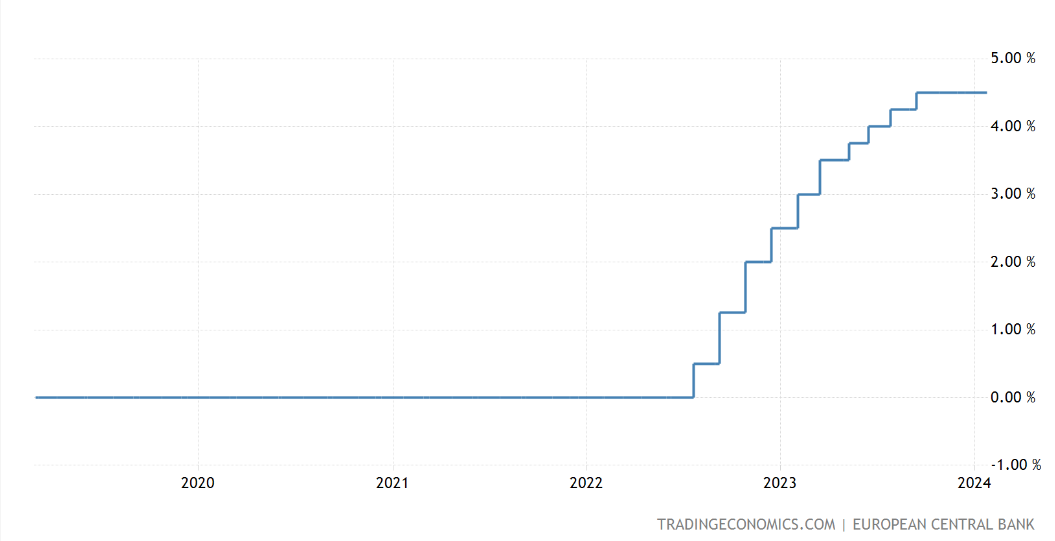 Chart of the ECB's policy rate. (Source; Tradingeconomics.com)
There no longer seems to be a need to raise interest rates any further. Inflation rates have been falling for some time. In December, inflation in the Eurozone was still 2.9 percent on an annual basis. Since the ECB aims for a two percent price increase on an annual basis, the current inflation rate is still too high, but inflation rates have been falling for some time. In October 2022, products in the Eurozone were still 10.6 percent more expensive than one year previously. Inflation has fallen sharply since then and is approaching the policy target. At the same time, the central bank must also be careful not to raise interest rates too much and thereby exacerbate a possible recession. There are signs that economic growth is being slowed down by higher interest rates. For example, German industry is having a very hard time at the moment. Economist Han de Jong expressed his concerns on several occasions about developments in our neighbouring country.
Klaas Knot, President of the Dutch Central Bank (DNB), provided more clarity on the ECB's upcoming interest rate decisions in the Buitenhof programme. He explained that the ECB's only mandate is to maintain price stability. The central bank therefore does not take into account the industrial developments of specific countries. In this respect, the ECB's mandate differs from the mandate of, for example, the US central bank. In America, in addition to maintaining price stability, the central bank is also burdened with maintaining maximum employment.
According to Knot, price stability in Europe is moving in the right direction; 'Due to high inflation, it was inevitable that we raised interest rates. We now have a credible prospect of inflation returning to two per cent by 2025. The last piece of the puzzle that is still missing is proof that wage growth will also adjust to low inflation in the near future. If that piece of the puzzle falls into place, we will have the room to lower interest rates,' Knot said in Buitenhof. The wage surge we have seen in recent months now seems to be over. In January, wages rose by 'only' 5.3 percent. In December, the wage increase in new collective labour agreements was still 6.8 percent.
The prospect of precious metals is also strong in 2024. During a recession, investors often flee to a safe haven. Especially in the event of a hard landing, a resort to precious metals can be expected. If, at the same time, policy rates are lowered next year, it will be gold Attractive. Against Holland Gold, several analysts indicated an increase in Gold price expected in 2024. Jack Highland saw the price of gold rise in 2023 while the recession failed to materialise; 'In 2024, the gold price could rise much further if a recession occurs and policy rates go down,' Hoogland said.
Also Frank Knopers Expect a higher gold price by the end of 2024. In November, market interest rates fell and then prices of precious metals, but also of stocks, bonds and cryptocurrencies rose. If interest rates fall further and the geopolitical situation remains uncertain, a rise in the gold price is likely, according to Knopers. So, the prospect of precious metal remains good.


