English
EN


The value of Acacia Mining's share has increased by 42% in three days Dropped, after the government of Tanzania filed a $190 billion tax claim with the gold mine. The government is demanding $40 billion in lost taxes and $150 billion in fines and lost interest from Acacia Mining, the company that owns all the major gold mines in Tanzania.
According to the government of the African country, Acacia Mining provided incomplete information on the total production and exports of two of its gold mines between 2000 and 2017, but that claim is contradicted by the mining company. Acacia Mining says it has fully declared all production figures and export data to the government of Tanzania, but investors are not interested in that for the time being. The stock lost as much as 42% of its value in three days.
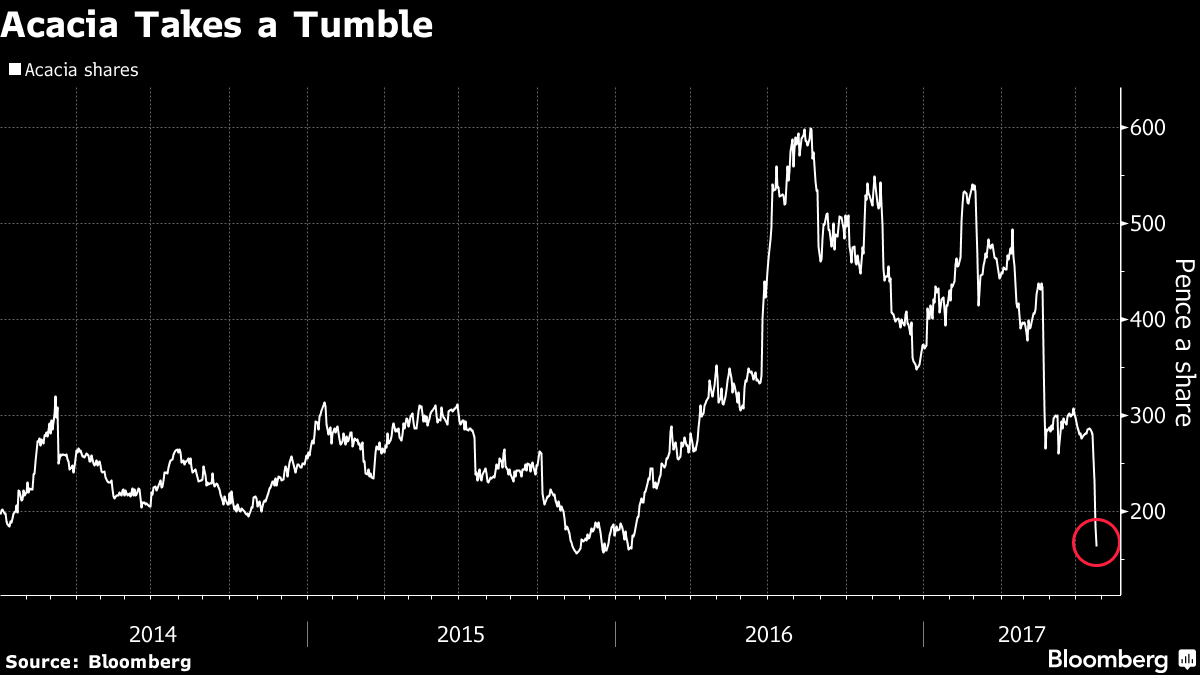
Acacia Mining stock down 42% in three days (Chart via Bloomberg)
The tax claim that Acacia Mining is facing is excessive in all respects. According to Hunter Hillcoat, an analyst at Investec, the claimed $40 billion in lost taxes alone is more than twice as large as the total tax paid by the world's five largest gold mining companies since 2000. On top of that, there is the $150 billion fine.
For Acacia Mining, this fine is virtually prohibitive, as the company made $1.05 billion in profits from revenue of $7.7 billion last year. In a statement, the mining company says it is doing everything in its power to challenge this fine. It is not the first time that the mining company has clashed with the government of Tanzania. In March, the African country banned the export of raw gold and copper, which means that Acacia Mining says it is missing out on $1 million in revenue every day . Relations became even more strained when the government accused the mine of illegal activities and tax avoidance.
Investing in gold mines can yield very high returns, as the gold mine's profit margin increases rapidly with an increase in the Gold price. But this high return is also offset by a number of risks that can adversely affect the return on this investment. For example, the activities of a gold mine can be interrupted by a strike, bad weather conditions or government measures.
In the most extreme case, the gold extracted from the ground by a gold mine is the property of the land where it is excavated. Normally, mines pay a fee to the government for the right to mine gold, called a royalty. But the moment the government decides that the mineral resources are national property, you have a difficult negotiating position as a gold mine.
It is precisely for this reason that it is important to distinguish between an investment in physical gold and an investment in gold mining shares. Gold Coins And bars do not have counterparty risk, while gold mining stocks do have that risk.