English
EN


The decision to buy gold is often made quickly, but the way in which you invest requires careful consideration. Do you choose an ETF, professional storage, or physical gold under your own custody?
Each option has its own advantages and disadvantages. It is a choice within a triangle of liquidity, costs and autonomy, where not everything can be maximized at the same time. What is gained in liquidity is often lost in autonomy. Lower costs often come at the expense of control and ownership. Where do these options fit within that triangle, and how should the right choice be made?
When buying gold, a balance must be found between liquidity, autonomy and costs. Liquidity refers to how quickly gold can be sold and at what price. If it can be sold at market price with the click of a button, liquidity is high. If liquidity is lower, a buyer must first be found and spreads, the difference between buying and selling price, are wider. Costs include all expenses involved in buying and owning gold: the premium (the difference between the market price and the actual purchase price), storage fees and transaction costs. High costs reduce the return on the investment. Autonomy refers to the degree of control and ownership. Is the gold legally owned, or is there only a claim on it? Can decisions be made independently regarding the gold, or is there dependence on other parties? High autonomy means limited counterparty risk, for example in the event of bankruptcy.
This trade-off exists because these characteristics partly conflict with one another. High liquidity is achieved through centralized management: if the gold is held in the name of the custodian and stored in one location without delivery options, liquidity is high and costs are lower. However, this comes at the expense of ownership and control over the gold.
High autonomy, on the other hand, is achieved through decentralization. If the gold is legally registered in the owner's name and there is no dependence on counterparties, autonomy is high. This does involve higher costs: there are fewer economies of scale and personal storage is more expensive.
Most gold ETFs such as SPDR Gold Trust are backed by physical gold. For every share, gold is actually purchased. However, the gold is not legally owned by the shareholder, because what is purchased is a share in a fund: the investor owns shares in a fund that manages gold. The gold remains registered in the name of the custodian.
There is also dependence on other parties: the gold is managed by institutions such as JPMorgan, and the purchase of gold backing each share is arranged by large banks. It is also not possible for private investors to take physical delivery of the gold. Because the system is centralized, costs are low and liquidity is high.
With professional vault storage, such as the Holland Gold precious metals account, gold is purchased and insured in a secured vault. In this case, the gold is the legal property of the buyer and registered in their name. It is bought at the current gold price and can be sold at any time. Physical delivery is also possible.
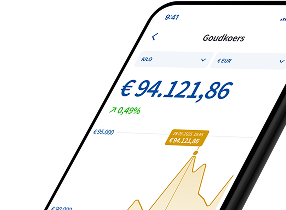
The costs of this option are slightly higher than with an ETF: there are transaction costs, annual storage fees and possible delivery charges. Although control over the gold is greater than with an ETF, counterparty risk remains because the gold is managed by an external party. This option offers the best balance between the three factors. Read more about our Holland Gold App.
This option involves purchasing physical gold coins or bars that are stored personally. It offers full ownership and control: there is no counterparty risk, the gold is fully legally owned, and direct access is possible.
As a result, costs are also highest. Premiums are paid above the market price, with production costs having a relatively stronger impact on the price you pay, especially for smaller quantities. With larger quantities, this difference becomes smaller. In addition, personal ownership requires secure storage and possibly insurance.
Liquidity is also lower. Selling gold takes time and cannot be done with the click of a button. A dealer or online platform must be approached, the gold must be verified, and payment must be awaited.
There are many ways to buy gold. Each option has its own advantages and disadvantages, and the decision always comes down to balancing liquidity, autonomy and costs. The preferred choice is personal and depends on the investment objective and intended holding period.
If the investment horizon is short and the main goal is gold exposure with the ability to trade quickly, liquidity becomes the most important factor. If gold is bought as a hedge against systemic risk or because of distrust in the financial system, autonomy and minimizing counterparty risk become more important. A combination of both can also provide a balanced approach: professional storage offers a middle ground, while a combination of physical gold and an ETF spreads both risks and advantages.
Also take a look at our YouTube channel
On behalf of Holland Gold, Paul Buitink and Yael Potjer interview economists and macroeconomic experts. The aim of the podcast is to help viewers better understand and navigate an increasingly fast-changing macroeconomic and monetary landscape. Click here to subscribe.