9.3
8.879 reviews

English
EN


Due to low interest rates, more and more people are investing. For example, the percentage of assets that Americans hold in the form of stocks is at an all-time high this year Increased. In the first quarter, 28.6% of their total household wealth consisted of equities. This is as high as 40% of the financial assets. Is it still wise to buy shares? Or is Buy gold A better alternative, given negative interest rates and rising inflation?
U.S. households currently have more wealth in equities than they did during the peak of the internet bubble at the beginning of this century. This is partly due to the rise in stock prices, but also because more and more people have started investing. Because saving no longer yields interest, more and more savers are choosing to invest capital via the stock market. And there's something to be said for that, because it's Dividend yield on stocks is still higher than the interest rate on savings.
So households currently have a lot of wealth in equities, but does that also mean that the stock market is in a bubble? Not necessarily, because corporate profits are also rising. For example, of all the companies in the US S&P 500 stock index, the earnings per share are now higher than before the corona crisis.
Nevertheless, share prices have significantly anticipated the rise in corporate profits. For example, the average price/earnings ratio over the past ten years (the so-called Shiller P/E ratio) has now risen to over 37. This is higher than the peak of the Roaring Twenties, but lower than the peak of 44 during the Internet bubble of early 2000.
Based on corporate profitability, stocks are currently slightly overvalued, but not as extreme as during the internet bubble of the early 2000s. Also, there is still plenty of upside potential, given that interest rates are so low and more people will start investing. As a result, it remains attractive to buy shares, even at current valuations.
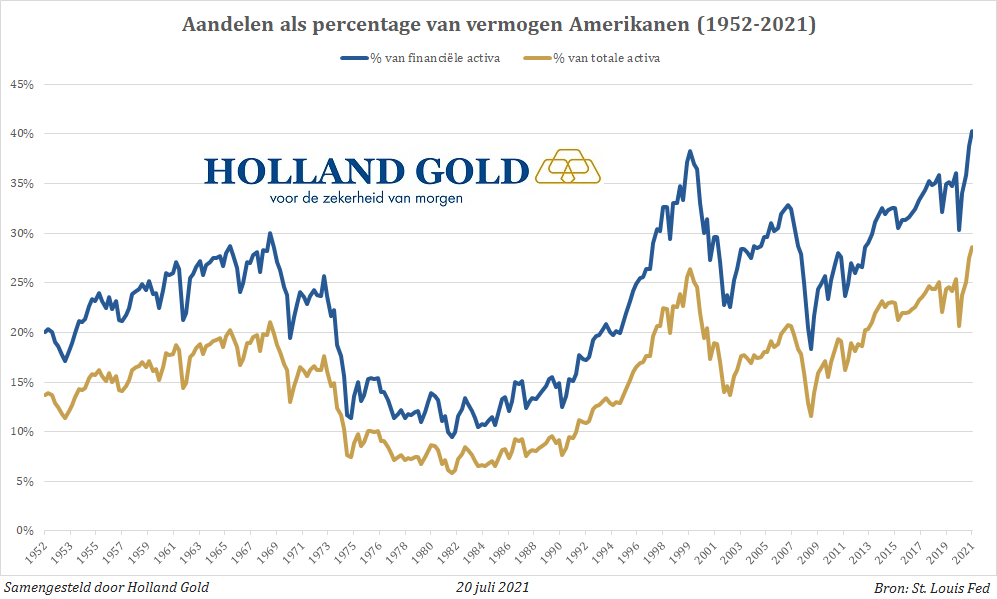
Americans are holding more and more wealth in the form of stocks
In the near future, more savers will convert their assets into things that still yield returns and offer protection against inflation. These can be tangible items such as real estate and precious metals, but also financial assets such as shares. This explains not only the high share prices, but also the rapid rise in the price of real estate, art, watches and other valuable objects over the past few years. As long as this trend continues, the valuations of all these assets could continue to rise.
The chart above shows that stocks have become a popular safe haven. As a result, stock prices are currently near record highs. Real estate valuations also show the effect of low interest rates. This is despite the fact that the prices of precious metals have risen much more slowly. For example, the gold price is currently more than ten percent lower than last year's record.
Now that Treasury yields are back Drops and inflation increases the precious metal becomes even more attractive as an alternative to the savings account. Since 1971, gold has yielded an average return of more than 8% per year. As a result, the precious metal remains a good alternative to equities, especially if the economic outlook deteriorates. In times of crisis, the precious metal tends to outperform the stock market in fact.
This contribution was made from Geotrendlines


