English
EN


The war with Iran is driving energy prices higher and fueling global concerns about inflation and economic growth. In such an environment, one would expect gold to benefit strongly as a safe haven, yet it remains relatively calm. Why is the gold price not rising much more sharply? Could growing institutional interest trigger the next major price increase?
The gold price has been moving sideways recently, well above $5,000 per ounce and €140,000 per kilogram. Since the start of this year, that still amounts to a return of more than 20 percent. Yet the absence of a further rise following the escalation in the Middle East raises questions. Rising geopolitical tensions would normally provide strong support for a safe haven such as gold. So what is happening? 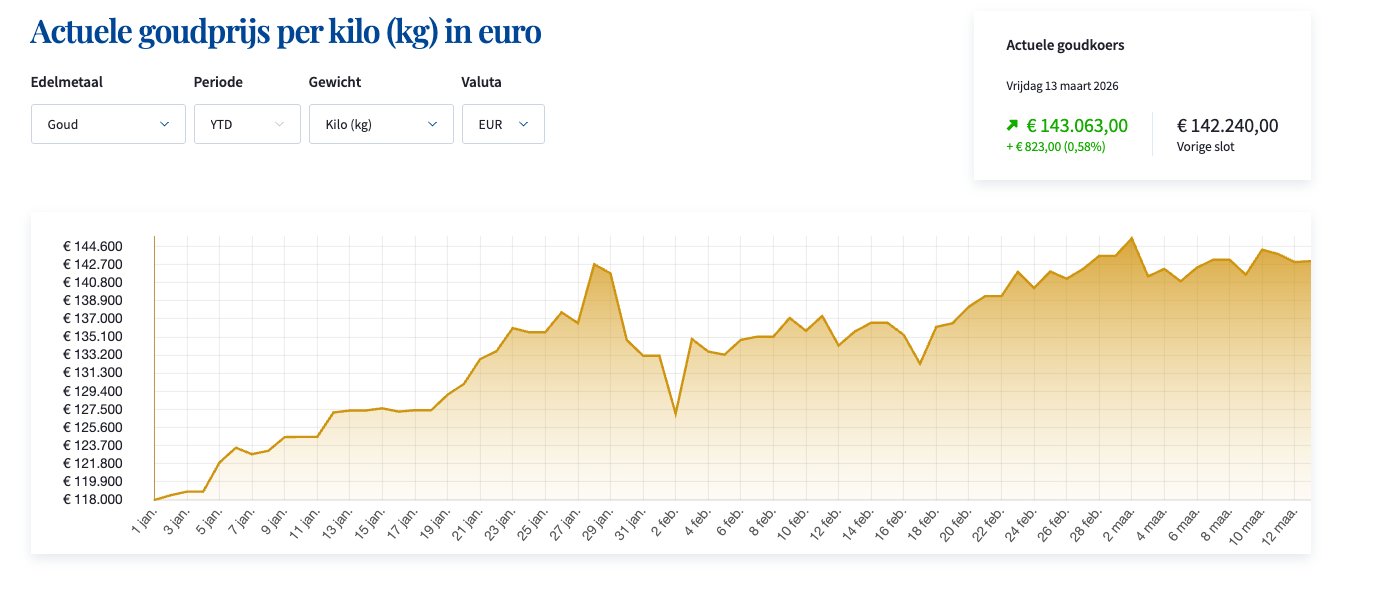
Last week we wrote about the blockade of the Strait of Hormuz. Bloomberg now describes it as the largest disruption ever on the global oil market. Rising energy prices are pushing inflation expectations higher, not only because fuel becomes more expensive, but also because oil and gas affect almost the entire economy: from transport and production to food prices and industrial processes.
When inflation expectations rise, the likelihood of interest rate cuts by central banks such as the Federal Reserve declines. Lower interest rates have historically had a positive effect on gold prices, because precious metals themselves do not generate interest. When rates fall, the opportunity cost of holding gold declines, making it relatively more attractive compared with interest-bearing investments.
A second explanation for the absence of further gains in the gold price is liquidity. In periods of heightened uncertainty, investors often seek additional liquidity. Gold is then regularly used to free up cash, meet margin calls, or rebalance portfolios.
According to Ole Hansen of Saxo Bank, it is too early to assume that the Federal Reserve will not cut rates further. Higher energy prices do indeed create additional inflationary pressure, putting the inflation target under strain, but they can also lead to weaker economic growth and employment. This could result in stagflation. Policymakers therefore face a dilemma: fight inflation or support economic growth. In such a scenario, the Fed may ultimately still be forced to support the economy with lower interest rates.
Ole Hansen also writes that although gold may face some short-term headwinds due to the factors mentioned above, the structural drivers behind strong demand for gold remain firmly in place. Geopolitical tensions and persistent budget deficits, which keep investors concerned about purchasing power and the value of currencies, remain present. In fact, in a prolonged conflict, deficits could rise even faster. Governments will take on additional debt due to higher defense and energy costs. Central banks may then be forced to ease policy in order to keep an increasing debt burden financeable.
In addition, demand for gold from central banks remains an important pillar of support for the market. Hansen therefore expects the gold price to rise toward $6,000 per ounce over the coming quarters, while silver could test the $100 level again. Bank of America has also recently issued a twelve-month price target of $6,000 for gold.
According to Michael Widmer, head of commodities research at Bank of America, there is another reason to remain positive on gold: investor allocations are still relatively low. That now appears to be changing slowly; institutional investors are discovering gold. We recently wrote an article about this as well. 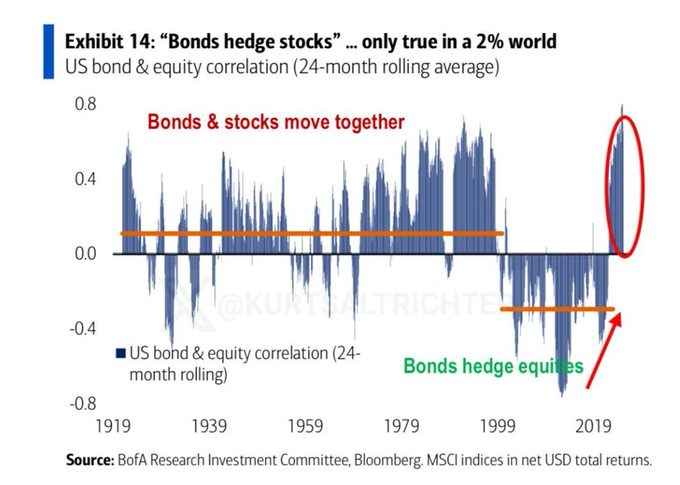
Institutional investors increasingly see gold not as a niche position, but as a fully-fledged component of strategic portfolio construction. For years, the classic 60/40 portfolio dominated, with 60 percent equities and 40 percent bonds, but interest in gold is now growing. Morgan Stanley, among others, has pointed out that bonds offer less protection than before in an environment of high inflation and low real interest rates. In 2022, equities and bonds fell simultaneously, showing that this traditional diversification strategy was no longer effective. Even a limited shift of institutional capital toward gold could create significant additional demand, given the relatively small size of the gold market.
This week, Het Financieele Dagblad published an interview with such an institutional investor. Thomas van Galen, chief strategist at Achmea Investment Management, argues that a fundamental shift has taken place: “The period in which markets could rely on a structurally stable environment is over, as is the certainty of low inflation, free global trade, and free movement of capital.”
He observes that central bank independence has become less self-evident and sees the risk of fiscal dominance, in which central banks maintain low interest rates to keep government debt affordable. He also considers the shift from a unipolar to a multipolar world order, with more inflation shocks and instability, to be an important factor for the coming years.
He questions the safety of bonds as an investment in a period of elevated inflation risk and their role in diversification: “A number of old certainties no longer hold. The long-standing correlation between equities and bonds has broken down (when equities fall, bonds rise in value). In times of stress, both now decline together.”
Van Galen therefore advocates more robust portfolios with real assets such as real estate, infrastructure, commodities, and gold.
We can therefore conclude that the gold price may still face some short-term headwinds, but over the longer term the wind remains at its back.
Finally, a brief update from Switzerland. Regular readers of our weekly selection may remember that in June last year we wrote about a possible referendum in Switzerland to constitutionally protect cash. That referendum has now taken place: the preservation of cash is being enshrined in the Swiss constitution.
Last Sunday evening it became clear that 73.4 percent of voters approved the legal amendment. The Swiss voted on two separate proposals concerning cash. The citizens’ initiative ‘Cash is freedom’ by the Swiss Freedom Movement (MLS) narrowly failed to secure a majority, receiving 46 percent of the vote. The parliamentary counterproposal, however, received broad support.
As a result, Switzerland joins countries such as Hungary, Slovakia, and Slovenia, where the right to physical cash is also embedded in the constitution. Supporters see this as an important step to protect privacy and financial autonomy, especially at a time when central banks are working on the development of a digital currency (CBDC).
Take a look at our YouTube channel as well
On behalf of Holland Gold, Paul Buitink and Yael Potjer interview various economists and macroeconomic experts. The aim of the podcast is to give viewers better insight and guidance in an increasingly fast-changing macroeconomic and monetary landscape. Click here to subscribe.