English
EN


Gold prices hit a new all-time high of more than $2,000 per troy ounce in August. Investors seek refuge in safe havens and therefore add gold to their portfolios. The increase in the Gold price is attributed not only to economic uncertainty, but also to the threat of inflation. Savers and investors fear that central banks and governments will cause more inflation with their stimulus programs. But is there a direct relationship between the price of gold and inflation?
According to the Bank of England, the price of gold has No predictive function whatsoever with regard to inflation. At least that's what Gertjan Vlieghe, a policymaker at the central bank who previously worked at Deutsche Bank's bond department, says. "The record price of gold doesn't mean anything at all. If you look at previous periods when the gold price was high, you quickly find out that gold is a terribly bad predictor of inflation." To say something about inflation, we should look at other macroeconomic indicators, according to Vlieghe.
For many savers and investors, inflation is an important reason to buy gold. After all, in the long term, money loses purchasing power, while the precious metal manages to retain its purchasing power in the long term. For example, with a troy ounce of gold you can still buy a good tailor-made suit and you can still buy a beer with the proceeds of a silver guilder (€3.40 at the current silver rate). That is difficult with a guilder that does not contain precious metals, because it is only worth 45 euro cents when exchanged.
In the long term, the prices of precious metals rise in line with those of other goods and services, but in the short term, this certainly does not have to be the case. In that respect, Gertjan Vlieghe of the Bank of England is right. Indeed, in the short term, there is no relationship between the price of gold and inflation, as the chart below based on US inflation data shows. There are probably better indicators to predict future inflation than the price of gold.
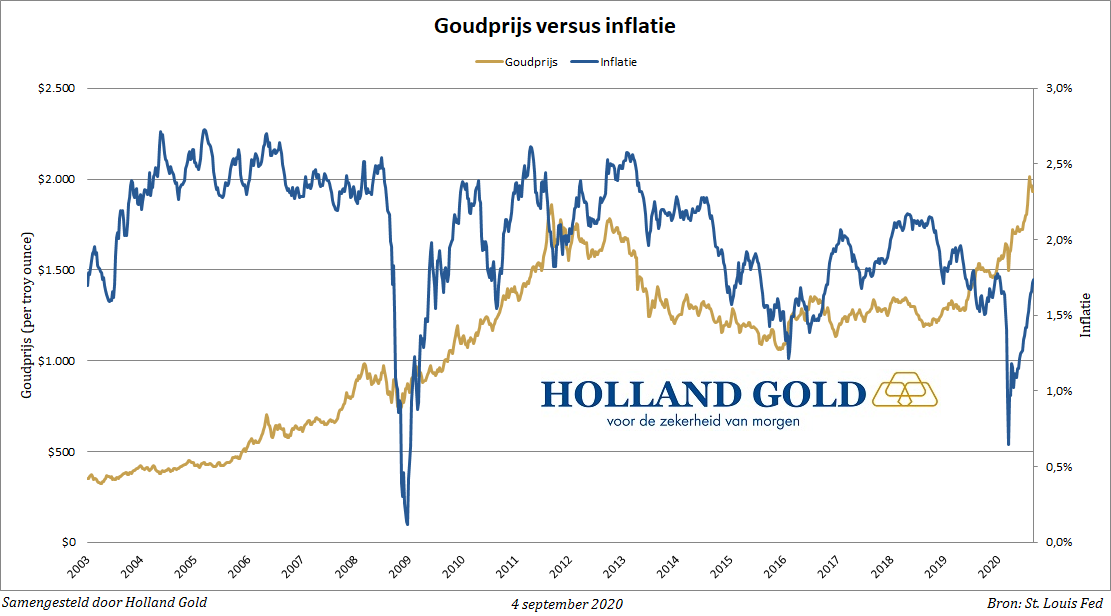
No correlation between gold price and inflation
The price of gold and inflation follow their own path in the short term, but there is a strong correlation between the price of gold and the real interest rate. When interest rates are low, it becomes more attractive to buy gold as an alternative safe haven. That is why the following graph is interesting, in which we compare the gold price with the real interest rate on US 10-year government bonds. In recent years, lower interest rates have been accompanied by a rise in the price of gold, while rising interest rates often produce the opposite result.
The development of the gold price therefore does not only depend on inflation and inflation expectations. The level of interest rates is also an important variable. Historically, there is strong evidence that the precious metal provides good returns at low or negative real interest rates and lower returns at higher interest rates. As long as the interest rate on government bonds remains close to zero, the outlook for the gold price looks favourable. Especially if that dreaded inflation becomes a reality in a few years...
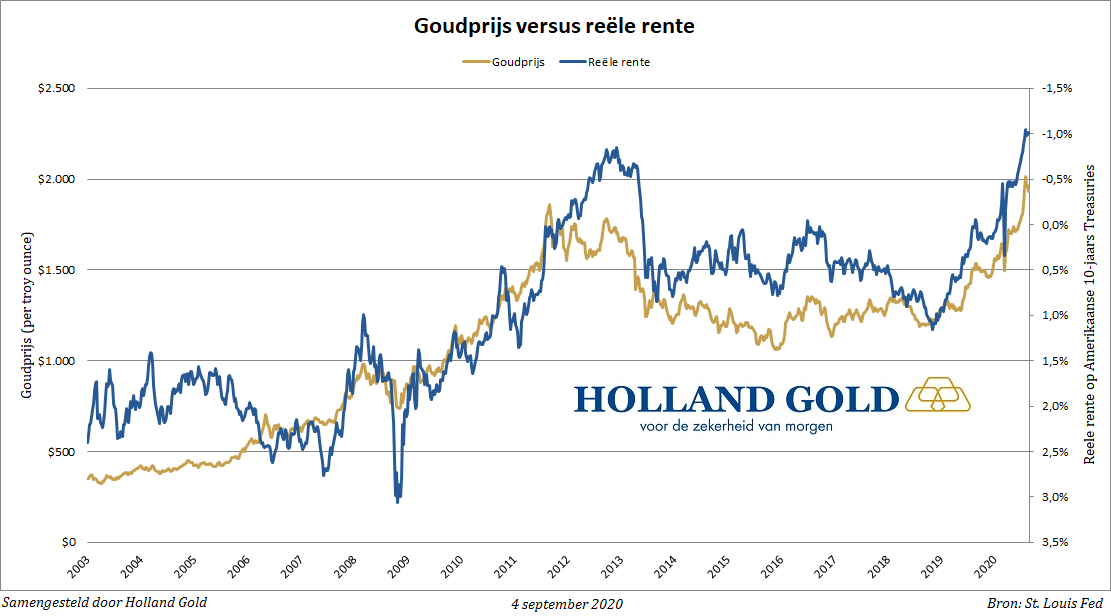
Gold Price vs Real Interest Rates
This contribution was made from Geotrendlines